A new medicine could reach the market the day it wins EU approval, yet stay out of reach for most patients. For Valentina Strammiello of the European Patients’ Forum, that would only deepen inequality. And governments, she says, are waking up late.
Europe’s drugmakers want new medicines on the market from day one, before governments decide on price and reimbursement. Valentina Strammiello warns that unless member states make such treatments accessible, early launch “can only widen the discriminatory effect”. “Accessible in day one, but only for those who can pay,” she says.
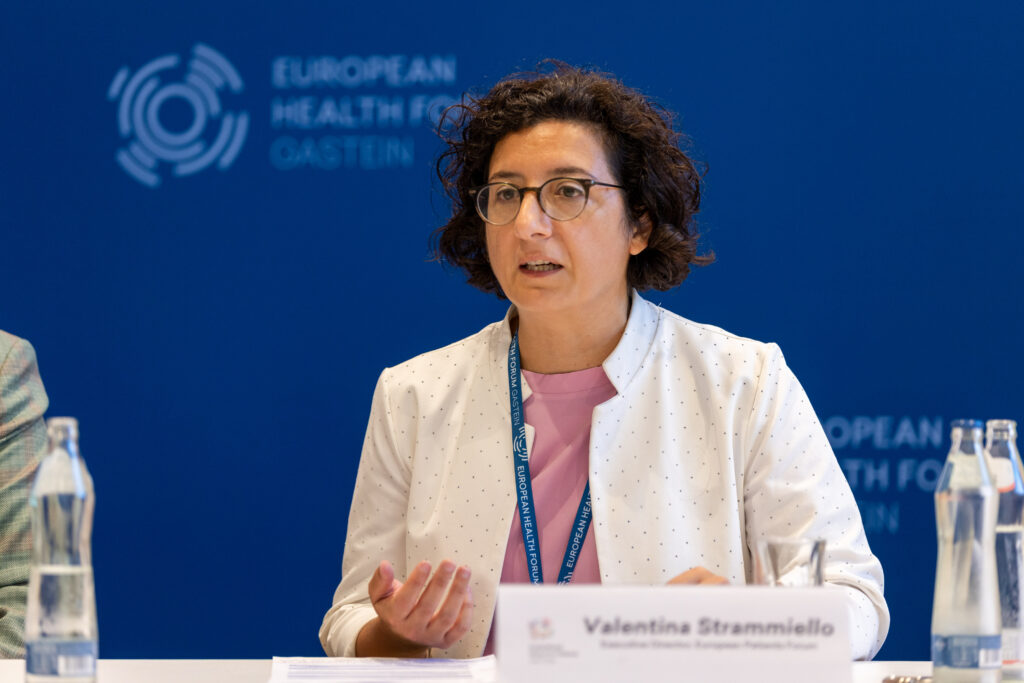
Ms Strammiello is executive director of the European Patients’ Forum (EPF), an umbrella group of patient organisations across Europe. She spoke to EU Perspectives on the sidelines of the European Health Forum Gastein in Bad Hofgastein, Austria.
The day-one proposal comes from the European Federation of Pharmaceutical Industries and Associations (EFPIA). Its director general, Nathalie Moll, presented it at a press briefing in Gastein, as EU Perspectives reported.
Under the plan, new medicines would launch in all member states ahead of national decisions on price and reimbursement. “It wouldn’t be reimbursed yet,” Ms Moll said. It would reach “a very small group of patients”, she added. For now, the plan exists only on paper, with no draft law behind it.
Ms Strammiello does not dismiss the idea. It “can be interesting”, she says, as long as member states do their part. On whether governments are doing enough to improve access, her verdict is: “I think they are waking up, maybe a bit late.” Facing funding pressures, EPF itself is “doing more with less”.
Start small, with transparent criteria
At a press briefing here in Gastein, EFPIA’s Nathalie Moll proposed access from day one. Is that an initiative you could support?
It can be interesting as long as member states come on the other side with also some mechanisms, I would say similar, for example, to compassionate use [a treatment option that allows the use of an unauthorised medicine], that can make these treatments accessible to patients. Otherwise, this access in day one, but having to pay for these treatments, can only widen the discriminatory effect. Because, of course, yes, accessible in day one, but only for those who can pay.
So we would need member states to put in place some mechanism to make this treatment accessible, maybe to a small cohort of patients. They can select, for example, patients that will have access based on how severe the condition is, so the stage of the condition, but they could look at age range, for example.
There are avenues to maybe start small with a small group of patients and then expand the population at a later stage. With some transparent criteria, though, that can be acceptable from the patient side. But this is nothing new, honestly. These are approaches that member states already implement when it comes to access to treatments.
Belgium launched a fast and early access programme. Is that the type of example you mean?
Exactly. It’s nothing new. A lot has been experimented already. So we are not really there to reinvent the wheel. There is a lot that can be implemented. There are approaches that have been tested. We just need to move on and take action.
Years of waiting
Access is still a big problem in Europe. Is current action enough to address it?
Most probably not enough yet. The mechanism that was discussed during one of the sessions here in Gastein, Article 59 [of the EU’s new pharmaceutical legislation], is a measure we support because it gives a signal that there is at least a recognition of the fact that there is still a lot of inequalities across Europe when it comes to access to treatments.
[Under this provision, a member state will be able to ask a company to launch a new medicine on its market and to supply it. A company that does not do so within three years of the request will lose its market protection for that medicine in that country. The Council adopted its position on the reform on 28 September. Parliament still needs to approve it in a final vote.]
Often patients have to wait many years before they get access to innovative treatments. — Valentina Strammiello, Executive Director, European Patients’ Forum
Our big concern is not only about whether a product will be accessible but also when it will be accessible. Often patients have to wait many years before they get access to innovative treatments. And we still see a lot of discrepancy across European countries.
Many pieces of legislation are now ongoing. Do they address this?
There are pieces here and there. There are instruments that can be activated. This is both an opportunity and a challenge. Because this is also increasing the complexity of the legislative framework. And I’m rather focusing on the complexity these intersections of legislation may bring because they can generate bottlenecks.
The pharmaceutical legislation with Article 59 supports launch in all countries, even though it was said it’s not an obligation. It’s not compulsory. But maybe this measure may foster the launch in all countries. We’ll see how it goes, whether there is a real willingness to uptake all these pieces of legislation or not.
And sometimes I don’t see the willingness in member states to really go in that direction and to take advantage of all the instruments that are available for them. Or it’s maybe sometimes lack of capacity, lack of knowledge. It’s not just lack of willingness. I recognise that member states are also faced with multiple crises at once. And it’s difficult to prioritise one or another.
“Waking up, maybe a bit late”
There is a lot of talk going on. Do you think there is enough real action?
I think they are waking up, maybe a bit late. I hope it’s not too late. But I would have expected more action earlier, for sure. Because the question marks from our side were there already last year.
You mean access can be affected because of the political crisis?
Yes, and very severely. Because the access issue has always been there. It’s nothing new. But the political crisis is adding another layer of complexity that makes it unmanageable. Also, in my view, it may redefine what member states are willing to accept.
If you take into account all these crises, the future doesn’t look bright at all. — Valentina Strammiello
And if we also consider this crisis together with the security crisis, and the shift of funds towards defence, this is an additional layer. It makes it unpredictable for us to assess whether patients will have better access or not. Because if you take into account all these crises, the future doesn’t look bright at all.
A lot of the legislation will take effect only in a couple of years. Does someone need to step up?
Yes, there is a clear need for leadership. Member states need to step up, but also acting in solidarity with each other, not in isolation. Because working in isolation, of course, from my perspective, it’s just to protect specific interests. National interests, but not necessarily patients’ interests.
“I feel a bit powerless”
What can you do as a patient organisation? A lot is happening above your head.
Exactly, I feel a bit powerless. But at the same time, probably raising awareness about these matters without scaring the patient community would be important. We need them to be aware of the potential implications. I think a lot of our members in the European and national context are aware and they are concerned.
Are you planning a collective action?
In 2027 we will look closely at the developments of access to treatments in general, access to healthcare. And we will keep monitoring. We have run a consultation in 2016, 2017. We have run a campaign on access. But we are aware that the campaign is now outdated. Ten years ago it was a different reality. So it’s now time probably to look into this again, together with the learnings from these past ten years.
We can work together on identifying indicators to let us make some early assessments. Patients for sure can quickly warn us of what shortages they are facing. In fact, we have often called for a patient organisation’s role in measuring shortages.
“Doing more with less”
There is also the challenge of funding for organisations. How much is that disturbing your work?
Yes, indeed, that’s of course a challenge because we need and want to focus on the policies that are under discussion, but at the same time we need also to focus on our sustainability, to be able to support our members and patients. At the end of the day, it’s also a signal of how we want to prioritise on health or not.
Patient organisations are there to contribute to the system. We are not just there to complain about what doesn’t work. We want to bring solutions, but if we don’t have the capacity, it’s difficult for us.
Did you lose capacity because of this?
I would say we are doing more with less at the moment. We have learned resilience and efficiency, but of course, it cannot be never-ending. There is a point where we need to reassess to which extent we can further stretch our capacity.
On the MFF [the multiannual financial framework, the EU’s long-term budget], there is a lot of debate on the role of health and whether it gets its own dedicated envelope. What is your position?
We support the idea that there is a need for ring-fenced funding, but it’s not only about that. It’s not only about how much money will be made available if it is reinforced, but also what criteria apply to access this funding, because often this is the real limitation, not whether the money is there.
For example, the EU4Health programme, it was €5bn, a lot of money, but not really accessible because a co-funding mechanism was there. Often NGOs don’t have the financial capacity to bring this 40 per cent co-funding to the table because we are NGOs, we don’t make profits. We may have some savings, but that’s to ensure sustainability. So adding this 40 per cent can be extremely challenging for NGOs.
What needs to change?
Some core funding accessible to health NGOs and patient organisations specifically, to let us keep our work sustainable. On the operational side it would be key because this is what really would support our independence and would let us indeed not distract ourselves from the core work that we should be doing.
I don’t want to invest half of my time on ensuring the sustainability of EPF in the next few months or years. I want to use also my time to be able to contribute to the policy debates and bring the patient perspective.
[Editor’s note: Since this interview was conducted, EU member states have adopted the 2026 EU4Health Work Programme, reinstating operating grants for EU health civil society organisations, including patient organisations. The European Patients’ Forum welcomed the decision but said the €1.8 million allocated remains far below the €9 million provided in 2024 and is insufficient to address the financial pressures facing patient organisations.]
A new generation of advocates
You have an event coming up at the end of October. What is it about?
We are organising the EPF Youth Congress [on 23–24 October in Brussels] and this Congress is co-designed with our youth group, so the group of young patient advocates. The topics we are going to cover go beyond the usual policy topics. It’s also about climate change and the geopolitical crisis and how all these multiple crises bring uncertainty to the younger patient population and also how they can step up as patient advocates.
Soon there will be a generational shift. The older advocates at some point will step down. We need a new generation of advocates.