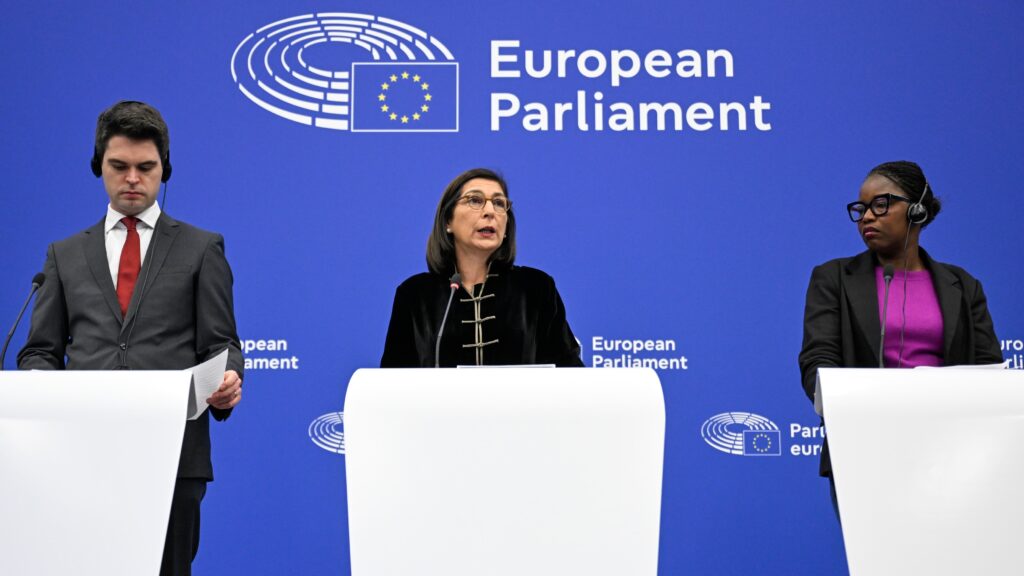
More money for asylum and integration, tighter border controls and more effective returns, stronger internal security and greater solidarity among member states. These are the priorities shaping the European Parliament’s proposals for the EU’s next seven-year budget.
Three reports, three different priorities. And a bigger bill for the EU’s next multiannual financial framework (MFF). The European Parliament’s Civil Liberties Committe (LIBE) backed funding proposals covering migration, asylum and security policies.
But the proposals highlight the differing political priorities at play: while some lawmakers focus on tightening controls and returns, others insist that European migration policy must not be reduced merely to the defense of borders.
Asylum and integration: the largest budget share
Lawmakers want to increase the Asylum, Migration and Integration Fund to €13.31 billion. The European Commission had initially proposed €11.97 billion. The proposal also set aside two 15-per-cent shares of each member state’s allocation. One would go to the Common European Asylum System, including its external dimension. The other would support legal migration, integration, and social inclusion.
You might be interested

Rapporteur Ana Catarina Mendes (S&D/PRT), who led the work on the report, emphasised the effort to maintain a balance between border management and the protection of rights.
“European migration policy cannot be limited to defending borders or controlling who enters and leaves Europe,” Ms Mendes said. “It must ensure protection for those who need it, provide adequate reception conditions, and create the circumstances in which these individuals can fully contribute to our societies,” she added.
The rapporteur argued the integration needs to be seen as an investment rather than a cost. “Integration does not end when a person arrives in a country. It takes place when a young person attends school, a student is able to pursue their studies, a man or woman finds employment, a family secures a home, and an individual becomes part of the community in which they live.”
Another key point concerns how responsibilities should be shared among member states. And also what role should local authorities play, since they are often on the front line of reception efforts. MEPs are therefore calling for more direct access to EU funding for regional and local authorities, with co-financing rates of up to 100 per cent.
Extra €2bn for resources and infrastructure
Regarding border management, the Parliament’s position is equally ambitious. Rapporteur Karlo Ressler (EPP/HRV) proposes increasing the budget for the Schengen area, integrated border management, and visa policy from €15.4 billion to €17.12 billion.
It includes funding for the construction, maintenance, and modernisation of infrastructure at external borders. It would also cover new technologies and stronger return procedures for people who do not have the right to remain in the EU.
Mr Ressler calls for more effective border controls. “Borders are not protected by good intentions, but by clear and enforced rules, adequate equipment, personnel on the ground, and political will,” he said. According to him, the goal is to ensure that border management goes hand in hand with effective procedures, including returns.
The text also provides for the possibility of funding for activities in third countries or in cooperation with them. It broadens the scope of border management to cover hybrid threats, as well as the instrumentalisation of migration, when governments or other actors deliberately use migration to put political pressure on the EU or its member states.
It also introduces the possibility of funding for independent monitoring of screening and border procedures, as well as search and rescue operations as part of maritime surveillance.
A bigger focus on Europe’s security
The third report, led by Assita Kanko (ECR/BEL), focuses on the Internal Security Fund. It was already adopted by the LIBE Committee on 4 November 4.
The dossier aims to help member states to prevent and combat organised crime, terrorism, and cybercrime. It also seeks to improve the exchange of information between national authorities and European agencies.
For Ms Kanko, a key priority is tackling hybrid threats, as they pose a growing challenge to European security. “Today, one cannot imagine internal security without considering hybrid threats,” she said. She also called for closer cooperation between police forces and judicial authorities, alongside greater flexibility for member states.
Transparency for everyone
All three reports call for greater transparency in how EU funds are spent. Lawmakers want stronger parliamentary oversight, particularly over the national and regional partnership plans. They propose replacing the Commission’s “implementing acts” with “delegated acts”.
Furthermore, the Commission should submit annual reports on the implementation of these programmes, including details on resources allocated to activities in third countries.
The negotiating mandates have now been brought to the plenary session for approval. Once the MEPs give them the green light, they can start negotiations with national governments, after the Council and Parliament have agreed on the overall figures for the EU’s next budget.