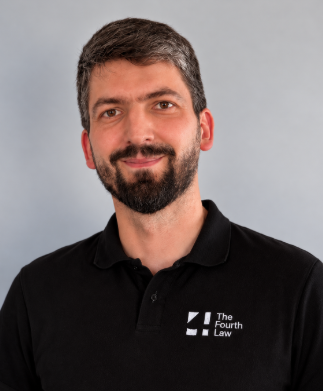
“If China were to decide to restrict its exports, Ukraine as well as the rest of Europe and the US would feel that immediately,” says Igor Nakonechnyi. The CEO of Project Foundation, a Ukrainian bid to build chip capacity in Europe, tells EU Perspectives why the drone industry depends on China and what Europe can learn from Ukraine’s frontline.
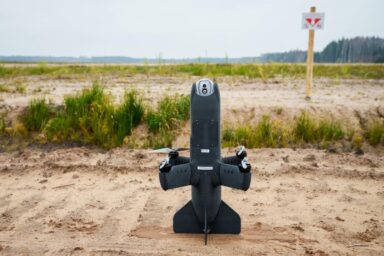
The war in Ukraine has exposed how heavily the world’s drone industry relies on China for critical components. The Fourth Law is a Ukrainian defence technology company that develops autonomous drones for use on the battlefield.
Together with its sister company Odd Systems, which supplies drone cameras, it is working to establish semiconductor manufacturing capacity in Europe through an initiative called Project Foundation. The two firms want to reduce reliance on Chinese suppliers and address a vulnerability that affects Ukraine’s drone industry and Europe’s wider security.
In the interview, Igor Nakonechnyi describes the daily struggle to source components amid sudden shortages and price hikes. He also explains why the company is opening an R&D hub in Eindhoven, why many EU funding programmes take too long to pay out, and why the Chips Act should cover dual-use technologies.
You might be interested
Your company was founded and became operational shortly after Russia’s full-scale invasion of Ukraine. Could you share a bit more about the origin story of your company?
Our company was created in response to Russian aggression. Our team already had quite some experience in entrepreneurship and consumer electronics, so they were looking at how they could best use their skills in the face of the aggression.
Drones are a defining feature of modern warfare. One of the key components of a drone is a camera. Basically, they are the eyes of the drone.
The real bottleneck here is the thermal sensor — a semiconductor chip that allows a camera to detect heat. China can make around 20 million of those a year. Every thermal drone needs a sensor, so whoever controls sensors controls how many thermal drones can be built.
Outside China, it is pretty much only North America and France that have some manufacturing capacity, which is maybe a couple of million in total. That’s a huge discrepancy, and we see it as a huge vulnerability.
So essentially, your company sits at the intersection of a military vulnerability and a supply-chain vulnerability?
Indeed. If China were to decide to restrict its exports, Ukraine as well as the rest of Europe and the US would feel that immediately.
Even if we haven’t yet seen a full restriction, there’s already always a shortage of specific things, or the price suddenly goes up. — Igor Nakonechnyi, CEO of Project Foundation
Even if we haven’t yet seen a full restriction, there’s already always a shortage of specific things, or the price suddenly goes up. It’s a constant challenge that our procurement team deals with on a daily basis.
That’s a critical vulnerability that we want to solve not only for Ukraine, but also for Europe and the rest of the world. That’s exactly why we launched Project Foundation, to build thermal-sensor fabs in Europe and the US, so the West no longer depends on China for the eyes of its drones.
We are currently setting up a subsidiary in the Dutch city of Eindhoven, where Project Foundation is headquartered and will serve as one of our main R&D hubs.
We see ourselves as part of Europe. And we see a lot of opportunities and talent in Europe to build this with.
Do you think Europe is sufficiently aware of the vulnerabilities that your company faces on a daily basis?
I see that a lot of relevant stakeholders already understand this, and more and more are becoming aware. In the US, even more so: more money is being invested in sovereign production, specifically of military equipment. This has always been the case, but investment is growing even more now. In Europe, it’s gradually getting better.
Do you see that reflected in policy as well?
To be clear: my company does not receive any EU funding at the moment. But we are looking at a few funding calls.
However, we see that many funding programmes have timelines that are simply too slow for us. If you want to apply for funding, it can easily take a year before you actually get it. So you need to write a project, wait almost a year until you get the money, and then you have two or three years to build a prototype.
Even within a year, warfare in Ukraine will have changed completely, and the concept you requested funding for might no longer be relevant. — Igor Nakonechnyi
That timeframe doesn’t match modern warfare. Even within a year, warfare in Ukraine will have changed completely, and the concept you requested funding for might no longer be relevant.
There are more agile programmes coming, but we need more of them. We really need more speed.
Does your company also look with interest at, for example, the Chips Act [the EU’s law to strengthen its semiconductor industry, increase production capacity and reduce dependencies on suppliers outside the bloc]?
Yes, that’s a very good initiative, but a big problem for us is that it’s primarily for civil use and not dual use. For example, what we are working towards—thermal-camera sensors or image sensors—is not really part of the Chips Act, whereas we believe it is an important topic.
Don’t you think that, in that sense, those dual-use technologies are better covered by another policy than the Chips Act?
We are talking about semiconductor manufacturing here, so it makes sense from that perspective. We do already see dual use in, for example, the Industrial Accelerator Act [a proposed EU law aimed at boosting manufacturing and demand for European-made and low-carbon products].
The reality of today’s world is that many different things are interlinked. Embracing dual use in, for example, the Chips Act would reflect that reality.
Looking ahead, where are you hoping to take your company and your subsidiary in the Netherlands?
Our company is originally driven by demand in Ukraine, but we of course want a just and lasting peace for Ukraine. And that peace only lasts when there’s a strong, independent defence industry behind it to deter another war. We hope to continue contributing to that; not only for Ukraine but for the wider Western world.
We see ourselves as a global company, and also hope to use our products in civilian applications in the future, such as consumer robotics and cars. We don’t want this to end up only in the hands of China.