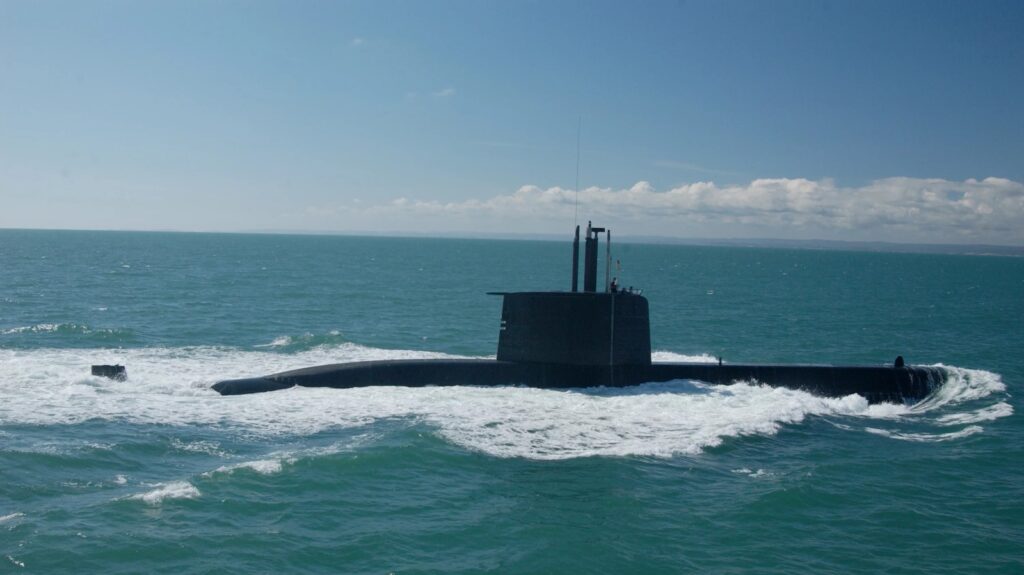
The European Union has adopted a massive joint seabed defence project to curb fragmentation, but doubts grow faster than actual funding.
Fincantieri, one of Italy’s largest shipbuilders, builds surface combatants and submarines. It also has its own underwater systems business. In September it took a bigger step into that market. It signed a memorandum of understanding with Germany’s TKMS to deepen cooperation in submarines and underwater systems.
The two firms plan to establish a collaboration framework by the end of 2026, subject to regulatory approvals. They want to use ‘complementary strengths, pursue new programmes, and realise cost synergies’. They also intend to explore joint international procurement opportunities. In other words, they know a good business deal when they see it.
Neither side calls it a merger. No acquisition is involved. Both companies will keep operating independently, and existing contracts, programmes, and projects remain unaffected. They already work together on the 212A and 212NFS submarine classes, a partnership built over decades.
You might be interested

A shield for the sea
The timing is no accident. In July, the European Commission proposed five large-scale European Defence Projects of Common Interest (EDPCIs). One of them is the Integrated Maritime and Seabed Defence (IMSD) project, which is the focus of growing industrial interest.
In late September, the Council of the European Union formally adopted the IMSD as one of the first five EDPCIs. The move purports to turn large multinational programmes into a unified industrial and procurement framework. Its purpose is to reduce the vulnerability of maritime and subsea infrastructure. In plain English: is should be able to both wage a war and protect whatever business is conducted underwater.
The aim is to overcome the fragmentation caused by governments procuring separately and in small quantities, which keeps production runs short and unit costs high.
— Juan Mejino-López, Guntram Wolff, Bruegel
Concern is growing over threats to submarines and seabed infrastructure, as well as undersea communications cables. The IMSD aims to improve cooperation in maritime surveillance, naval combat, underwater warfare; it is also designed to protect cables and pipelines. It calls for coordinated development and procurement of naval platforms, unmanned vehicles, and surveillance tools, among other things.
The project has three pillars. The first is maritime domain awareness and interoperable information-sharing. The second is naval combat and maritime interdiction. The third is underwater and seabed warfare. It also envisages cooperation with civilian authorities.
Strength in numbers
Pierroberto Folgiero, chief executive and managing director of Fincantieri, presented the deal as a cure for a divided industry. “At a time when Europe is called upon to strengthen its defence capabilities, defragmentation represents a concrete and pragmatic path towards a more competitive and integrated industrial base,” he said.
Oliver Burkhard, CEO of TKMS, stressed trust. “Our partnership with Fincantieri demonstrates what European industrial collaboration can achieve when it is built on trust and shared technological excellence,” he said, pointing to strategy. “By combining our complementary expertise, we can drive innovation, create new opportunities for our customers, and strengthen Europe’s strategic autonomy,” Mr Burkhard said.
Mr Folgiero stressed customers. “This agreement is designed to leverage complementary strengths and expertise to better serve our customers while contributing to the long-term development of Europe’s underwater capabilities,” he told reporters in September.
As companies go, these are no touchy-feely Robin Hoods; it comes with the territory. Your correspondent approached the Fincantieri stand at this years’ Eurosatory trade show in Paris with a humble request for an interview. The company’s representative was unimpressed. “We are not here for interviews,” he said dryly. “We are here to do business.” This was three months before the TKMS deal.
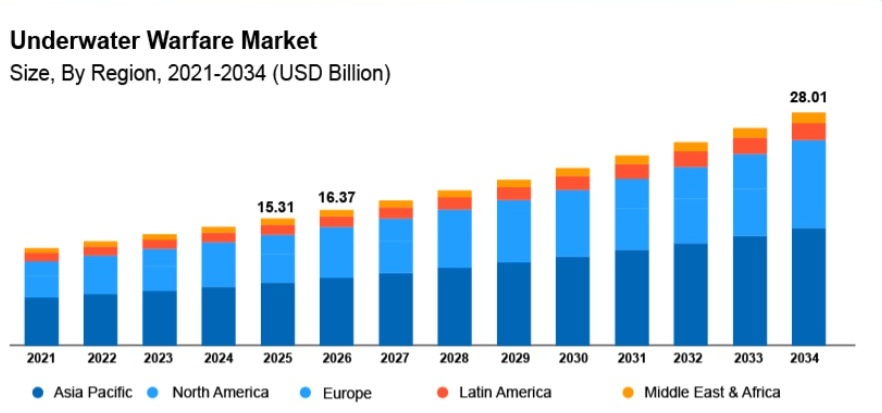
The market is the prize
The alliance shifts the focus from selling submarines to selling whole underwater architectures. Fincantieri has expanded its Underwater Technology Hub by acquiring specialist drone and component firms. TKMS brings expertise in Air-Independent Propulsion submarines, so the pair could dominate crewed-uncrewed teaming.
Fincantieri acquired 100 per cent of Remazel Engineering, which handles launch and recovery systems for undersea vessels. It also bought majority stakes in NextGeoSolutions, WSense, GraalTech, and DefComm. The €600m expansion gives it a vertically integrated drone ecosystem.

Analysts see more than courtesy behind the move. Europe’s naval sector has long suffered from duplication, with nations funding overlapping submarine programmes. Germany’s Type 212 and 214 lines compete with French, Italian, and Spanish domestic designs. Unlocking cost synergies, a consolidated framework could let the pair present a unified front in international tenders.
The legal limits are tight. For the two companies, it is de-fragmentation. But smaller regional shipbuilders may struggle to compete; critics might call the result a duopoly. All joint activities must therefore comply with competition law and export-control regulations. They will also reflect specific customer needs and require the necessary customer approvals.
Who is in, and who pays
The Commission’s proposal listed 17 IMSD participants: Belgium, Bulgaria, Cyprus, Finland, France, Germany, Greece, Ireland, Italy, the Netherlands, Norway, Poland, Portugal, Romania, Spain, Sweden, and Ukraine. The finalised coalition is reported to include 22 EU member states. Participation stays open to Norway, and Ukraine takes part in the network.
The Commission estimated that the project could involve €42bn to €82bn until 2045. A later estimate puts the total between €43bn and €72bn. Analysis by the think-tank Finabel stresses that this is an indicative figure, not a confirmed EU budget allocation or a guaranteed procurement envelope.
At a time when Europe is called upon to strengthen its defence capabilities, defragmentation represents a concrete and pragmatic path towards a more competitive and integrated industrial base.
— Pierroberto Folgiero, Fincantieri
The legal basis is the European Defence Industry Programme (EDIP). The EDPCI framework aims to overcome the structural fragmentation of the European Defence Technological and Industrial Base. States have long bought custom equipment separately and in small batches. The EDPCIs encourage them to pool resources for projects too big for one state.
Juan Mejino-López and Guntram Wolff, European defence policy analysts from Bruegel, made the point in the Finabel report. “The aim is to overcome the fragmentation caused by governments procuring separately and in small quantities, which keeps production runs short and unit costs high,” they wrote.
The rules of the game
The sharpest rule concerns ‘design authority’. Under EDIP, corporate beneficiaries must hold the full legal and operational power to modify systems or substitute components. They cannot be restricted by non-associated third countries—such as the US or China—in doing so. Contractors must have this authority by 2033.
The rule favours European prime contractors. Analysts say it could lock American, British, and Asian firms out of prime positions in the IMSD pipeline. Those firms would be pushed into tier-two supplier roles. A German-Italian alliance is well placed to benefit.
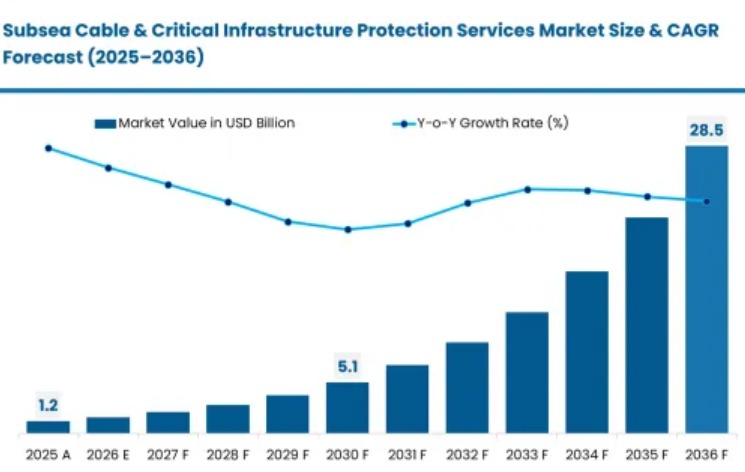
Other firms are circling. Saab of Sweden has launched its Ocean Barrier surveillance network in auutmn to complement its Autonomous Ocean Core control software. Exail of France sells uncrewed vessels and sonar. Kraken Robotics sells towed sonar. America’s Anduril has introduced its Seabed Sentry system for the European theatre.
Politics and money
Politicians are keen to stress unity. “These projects further demonstrate practical cooperation between EU member states to provide for our own security,” said Helen McEntee, Ireland’s Minister for Defence, in late September. She added that, with Norway and Ukraine, the EU is taking decisive steps to protect space, skies, seas, and undersea cables.
The funding is thinner than the ambition. The Commission allocated an initial €325m from the EDIP budget to jumpstart the five projects. Their total scale is €270bn. Think-tanks warn of a vast gap, and the European Competitiveness Fund that might fill it is not finalised.
The United Kingdom is effectively blocked from EDIP eligibility and funding. Analysts note that Britain commands large subsea monitoring assets in the Atlantic, including its Atlantic Net and RFA Proteus systems. Excluding it could cause duplication or blind spots between NATO and EU networks in the North Sea.
The design authority rule has risks of its own. It could alienate critical non-EU technology suppliers. If European primes struggle to scale up advanced subsea sensors, the rule may delay deployments.
The fine print
The scope raises additional questions. The IMSD combines surveillance, combat, unmanned systems, and infrastructure protection. That breadth risks turning it into a political umbrella. Governance is another worry, since countries may differ over data ownership, classification, and rules of engagement.
Fincantieri and TKMS seem the logical beneficiaries of the defragentation drive. Yet, as of early November, they are not the chosen ones. No company-by-company list exists; the IMSD is a capability and industrial framework, not a single contract. Work packages are still to be defined, just as lead contractors and national procurement decisions.
Our partnership with Fincantieri demonstrates what European industrial collaboration can achieve when it is built on trust and shared technological excellence.
— Oliver Burkhard, TKMS
The EU says the project builds on existing PESCO and European Defence Agency initiatives while taking NATO activities into account. Interoperability is not the same as institutional integration, however. The devil is in the detail; in this case, it is the clear division of labour. Without it, the IMSD could duplicate NATO surveillance and national modernisation programmes. Instead of easing a bottleneck, it may effectively double the nightmare.
The timeline is long. Common surveillance test-beds, managed by the European Defence Agency, are due in 2027. They must use NATO’s STANAG 4817 data standard. Initial operational capability is targeted for 2030 in the Baltic and Mediterranean basins. Full maturity is planned for 2045. Vladimir Putin will not be around by then; but who will, may depend on how quickly these capabilities develop.