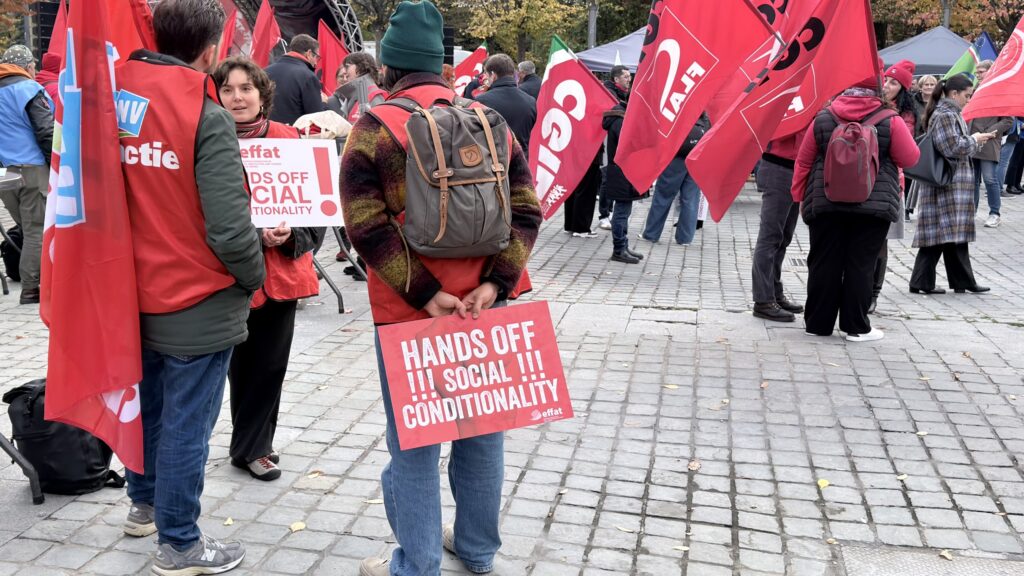
Farm employers who break labour laws could keep their full EU subsidies after 2027. Hundreds of farmworkers and trade unionists gathered in Brussels on Tuesday to stop that from happening. Their hopes now rest on the European Parliament.
More than 500 agricultural workers and trade unionists rallied at Place Jean Rey on 3 November. They oppose changes to the Common Agricultural Policy (CAP), the main system through which the EU supports farmers. The protesters fear that employers who breach labour laws could keep receiving farm subsidies without facing an additional financial penalty.
Their anger targets the Council of the EU. On 26 October, agriculture ministers unanimously agreed a partial negotiating position on the CAP for 2028–2034. According to the European Federation of Food, Agriculture and Tourism Trade Unions (EFFAT), which organised the rally, the text drops the link between subsidies and labour rights. The federation raised the alarm days before the protest. The European Parliament, meanwhile, is preparing its own position on how the CAP will work from 2028.
Subsidies tied to fair work
Workers and trade union representatives from across Europe gathered under the slogan “Hands off Social Conditionality! For Fair Work in European Agriculture”. The rule they defend has been part of the current CAP rules since the 2021 reform. Farms receiving EU subsidies must comply with certain employment and workplace safety laws. If inspectors find violations, employers can lose part of their farm payments.
Without it, a farm caught exploiting its staff would keep its full EU payments. EFFAT argues that the rule protects vulnerable agricultural workers, particularly migrant and seasonal employees. It also helps responsible employers, who would otherwise compete with rivals that cut corners on labour costs.
The ministers’ text is not the final word, however. It is only the Council’s opening position for talks with Parliament, and the current protections stay in place while negotiations continue.
Scrapped before anyone checks
Timing fuels much of the protesters’ frustration. According to EFFAT, most member states have applied social conditionality only since 2025. Yet ministers have already moved to drop it from the next CAP.
The unions say ministers acted before the European Commission had a chance to evaluate the rule. “They decided to scrap Social Conditionality last week, well before the Commission could release a real assessment expected in 2027,” said EFFAT General Secretary Enrico Somaglia.
Mr Somaglia argued that the rule could improve conditions in a sector where many employees face insecure jobs and harsh workplaces. Scrapping it before any assessment, EFFAT says, would be a serious setback.
One of Europe’s riskiest jobs
EFFAT points to poor working conditions as a major reason to keep the rule. The federation estimates that around a third of agricultural work in Europe is undeclared or only partly declared. That is roughly six times the average across the wider labour market.
The work is also dangerous. Around 500 people die in accidents in EU agriculture and forestry every year, according to the federation. Workers fear that without social conditionality, employers would have one less reason to respect existing laws.
The change would not abolish national employment or workplace safety laws, and employers would still have to obey them. What would disappear is the risk of losing CAP money over labour violations. EFFAT also rejects claims that the rule burdens farmers. It covers only laws they must follow anyway.
Next stop, Parliament
After the rally, EFFAT and its member unions joined a European Parliament meeting titled “Promoting Fair Work in European Agriculture”. MEPs Camilla Laureti (S&D/ITA) and Thomas Waitz (Greens/EFA/AUT) hosted the event.
At the meeting, Mr Somaglia called on lawmakers to defend social conditionality in the next round of talks. “We urge MEPs to support a strong parliamentary negotiating mandate to preserve and strengthen Social Conditionality, opposing any attempt to weaken or remove it,” he said.
EFFAT estimates that more than 12 million agricultural workers have a stake in the outcome of the debate. The federation wants Parliament to oppose the Council’s approach and strengthen the link between farm subsidies and labour standards.
Public money should never subsidise the violation of workers’ rights, and that is what Member States seem not to grasp. — Enrico Somaglia, EFFAT General Secretary
For Mr Somaglia, the issue comes down to principle. “Public money should never subsidise the violation of workers’ rights, and that is what Member States seem not to grasp,” he said.
The next battle over farm subsidies
Parliament plans to vote on its negotiating position in January 2027. Talks with the Council will then follow. The final agreement will decide whether social conditionality stays in the CAP for 2028–2034. In other words, it will settle whether breaking labour law can still cost employers part of their farm subsidies.
For EFFAT, the priority is simple: EU farm money must stay tied to respect for workers’ rights. Lawmakers now have to decide whether making farm subsidies simpler justifies scrapping a labour safeguard before anyone knows how well it works.