Every war has its winners. Ukraine’s plight translates into the success of BAE Systems Hägglunds, a Swedish daughter of the British defence giant. Having increased revenues more than five-fold since 2020, the company expects a flurry of international orders to arrive by September.
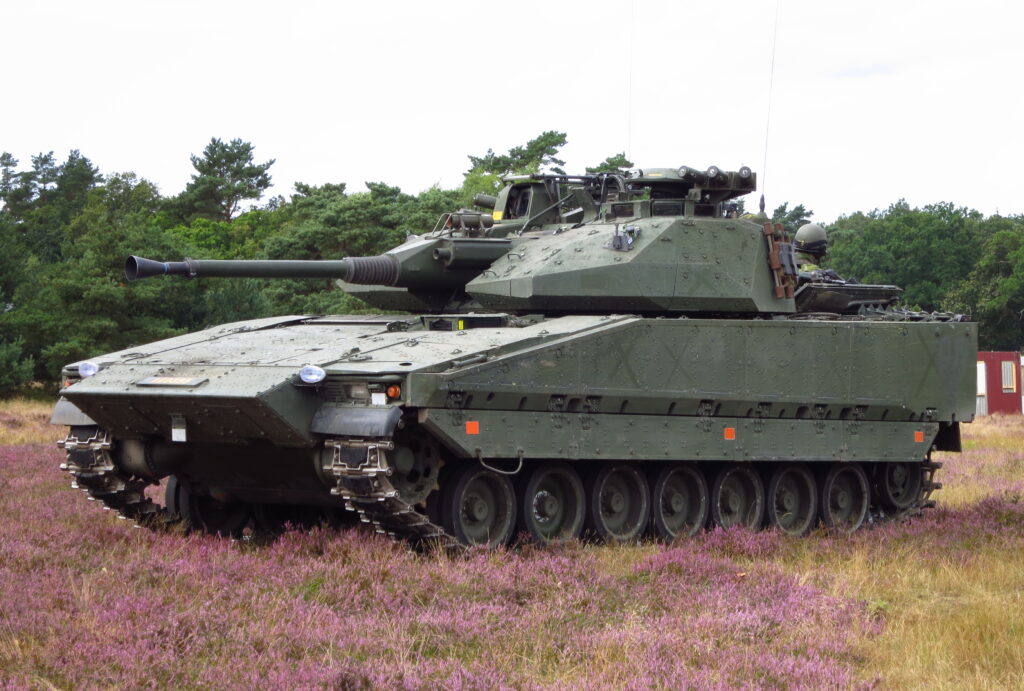
Engines rumble through the pines north of Örnsköldsvik as three CV90 infantry fighting vehicles thunder round a snow-dusted test track. The armoured trio symbolises a wider European mood. Russia’s 2022 invasion of Ukraine jolted defence ministries out of post-cold-war torpor. Orders have poured into BAE Systems Hägglunds, the Swedish subsidiary of Britain’s biggest defence company. Managers talk not of survival but of throughput targets and delivery bottlenecks.
Tommy Gustafsson-Rask, Hägglunds’ managing director, feels the urgency. “Given the security situation, our customers want their gear yesterday . . . They are prepared to do a trade-off,” he was quoted as saying by Financial Times this week. As to the scourge of standardisation, his recipe is simple: “As one army chief said to me, ‘if it’s good for the Dutch army chief, it’s good for me’.”
Supply lines widen
Such pragmatism underpins a prospective joint order for about 500 CV90s by Sweden, Finland, Norway, Lithuania, and the Netherlands—a deal that would almost double the firm’s backlog and keep its line busy until 2032.
Mr Gustafsson-Rask pretends to no clairvoyance, yet the figures shine. Sales rose from roughly $200m in 2020 to $1.1bn last year. The order pipeline already stands at 600 vehicles. A signature on the Nordic-Baltic pact, pencilled in for the third quarter, would lift the tally above 2,400 machines and push annual output towards the management goal of more than 250 vehicles by the end of 2026.
The surge has forced an overhaul of the wooded campus on the Gulf of Bothnia. Hägglunds has erected three new halls, stacked welding robots, and built a logistics centre in a €450m splurge designed to let workers eventually finish one CV90 a day. Headcount has jumped from about 750 three years ago to 2,600. Two eight-hour shifts may soon become three. Even the press shop, where burly plates are bent into mine shields, runs close to capacity.
Some work now migrates abroad. Chassis welding stays in Örnsköldsvik, yet turrets and electronics plug in locally. Sash Tusa, analyst at Agency Partners, said Hägglunds had been a “slow burn success for 30 years” but was now “big enough to move the needle slightly for BAE”. In competitions the Swedes win, he said, because they “offer the customer what they need in terms of local assembly or workshare”.
Old roots, fresh shoots
Cash arrives too. BAE Systems has injected $300m since 2021 and promises another $150m by 2028. A micro-factory project with Saab will 3D-print spares near the front, trimming repair times. After decades of contraction, investment feels almost decadent. Mr Gustafsson-Rask traces the pivot to Moscow’s full-scale invasion of Ukraine. “That was the turning point, the switch, and Europe started to think again.”
Hägglunds’ origins lie in a forest-machinery workshop founded in 1899. The firm split its defence arm as Hägglunds Vehicle AB in 1988 before British armoured-vehicle specialist Alvis plc bought it in 1997. Six years later BAE Systems crept in with a minority stake, then swallowed the rest after a bruising takeover fight in 2004. The Swedish entity survived intact inside BAE’s land-systems portfolio and today sits at the heart of Europe’s tracked-vehicle revival.
Counter-drone technology has lagged behind advances in drone technology up until now. — Nick Reynolds, Royal United Services Institute
The CV90 itself is no rookie. Early marks entered Swedish service in the 1990s. Combat tours in Bosnia and Afghanistan burnished its reputation. Slovakia became the tenth European operator in February, receiving the first of 152 CV9035 Mk IVs under a government-to-government pact with Stockholm. Recent variants add jammers, sensors, and active-protection kits honed from Ukrainian battlefield lessons.
Estonia briefly unsettled the celebrations when it quit the Nordic consortium, preferring to upgrade its older CV90s and beef up air defences. The defection scarcely registered. Mr Gustafsson-Rask noted the loss would have only a “marginal” impact on the overall order. Infantry fighting vehicles, he argued, remained indispensable. “If you want to win the war, you need infantry fighting vehicles and main battle tanks because you need to control the ground and take the ground.”
Drones and doubts
Sceptics respond that cheap drones now spot, stalk, and strike armour with ease. Nick Reynolds, research fellow for land warfare at the Royal United Services Institute, acknowledged the chatter. “There is a narrative in some parts of the defence commentariat that armoured vehicles will not be relevant in future,” he said.
Yet gaps close. Drone detectors and hard-kill systems mature quickly. Mr Reynolds observed that counter-drone technology “has lagged behind advances in drone technology up until now, the belated realisation of the importance [of counter-drone systems] has spurred a great deal of R&D and investment”.
Competitors also respond. Rheinmetall’s 42-tonne Lynx KF41 wooed Bucharest with 232 vehicles plus options for another 66 at a price of €2.6bn. Berlin later agreed to fund the first Lynx batch for Kyiv, deliveries starting this year. KNDS scored a 222-unit deal for its wheeled Boxer RCT30 from Germany and the Netherlands, exploiting a cheaper eight-wheel format. Down Under, Hanwha’s AS21 Redback bagged Australia’s LAND 400 Phase 3 award for 129 vehicles—worth about A$7bn—despite audit warnings over integration risks.
Staying in front
Hägglunds therefore cannot dither. Its single Swedish hub stretches. Distributed final-assembly cells in the Czech Republic, Slovakia, and the Netherlands may extend capacity beyond 350 CV90s a year by the decade’s end. More radical options loom. Mr Gustafsson-Rask floated licensed production for new customers. Asked whether he would court London if Britain’s ill-starred Ajax programme collapsed, he replied coolly: “They can always come and talk to us.”
Beyond tracks, Hägglunds nurtures its articulated BvS10 and Beowulf snow vehicles. Arctic nations prize their amphibious knack. Disaster-relief agencies like the low ground pressure. The niche is small but sticky, and faces little direct challenge. It also broadens the firm’s ledger at a time when German, Korean, and French rivals pile into the lucrative infantry-vehicle market.
Given the security situation, our customers want their gear yesterday. — Tommy Gustafsson-Rask, BAE Hägglunds
Technology remains the decisive race. Engineers plan plug-and-play turrets, loitering-munition launchers, and even hybrid-electric drives for the CV90 later this decade. The digital backbone inside the Mk IV allows such upgrades without tearing out cables. Meanwhile an in-house Welding School and a Hägglunds Academy train hundreds of recruits yearly, easing labour shortages.
Ground to take
The contrast with General Dynamics’ Ajax, Britain’s troubled reconnaissance vehicle, flatters the Swedes. Ajax groans under cost overruns and vibration woes. Hägglunds sails on with full order books and unblemished trials. Mr Tusa reckons that record helps buyers sleep at night. The war in Ukraine also boosts credibility: Sweden sent 50 ageing CV90s to Kyiv; their performance reinforces sales pitches in European capitals.
Investors need not expect miracles. Hägglunds’ revenues, while rising fast, remain small compared to BAE Systems’ £30.7bn group turnover. Yet the Swedish unit spreads risk, gives BAE a strong continental foothold, and—crucially—confers influence over Europe’s nascent effort to pool procurement. Success may even encourage Brussels to back genuinely joint armaments programmes rather than a patchwork of national orders.
Europe’s grand rearmament still faces obstacles: overstretched supply chains, fiscal fatigue, and the eternal temptation of protectionism. But orders already placed must be built. Hägglunds, born in the age of steam tractors, finds itself at the heart of a land-war revival. As long as tanks and infantry must seize ground, the roar echoing through Sweden’s forests will not fade.