European businesses attract just six per cent of global AI start-up investment, against 61 per cent for the United States. The European Parliament wants to close that gap by putting artificial intelligence at the heart of EU trade policy, covering everything from customs checks to easier market entry for small firms. Lawmakers backed the initiative with 527 votes in favour, but insisted the technology must not come at the cost of workers’ rights or environmental standards.
The initiative covers AI’s potential role in customs, border controls, logistics and consumer protection. Proponents argue the technology could make trade procedures faster and more efficient. But the report does not look only for the bright side. Lawmakers warn that an AI strategy must not come at the expense of workers, environmental protection or consumer rights. They also call on the Commission to assess the technology’s possible impact on those fields.
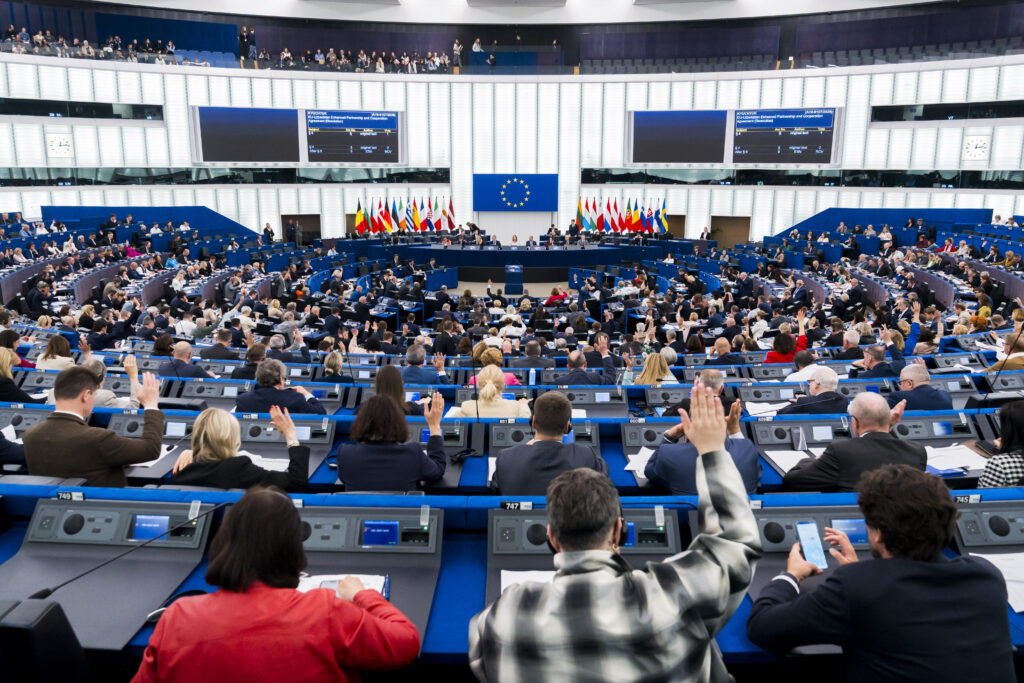
Brando Benifei (S&D/ITA) drafted the report, which cleared the International Trade Committee in April with 31 votes in favour and two against before going to a plenary vote this week. In the chamber, 62 MEPs voted against and 59 abstained. As an own-initiative report, the document is non-binding and sets out Parliament’s political position rather than creating new legal obligations. “AI must become an engine of European trade competitiveness, helping SMEs break into new markets, cut compliance costs, and sharpen customs enforcement against counterfeits,” Mr Benifei told EU Perspectives.
AI and Trade
The Commission sees AI and digitalisation as essential for the Single Market. “The Single Market must be digital by design. And the next phase of innovation will be defined by how digital capabilities are applied in the real world. Technologies like AI must be connected to the physical systems they are meant to improve,” Commission President Ursula von der Leyen said.
The Single Market must be digital by design. And the next phase of innovation will be defined by how digital capabilities are applied in the real world. Technologies like AI must be connected to the physical systems they are meant to improve.
— Ursula von der Leyen, President, European Commission
The OECD also considers AI and international trade “deeply intertwined”. The technology is capable of improving productivity, logistics, supply chains and services. Trade, in turn, can help spread AI technologies across economies. The organisation estimated that global value chains account for around 70 per cent of international trade.
The report calls on the World Trade Organization to help develop an AI governance framework for trade. International standards and WTO transparency rules, it argues, should be used to avoid market fragmentation caused by diverging AI regulations.
More autonomy
The report also links trade to Europe’s strategic autonomy. The EU cannot benefit fully from AI if it remains dependent on external suppliers. The EU represents around 10 per cent of the global semiconductor market and has set a target to double this to 20 per cent by 2030 under the Chips Act.
Europe is also highly dependent on a small number of suppliers for critical raw materials. According to the Commission, 97 per cent of the EU’s magnesium supply comes from China. Another 100 per cent of rare earths used for permanent magnets are refined there. And 98 per cent of the EU’s borate supply comes from Türkiye. The initiative, Mr Benifei said, “demands open strategic autonomy, reducing structural dependencies on China and the US through trusted partnerships and robust economic security tools.”
The investment gap is another concern. European companies attracted only six per cent of global AI start-up investment in the first half of 2024, compared with 61 per cent for US firms. To address these dependencies, Parliament calls for supply-chain diversification with trusted partners, targeted investment in European capacity. It also seeks closer coordination of EU economic security tools, including foreign direct investment screening, export controls and the anti-coercion instrument.
The vote comes as the Commission links digital policy more closely to competitiveness and the Single Market. Parliament’s push fits into a broader effort to reduce the EU’s technological dependencies. The investment gap with the United States and China is growing more urgent. Global competition in AI and semiconductors shows no sign of easing.