Some 48 hours before his maiden Brussels summit, British Prime Minister uses his first day in office to flaunt his pro-Europe, pro-Ukraine, pro-defence views amidst domestic political tumult.
“The Rt Hon Andrew Burnham MP accepted The King’s offer and kissed hands upon his appointment as Prime Minister and First Lord of the Treasury,” Buckingham Palace press service announced shortly after noon on Monday, 20 July. In plain English, it means Mr Burnham had just become UK prime minister — the seventh in a mere decade.
Viewed through a European lens, the break is not very dramatic. On the evidence available, his arrival is not a rupture, but a recalibration. Mr Burnham promises to be warmer on Europe, firm on Ukraine, and more explicitly tied to defence spending and industrial policy. His instincts are more pro-European than those of any British prime minister since Tony Blair. Yet his political constraints are just as real.
A summit and a reset
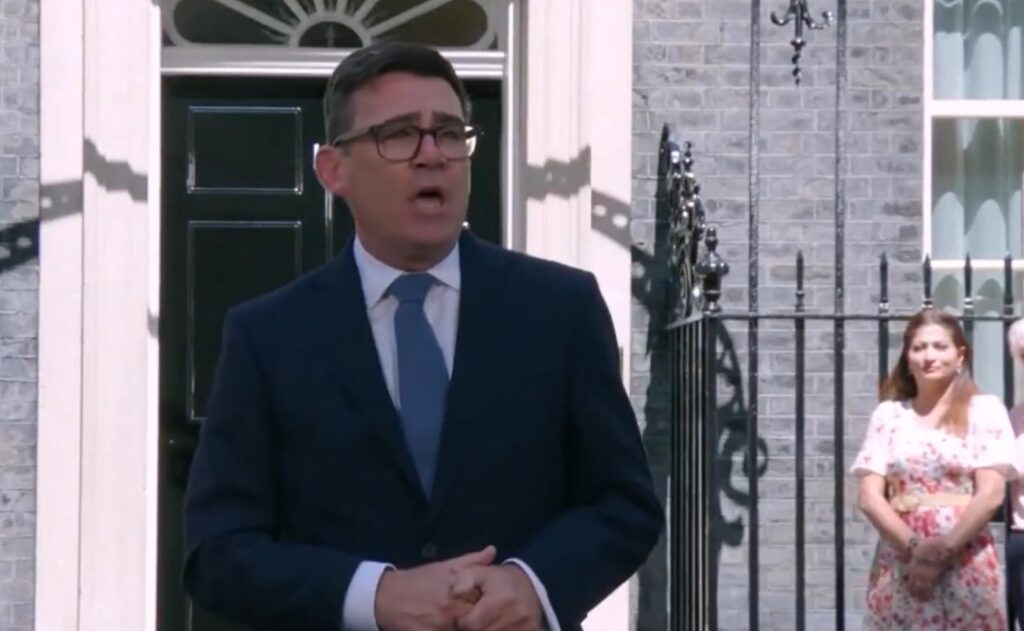
Mr Burnham’s first Downing Street day was both ceremonial and strategic. He met King Charles III and took office after Sir Keir Starmer’s resignation. He then used his first public remarks to promise both a perfect continuation of and a radical break with the immediate past as embodied by his predecessor.
Mr Burnham’s EU stance looks pro-European without being openly revisionist. He has said he hopes Britain will rejoin the EU in his lifetime, but he has also said he does not want to “rerun” Brexit and is not campaigning to re-enter now. Reuters reports he wants a closer relationship with the bloc on migration, security, and economic ties, while keeping Labour’s red lines on the customs union, the single market, and free movement. One may read it as the words of a cautious leader, or the balancing act of someone trying to be all things to all people at the same time.
That makes the postponed UK-EU summit in Brussels on 22 July especially important. The package inherited from Sir Keir appears to include a veterinary deal, emissions-trading linkage, and a youth mobility scheme. Those are limited measures, but they are concrete, and they will test whether Mr Burnham can turn a cautious reset into something durable without reopening the Brexit divide.
The summit was postponed after Mr Starmer’s resignation. There is some suspicion in London that Brussels deliberately waited for the more pro-European Mr Burnham before concluding the deal. His European predicament is as tricky as ever: he must not spook either markets or Britain’s Leave-leaning voters. He must find some middle ground, of which there is precious little.
Defence as industrial policy
Defence is what links Britain’s European role directly to domestic renewal. Mr Burnham has pledged to fully fund Labour’s defence investment plan. It aims for 3.5 per cent of GDP on defence by 2035, up from the current 2.56 per cent. He has argued that higher defence spending should support British jobs, reduce foreign dependence, and help reindustrialise the country. Speaking to The Times, he said extra defence spending should “back British workers and businesses”. The wording places industrial policy at the heart of his security agenda.
President Zelenskyy will be left in no doubt whatsoever that Britain’s support is steadfast (…) and I will be there personally for him too. — Andy Burnham, UK prime minister
That is a clear political frame, but the financing remains unresolved. The plan still leaves a £4.7bn gap, and Mr Burnham has not yet set out how fast spending will rise or where the money will come from. That matters because Europe is rearming fast, and Britain’s influence on the continent will depend partly on whether it can match words with credible funding. Some senior defence officials have floated the idea of ‘war bonds’—Treasury instruments ring-fenced for national security—but that remains a suggestion, not policy.
There is also a wider strategic logic here. Burnham’s defence pitch is not just about weapons. It is about industrial capacity, resilience, and reducing dependence on foreign suppliers. That aligns him more closely with the European debate about strategic autonomy than with the old British habit of treating defence as something separate from economic policy.
Steadfast on Kyiv
Ukraine is the clearest and strongest part of the picture. Burnham has promised that Britain’s support will “not waver”, that he will be with President Volodymyr Zelenskyy “100 per cent”, and that British and wider Euro-Atlantic security are tied to what happens in Ukraine. He also said he would speak to Mr Zelenskyy later on his first day in office, adding: “President Zelenskyy will be left in no doubt whatsoever that Britain’s support is steadfast, it is resolute, it will be there for him, and I will be there personally for him too.”
That language is more than rhetorics. It points to continuity with the coalition of support built under Mr Starmer, and it leaves little room for ambiguity. “Keir has done a really quite incredible job in not just backing Ukraine but being there in a personal way,” Mr Burnham said. He went on to stress that he intends to match that personal commitment. That is a deliberate signal to Kyiv and to European allies that Britain’s posture will not soften.
His record fits that reading. Mr Burnham has reportedly worked with Ukrainian mayors since the early stages of Russia’s full-scale invasion, and has backed support for Ukraine as a matter of principle and security. He has also pledged to keep NATO commitments, the nuclear deterrent, and the UK-US security relationship intact.
A domestic mandate, an international test
Seen together, the three themes form a single governing idea. The new PM wants to speak the language of sovereignty, resilience, and national renewal. In Europe, that means a practical reset rather than a grand return. It also means spending more on defence, but also spending British. In Ukraine, it means continuity, but in plainer and more emphatic language than his predecessor.
Monday’s events underlined that balance. The new prime minister began with domestic optics, then moved quickly to promise stability abroad. He refused calls for an immediate general election, said he would stick to Labour’s manifesto, and described his premiership as a chance to restore political trust. The foreign-policy message was that Britain will stay anchored to Europe’s security, even if its domestic politics remain unsettled.
Keir has done a really quite incredible job in not just backing Ukraine but being there in a personal way. — Andy Burnham
The central tension is obvious. Mr Burnham arrives with a mandate from Labour MPs, not the country. Reform UK has led national polls for over a year, and pressure for an early election will build. He also inherits an unsettled Europe, a costly defence promise, and a war in Ukraine that still demands sustained British support.
In short, if Mr Burnham can make the Brussels reset stick, fund defence credibly, and keep backing Kyiv without hesitation, his premiership may prove more consequential abroad than his domestic theatre first suggests. But those are truly gargantuan ifs.