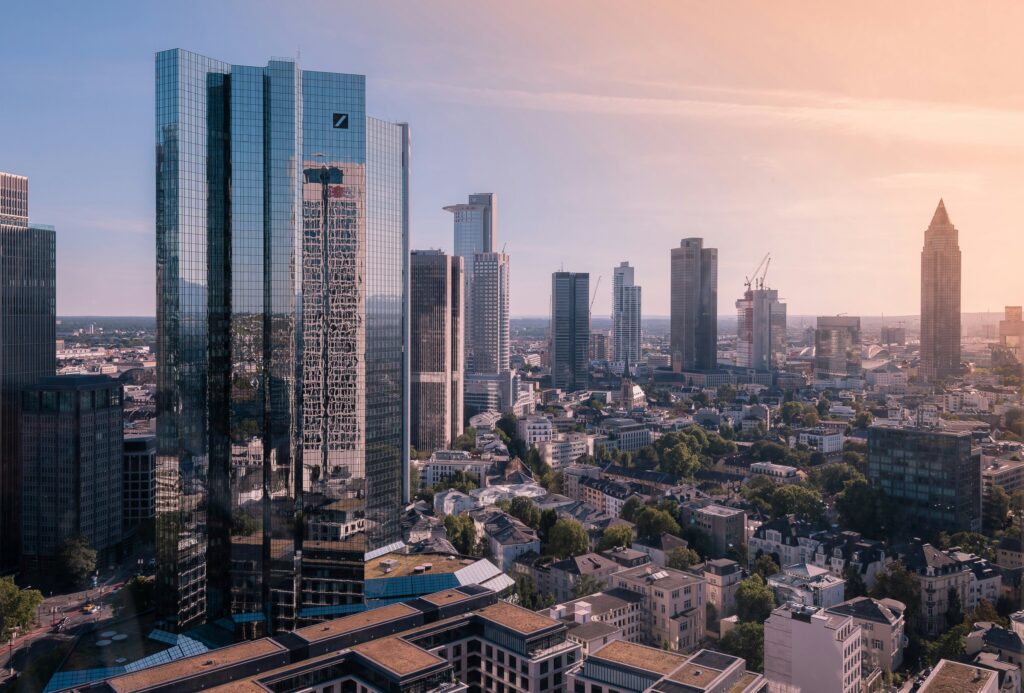
A decade after Brexit, London’s financial business never regrouped in one European city. It scattered across half a dozen instead.
Nicolas Véron, senior fellow at Bruegel and the Peterson Institute for International Economics, told EU Perspectives that this is not necessarily a problem. What matters more than a single financial capital, he argues, is a single legal jurisdiction. In this interview, he explains what is behind the dispersal, where it may be heading, and what should come next.
What do you see as the explaining factor for why there hasn’t been this gravitational movement to one place post-Brexit?
My way of looking at it is that it’s early days. First, it’s not obvious that this is an indication of failure. After all, it’s perfectly possible that the right steady state for the EU is one of several competing financial centres within a single jurisdiction, one that achieves the need for scale and depth and volume, but without everything concentrated in one geographical place. What is important is the singleness of the legal framework, the enforcement framework, the conditions for competition. But competition does not, with modern technology, have to result in everything in one square mile.
Competition does not, with modern technology, have to result in everything in one square mile.
— Nicolas Véron, senior fellow, Bruegel and Peterson Institute for International Economics
The other way to look at it is that it may just be a matter of time. We’re talking about very structural developments, and they will take time to materialise. At the beginning, if only for cost and capacity reasons you couldn’t have the relocation of activity from London all in one place. It would have been inefficient. But as time goes by, there will be more capacity building in the leading financial centres, possibly leading eventually to one place emerging with more clustering capacity.
I would also say that we have seen some patterns of clustering not necessarily where they were expected. For example, in the first few years after Brexit, largely for these reasons of capacity and ease of change, Dublin was among the leading financial centres in the eurozone. I think that has eroded to a certain extent, because it is peripheral and is not necessarily viewed by some market participants as easy to do business in as more centrally located financial centres.
And here I’m not only talking about financial infrastructure, but also context factors in terms of international connections in general. For example, the fact that the eurozone entity of Barclays relocated from Dublin to Paris recently has been viewed by some observers as an indication of some recalibration after a few years. Dublin is very successful in a number of market segments, so it’s not my intent to say they’re not winning. It’s just to say that there are second-round effects that are observable in the post-Brexit story.
Can Europe still compete without one dominant hub? Silicon Valley works because talent and infrastructure pool in a single place, creating a self-sustaining ecosystem. Does European finance need the same kind of concentration, or is it different by nature?
You mentioned Silicon Valley, and to state the obvious, Silicon Valley is not close to Wall Street geographically. So here you have an example in the US, a very mature market with a single jurisdiction from a legal standpoint for many decades: you have commodities in Chicago, venture capital in the Bay Area, equity and securities markets in New York. And actually, I say commodities in Chicago, but oil and fossil fuels are largely in Houston. You have secondary financial centres, and indeed some of them hold the leading position in their respective market segments.
So in a way, the position of London pre-Brexit — where London was aggregating activity across market segments, partly because of its privileged position of connection with the United States — was in a way an anomaly compared with the situation we’re observing right now in Europe, which is less super-centralised, and might remain so for some time, but these things are notoriously difficult to predict. I’ll just say that the fact that you have a handful of leading financial centres in the EU at this point — certainly Frankfurt, Paris, Amsterdam, and in some market segments Luxembourg, Milan, Dublin — doesn’t strike me as very scattered.
Then you have policy-driven fragmentation. For example, everybody talks about stock exchanges or securities depositories — market infrastructure. That is policy-driven. It’s a matter of member states protecting existing infrastructure against competition, and this is where there is a current policy debate around the Market Integration and Supervision Package (MISP). But that’s different — it’s not about liquidity, it’s about fragmented infrastructure.
How do you see moving toward a single jurisdiction right now, and what do you think is the most important mechanism to get closer to it?
It is happening, but it’s happening slowly. The breakthrough in that sequence was the integration of banking supervision, which was effective in 2014, so we’ve had nearly twelve years of it. It demonstrated that the EU was able not only to harmonise the rules but also to integrate the implementation and enforcement of the rules, which is what you need for a true single jurisdiction. That was for banking supervision, and it became a proof of concept.
Then the EU did the same — it’s a work in progress in terms of implementation — for anti-money-laundering supervision: there’s this new agency in Frankfurt, EU Anti-Money Laundering Authority (AMLA), that will be up and running in a year or two. And there is this debate on how to beef up the European Securities and Markets Authority (ESMA) so that it would basically play the same role as the Securities and Exchange Commission (SEC) and (United States Commodity Futures Trading Commission) CFTC do in the US, become a European SEC, as Christine Lagarde, President of the European Central Bank, memorably put it three years ago.
That’s what the discussion on MISP is. It is not elevating ESMA into a European SEC; it stopped short of that, as proposed by the European Commission in December and currently being discussed. But it is a step in that direction. If you take a step back, you see that everything points in that direction. That’s the direction of travel. It’s slow and halting because of the complexity of European politics, but it is happening.
Do you think there is political achievability in getting ESMA to absorb national supervisors over the next decade?
Again, the proof of concept was the Single Supervisory Mechanism (SSM). The SSM is up and running. It works. People grumble about it, which is normal, but it works essentially in line with the objectives that were set for it. People were saying it maybe works in terms of prudential, but it doesn’t work in terms of market integration. But now, with the Commerzbank–UniCredit merger, we see that it also works for market integration. It was a delayed effect, but it makes a world of difference, because it’s pretty obvious that if that transaction’s authorisation had been in the hands of a national authority, for example BaFin, it probably wouldn’t have been authorised the way it has been by the European Central Bank (ECB).
It’s pretty obvious that if that transaction’s authorisation had been in the hands of a national authority, for example BaFin, it probably wouldn’t have been authorised the way it has been by the European Central Bank.
— Nicolas Véron, senior fellow, Bruegel and Peterson Institute for International Economics
In that context, it is pretty clear that supervisory integration has consequences, and that supports the agenda of integrating supervision in other parts of the financial system than just microprudential supervision of banks. That’s what we’re seeing now in the discussion. I don’t know exactly where MISP will land, but at this point it is very likely to land somewhere not that far from the kind of ambition the European Commission put into it with their proposal in December.
What do you see within Europe over the next decade assuming we stay on this trajectory of travel?
In many ways the discussion has been reshaped by the geopolitical environment. Increasingly, a bit like with the defence industrial base, people look at the financial system as an enabler of strategic autonomy, to speak the jargon of Brussels. That has injected energy into the reform conversation in a very observable way. That’s an argument Enrico Letta, former Italian prime minister, has been making quite convincingly.
So if you assume, for the sake of discussion, that nothing changes and we stay with the current policy framework for the next twenty years, stating the obvious, that means the EU loses a lot in terms of efficiency, in terms of ability to invest, in terms of ability to develop its own enablers for investment and innovation and industrial transformation. So it has consequences.