The arrival of thousands of migrants in of Ceuta has triggered a wider European dispute over Schengen rules — even though the Spain’s enclave itself is not part of the Schengen Area.
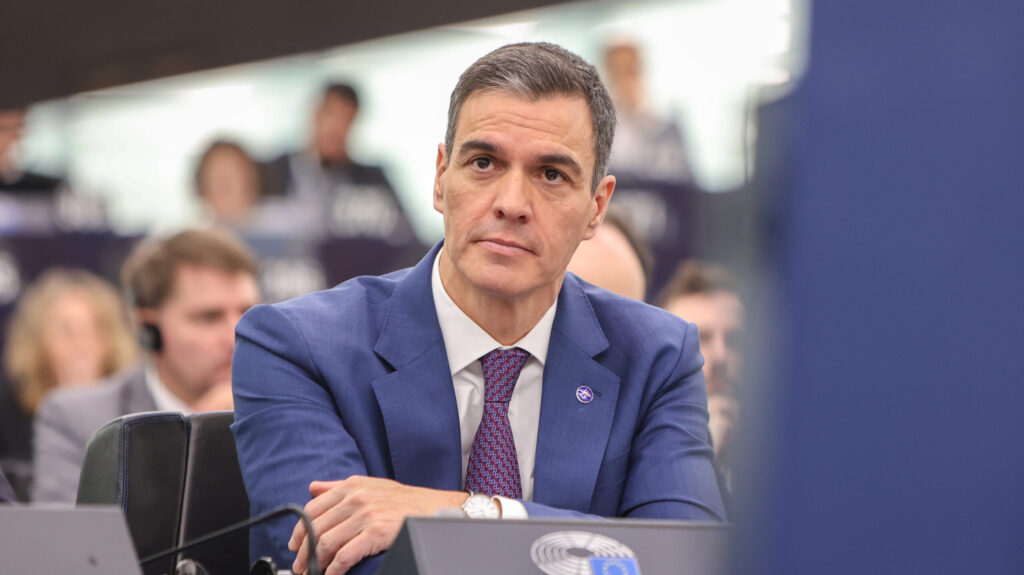
“An attack on Spanish national sovereignty.” This is how Spanish Prime Minister Pedro Sánchez described the large influx of migrants from Morocco crossing the borders of the Spanish enclave of Ceuta, on the northern tip of Africa.
This prompted an immediate reaction from European capitals, which called for swift intervention from Madrid to resolve the situation. According to a senior European official monitoring the situation, many of the migrants have been voluntarily returning to Morocco throughout Friday.
However, this “attack” has divided the European Union. Some have expressed solidarity, while emphasising the need to restore the status quo ante, like German Chancellor Friedrich Merz. Others, including Italian government, hold Madrid responsible for what happened, threatening to close the Schengen area — even though Ceuta is not part of the free movement agreement.
The Commissioner for migrations Magnus Brunner ensured that there are no movements towards the European continent and “the Schengen Borders Code provides special rules applicable to Ceuta and Melilla”.
Schengen cannot simply be shut down
Rome was one of the first to react on Thursday night on the matter, raising the possibility of suspending Schengen cooperation with Madrid. Former EU High Representative for Foreign Policy Josep Borrell came to Madrid’s defence, calling the move incompatible with European law. According to Borrell, “no member state can unilaterally suspend another’s participation in Schengen”.
The former head of European diplomacy also criticised the Italian initiative, arguing that it reveals how some governments are “using and abusing the EU legal system”, violating the principle of “loyal cooperation” that binds member states.
Criticism of Rome’s position also came from Javí Lopez, vice president of the European Parliament, who called Italian Prime Minister Giorgia Meloni’s statements “unworthy of a European partner”.
At the EU’s external border
Ceuta and Melilla—the two autonomous Spanish cities located in North Africa—operate under a special regime established by Article 41 of the Schengen Borders Code. An EU senior official explained that, under these rules, anyone leaving Ceuta or Melilla headed for Spain or another member state “must still be subject to controls at the external borders of the EU”.
In this case, therefore, Spain remains responsible for managing its own borders. Since this is an external border of the European Union, the situation also falls under Spain’s responsibility.
Generally speaking, compliance with Schengen rules is monitored through Schengen Evaluation and Monitoring Mechanism (Sch-Eval), which allows the EU to verify that member states are correctly applying the rules.
If serious deficiencies in the management of external borders are discovered, the Commission can report them. The findings are then examined with the state concerned and subsequently by the Council of the EU. “It is then up to the Council to adopt any recommendations and request an action plan to address the critical issues identified,” the source recalled.
Support to Meloni from the North
However, Italy’s position has received support from some European partners, such as Finland and Sweden. Finnish Interior Minister Mari Rantanen endorsed the Italian line, accusing Spain of failing to “protect the external border of the Schengen Area from infiltration”. All European countries must support Meloni’s proposal, she added.
Swedish Prime Minister Ulf Kristersson shared these positions, declaring that his minister for migration is in contact with his Nordic counterparts and “does not rule out taking the necessary measures to prevent a repeat of 2015.” He referred to the migration crisis during which over a million refugees and migrants reached Europe fleeing the wars in Syria, Afghanistan, and Iraq.
Danish Prime Minister Mette Frederiksen called on the EU to examine all options on the table “including suspending Schengen cooperation”. For Denmark, “uncontrolled immigration represents a threat” to the country.
The next European Council (EUCO) meeting in October could be very intense regarding this “summer” matter where traditonally Ms Frederiksen and Ms Meloni are working very close on the EU migration management.
Who’s trying to not leave Spain alone
On the other side of the Italian political initiative, Germany stressed that all EU member states have to respect the obligation of the European solidarity. Belgian Foreign Minister Maxime Prévot emphasised that “when a member state is under pressure, it is a European issue”. He specified that “in times like these, Spain must guarantee the protection of its borders and be able to count on the support of both European and Moroccan authorities”.
A helping hand also seems to be coming from those who are no longer in the EU but know their territory and its management problems. The new British Labour Prime Minister Andy Burnham is ready to offer support to Spain. The issue is “first and foremost a Spanish government matter, but it raises international concerns,” he said.
Speculations on the Rabat role
According to the EU sources, Morocco’s reaction about Ceuta crisis was swift. “The evidence is that the Moroccan authorities have fully mobilised,” they stated. Asked several times about the possibility that what is happening can be defined as a “hybrid war” the same sources reiterated “that, at this stage, they do not want to speculate”. So far, more than 37,500 of the 50,000 migrants who arrived in the enclave have already returned to Morocco.