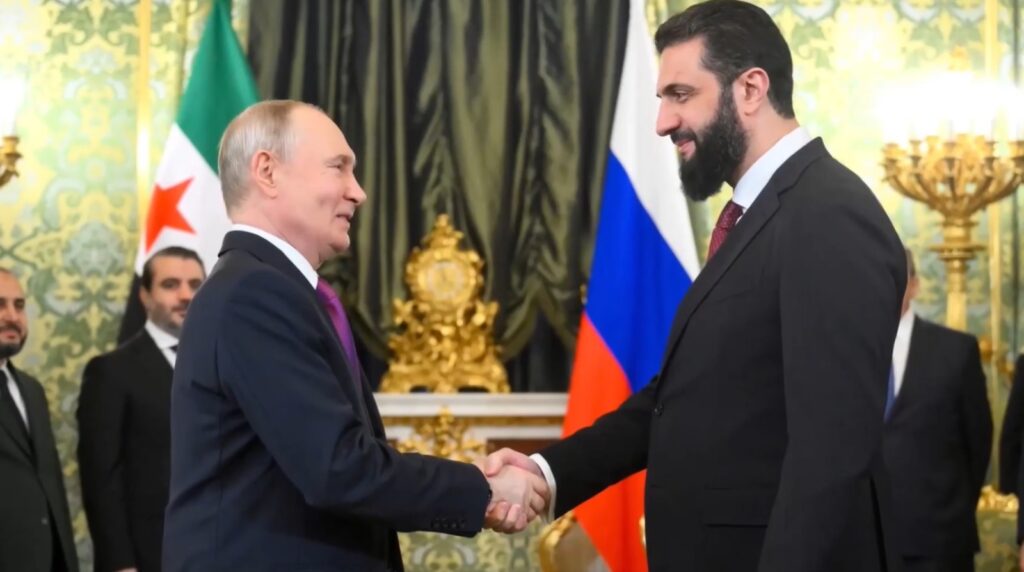
Damascus has handed a weakened Russia back its Mediterranean foothold. The European Union, divided and slow, watched.
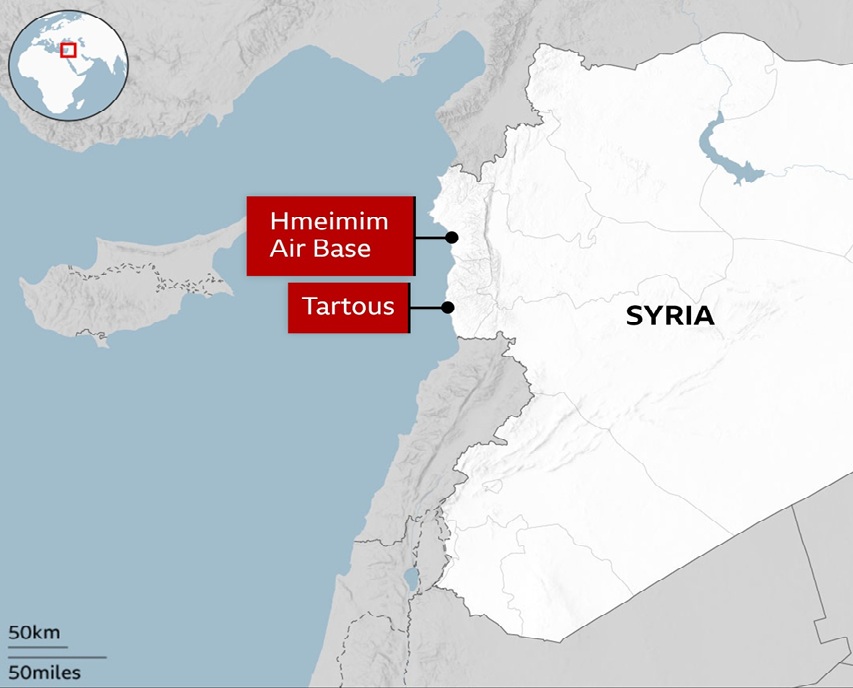
When Bashar al-Assad fled Damascus in December 2024, Russia’s military presence in Syria suddenly depended entirely on the goodwill of the government that had just toppled his regime. But last week, Syria’s new government agreed to convert the Russian military bases at Tartous and Hmeimim into ’joint training and qualification centres’ within three months. Damascus will manage civilian facilities at both sites, while Moscow will retain access to both.
The arrangement, formalised in a memorandum of understanding, creates a long-term legal basis for Russia’s presence in Syria while establishing ties with transitional President Ahmed al-Sharaa’s government. Europe had a chance to prevent this outcome. It did not take it.
From Assad’s fall to Moscow’s gamble
The deal is not a triumph of Russian strength. It is a triumph of Russian patience, and of European hesitation. To understand why it matters, one must first understand how close Russia came to losing everything.
The Kremlin’s position in Syria collapsed with Mr Assad’s presidency. The 49-year leases on Tartous and Hmeimim that Mr Assad had granted Russia in 2017 became, in effect, worthless overnight. Russia helped Mr Assad flee and gave him asylum in Moscow as fighters led by Mr al-Sharaa swept into Damascus and claimed victory in a civil war that had raged for nearly 15 years. Vladimir Putin, Moscow’s strongman could not, or would not, save his ally. That failure exposed how badly Russia’s military had been depleted by its war in Ukraine, now in its fifth year.
Tartous is Russia’s only naval base in the Mediterranean. Moscow has retained a presence there since 1983. Hmeimim, established in 2015, served as a platform to bomb opposition forces and, later, as a transit hub for Russian operations in Africa. Losing both would have severed Russia’s only direct military link to the Mediterranean and to the African continent beyond it. The stakes, for Moscow, could hardly have been higher.
Mr al-Sharaa did not demand an immediate Russian withdrawal. Syria and Russia instead spent more than 18 months negotiating a new arrangement, with Mr Putin hosting Mr al-Sharaa for talks in Moscow in October 2025 and again in January 2026. Moscow reduced its military presence at both sites considerably after the new government took over. It then waited. The freshly minted memorandum was the result.
Why it matters
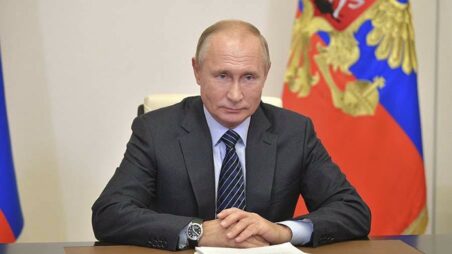
The deal is better for Russia than it first appears. “Much has been accomplished in terms of restoring our interstate relations,” Mr Putin gloats. By agreeing to change some of the functions of its military bases and allowing parts of the facilities to be used for civilian purposes, the Kremlin preserved them for use in operations in Africa, according to Bloomberg’s Moscow source familiar with the memorandum. The Putin regime has thus secured Russia’s presence at the two bases, allowing it to project strategic influence far and wide.
That projection matters geopolitically. Russia retains a Mediterranean foothold; diminished perhaps, but not gone. It keeps a symbolic claim to great-power status in the Levant. It maintains leverage over North Africa and energy transit routes. And it preserves what analysts describe as an anti-access and area-denial node in the Eastern Mediterranean, forcing the EU and NATO to plan around it.
For Europe, the consequences run in the opposite direction. Russia’s continued presence at Tartous and Hmeimim leaves the EU’s eastern Mediterranean flank more exposed. It complicates energy corridor planning, including the EU- and US-backed ‘Four Seas Initiative’ envisioning a Syria–Türkiye energy corridor, for which the European Commission endorsed a preliminary feasibility study in March 2026.
The window Europe left open
The post-Assad period, from December 2024 through most of 2025, was uniquely fluid. Syria’s new government craved international legitimacy. It needed reconstruction money, fast. Russia’s position was legally void and militarily weakened. That combination offered Europe a narrow but real opportunity to shape the outcome.
On the diplomatic front, Brussels could have offered rapid recognition and Association Agreement talks, conditional on Damascus requiring the exclusive use of Tartous and Hmeimim by Syrian or multinational forces. It could have pushed a UN Security Council resolution declaring Syria a neutral, non-aligned state.
Much has been accomplished in terms of restoring our interstate relations.
— Vladimir Putin, Russian president
Even a Russian veto would have raised the political cost of any basing deal, forcing Moscow to pay a higher diplomatic price for what it eventually obtained for free. It could have assembled a quadrilateral security guarantee from the EU, the US, Türkiye, and the Arab League. This would have given Damascus an alternative security umbrella, reducing its incentive to accommodate Moscow.
Formidable leverage
On the economic front, the leverage was substantial. The EU pledged €5.8bn at the ninth Brussels Conference in March 2025, with €3.37bn coming from the EU and member states directly. It later committed €2.5bn under the NDICI-Global Europe envelope for 2025–26, and an additional €620m for 2026–27.
A Financial Recovery Package of €175m followed the reactivation of the 1978 EU-Syria Cooperation Agreement in July 2026. That is serious money.
Conditioned explicitly and verifiably on a base hand-back, it could have given Damascus a powerful reason to act differently. Staged disbursements, satellite monitoring, and automatic sanctions snap-back for any Syrian entity facilitating Russian military activity could have been part of it.
Paths untrodden
On the security front, the options were real if untested. Speculatively, the EU could have deployed a training mission modelled on EUTM-Mali or EUAM-Ukraine, focused on coastal defence, maritime domain awareness, and air-traffic control for Syria’s new armed forces.
It could have expanded the mandate of Operation EUNAVFOR MED IRINI (which conducted a NEREUS surge in 2026) to monitor foreign military logistics to Syria. It could have offered a time-limited EUFOR-MED battlegroup at Latakia during the transition, deterring opportunistic Russian re-entry without substituting one foreign presence for another. Whether Damascus would have accepted any of these offers is another matter.
Europe did none of these things — not in time, anyway. The EU’s ‘step-by-step’ roadmap, endorsed in the June 2025 Council Conclusions, was calibrated for internal consensus and caution, not for seizing a narrow post-conflict window. The Brussels pledge was conditional, staged, and bureaucratically slow to disburse. Damascus needed cash quickly. Russia and Gulf states moved nimbler.
What Europe actually did
The EU established a planning cell (informally dubbed EUAM Syria) inside the European External Action Service in late 2025, to design a possible civilian mission focused on police training, border management, and judicial vetting. A political decision remained pending. By the time that cell was being discussed, Russia had already begun renegotiating its basing terms directly with the new Syrian authorities.
The first EU-Syria High-Level Political Dialogue took place on 11 May 2026, co-chaired by High Representative Kaja Kallas and Syrian Foreign Minister Asaad al-Shaibani. The Council decision to restore full application of the 1978 agreement followed on 11 July 2026. Both were meaningful steps; but both came too late to affect the talks about the bases, which concluded the following month.
The EU still risks ceding influence to Türkiye, Qatar and Gulf investors unless it upgrades from piecemeal projects to a coherent Syria strategy. — Carnegie Endowment for International Peace
Member-state divisions compounded the delay. Hungary and others blocked the kind of unified, assertive posture that might have given Brussels real leverage. UN Security Council reporting from May 2026 records unified EU member support for linking assistance to security-sector reform benchmarks. Yet that consensus never translated into conditionality over basing rights. The result was a common foreign and security policy that moved at the pace of its most reluctant member.
The cost of caution
Analysts had warned this would happen. “The EU still risks ceding influence to Türkiye, Qatar and Gulf investors unless it upgrades from piecemeal projects to a coherent Syria strategy,” one Carnegie analysis noted. Such warnings went unheeded.
It would be speculation to say that a bolder European strategy would certainly have succeeded. Mr al-Sharaa’s government had its own reasons to keep Moscow close. not least the need to manage a fragile security environment and avoid provoking a Russian reaction during a vulnerable transition. Russia had time, patience, and a direct military presence on the ground. Those are not negligible assets.
The EU continues to finance OPCW operations in Syria (€13.2m re-programmed for 2025) and has conditioned every new tranche of funding on inclusive governance and human-rights monitoring. Reconstruction assistance is shifting toward livelihoods and governance projects in 2026. None of it was ever linked to the one condition that would have mattered most strategically.
A failure of will
The managed continuation now dressed up as a compromise (Syrian civilian management in exchange for Russian access) is the outcome that results when a well-resourced actor declines to use its resources at the moment they would have counted most. Europe is now financing Syrian reconstruction while Russia retains the basing rights it should have been pressed to surrender.
All this is less a failure of capability than one of will and, consequently, of timing. The EU never seriously tested its leverage. It never made reconstruction money explicitly conditional on a base hand-back, and never offered a credible military alternative. It never moved fast enough to matter.