Belgium rarely burns. This week, its firefighters are battling the largest wildfire the country has ever recorded, while a thousand-year-old Spanish monastery has had to evacuate the bones of its founding kings.
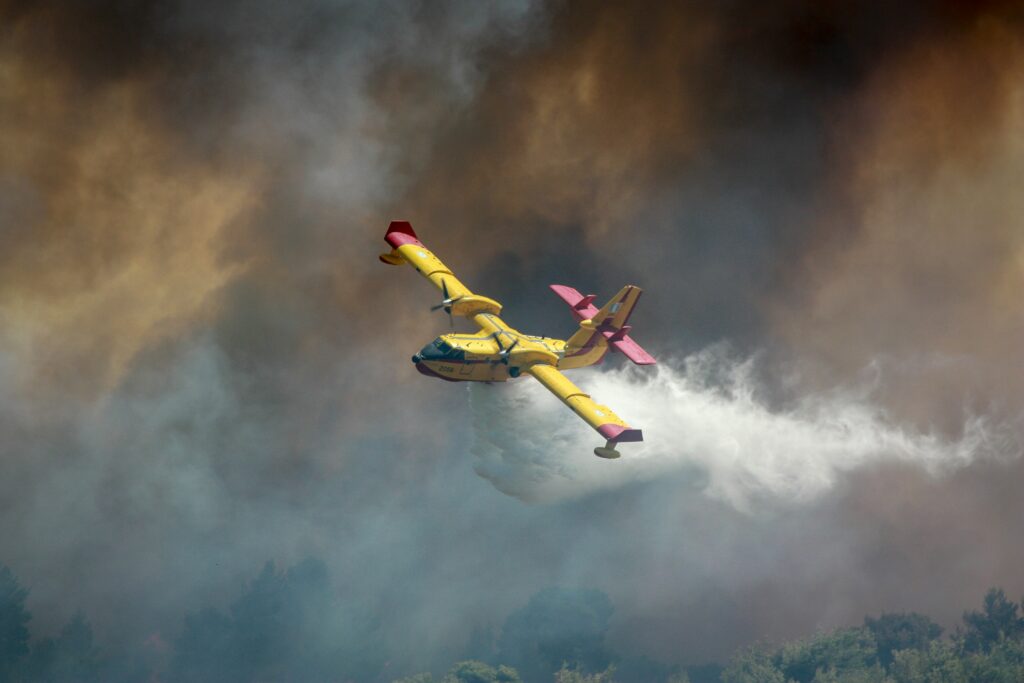
Flames tore through the Hautes Fagnes nature reserve in eastern Belgium over the weekend, forcing hundreds of residents from their homes and prompting Brussels to activate the EU’s Civil Protection Mechanism (UCPM). Sweden dispatched two rescEU aircraft, while the Netherlands, Norway, and Germany each sent two helicopters to help local crews contain the blaze.
In Spain, meanwhile, 104 ground firefighters and 36 vehicles from France have joined Spanish crews battling flames in the Aragón region, where 16,600 hectares have already burnt. The two deployments come as the EU’s satellite mapping service, Copernicus, tracks wildfires burning simultaneously across Belgium, Germany, France, Italy, and much of the Balkans and Iberia, including Spain, Greece, Montenegro, and Albania.
Belgium’s largest fire in decades
The fire broke out on Friday, 14 August, in the Hautes Fagnes, a protected moorland and peat bog on the border between Belgium and Germany. It has since become the largest wildfire in the country’s modern history, burning through more than 3,000 hectares of heathland, pine forest, and peat.
Around 600 residents of Waimes and Bütgenbach evacuated their homes. More than 250 firefighters and rescue workers are on the ground, with soldiers and local farmers helping alongside them. Smoke and flying embers forced the German town of Monschau to evacuate two streets on Sunday, as the fire threatened to cross the border.
Rain on Sunday brought some relief to exhausted crews and slowed the fire’s spread for the first time since it began. Firefighters warn, however, that the peat beneath the moorland can smoulder for weeks. That makes the blaze hard to fully extinguish even once the flames are out.
The European Commission’s Emergency Response Coordination Centre coordinates the response. It receives requests for assistance, matches them with offers from member states, and co-finances the deployments.
Racing to save Aragón’s heritage
In Spain, a fire that broke out on Monday in the Aragón region has burnt through 16,600 hectares and forced more than 1,000 people to evacuate from 18 villages. As flames closed in on the ancient monastery of San Juan de la Peña, the birthplace of the medieval Kingdom of Aragón, the army’s Military Emergency Unit removed the remains of the kingdom’s first rulers to keep them safe.
The fires in Belgium and Spain are part of what is already one of Europe’s worst wildfire seasons since 2022, according to the EU’s forest fire monitoring service EFFIS. More than 568,000 hectares have burned across the EU so far this year, an area more than twice the size of Luxembourg.
No country should face wildfires alone.
— Hadja Lahbib, Commissioner for Crisis Management
Commissioner for Preparedness, Crisis Management and Equality Hadja Lahbib said the deployment showed the value of European cooperation. “No country should face wildfires alone,” she said. “Through our Civil Protection Mechanism, Europe is moving aircraft, helicopters and firefighters quickly to where they are needed most. This weekend in Belgium and Spain, European solidarity was on the ground again.” With the fire season not yet over and temperatures still climbing across the continent, that solidarity is likely to be tested again before the summer is out.