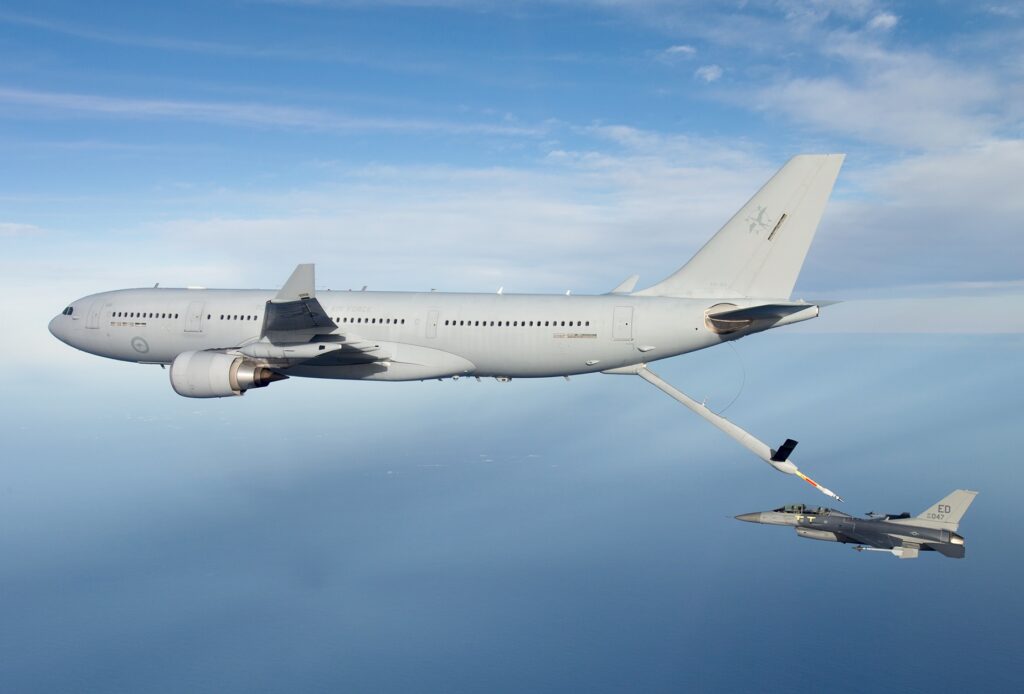
An expensive yet priceless multi-role tanker deal gives NATO’s eastern flank reach and endurance it has never had before.
Poland has no dedicated air-to-air refuelling aircraft. Its F-16s and incoming F-35s can fly only as far as their internal fuel allows. That constraint matters enormously on NATO’s eastern flank, where the ability to sustain fighters over contested airspace — or project force deep into a crisis zone — could prove decisive.
Four Airbus A330 Multi Role Tanker Transport (MRTT) aircraft, arriving by 2030, will change that calculus. The aircraft is built for exactly this kind of work. Derived from the commercial A330-200 airliner, it carries 111 tonnes of transferable fuel, offloads up to 50 tonnes at a radius of 1,800 km, and can remain on station for four hours at a time. Its range reaches 14,800 km.
A common platform, a stronger alliance
It can also carry 300 passengers or 45 tonnes of cargo, and convert to an aeromedical evacuation platform. Thus a single aircraft effectively does three jobs.
Poland’s four MRTTs will support its F-16s, F-35s, and potentially its FA-50 light fighters. They will also provide strategic lift for NATO and EU missions along the eastern flank. Crucially, Warsaw intends to plug into NATO’s Multinational MRTT Fleet (MMF) — a 12-strong pooled fleet managed by the NATO Support and Procurement Agency that allows member states to access refuelling and transport capacity by the hour. This reduces duplication across the alliance.
The strategic logic extends well beyond Warsaw. The A330 MRTT has become the standard large tanker across more than ten European air forces, including those of the United Kingdom, France, Germany, the Netherlands, Norway, Belgium, the Czech Republic, and Luxembourg.
A common type simplifies cross-border operations, air-policing rotations such as Baltic Air Policing, and NATO reinforcement drills. Every new operator that joins the ecosystem deepens interoperability.
Theory to necessity
Russia’s war on Ukraine sharpened the case for all of this. Long-range mobility and fighter persistence over Europe’s eastern approaches are no longer theoretical requirements. They are operational necessities. The MRTT addresses both. The RAF’s Voyager KC2/KC3 variant demonstrated precisely this during Operation Shader, sustaining high-tempo sorties over Iraq and Syria and routinely off-loading fuel to Typhoon and Tornado fighters.
Spain’s contribution reinforces the picture. Madrid already operates one MRTT with its Air and Space Force’s 45th Wing, accepted in April 2025 and immediately put to work on refuelling trials with Eurofighter and F/A-18M aircraft. A second followed in October 2025.
A third conversion is completing this year. Spain’s fleet features a hose-and-basket refuelling system, endurance in excess of 18 flight hours, and a range of 16,000 km. The new joint order extends that commitment significantly.
The deal and its mechanics
Spain’s Council of Ministers approved a €5.4bn ($6.3bn) spending plan on 26 August 2026, authorising a seven-year framework agreement covering both procurement and logistical support for entry into service.
Madrid did not disclose a specific aircraft quantity in its own statement. The Spanish government noted only that the framework agreement includes an addendum providing for Poland’s participation, funded under Europe’s new financing instruments. A final contract has not yet been signed. An Airbus spokesperson confirmed that “Negotiations will start soon.”
This is a crucial decision regarding NATO security and Poland’s security.
— Władysław Kosiniak-Kamysz, Poland’s deputy prime minister
The framework draws on the EU’s Security Action for Europe (SAFE) instrument — a financing mechanism designed to keep European defence spending inside the bloc’s industrial base. Conversions at Airbus’s Getafe facility near Madrid and a production line in Seville will anchor the programme industrially, while final assembly in Toulouse sustains the broader Airbus ecosystem.
Poland’s deputy prime minister and minister of national defence, Władysław Kosiniak-Kamysz, confirmed the headline numbers on social media. “At least seven aircraft will be purchased,” Mr Kosiniak-Kamysz wrote, adding that Warsaw would receive four by 2030. He was direct about the wider significance. “This is also a crucial decision regarding NATO security and Poland’s security,” Mr Kosiniak-Kamysz said.
Closing the gaps
The path to a signed contract is clear, if not yet complete. Both governments have committed, and Airbus has a production line ready. The MMF framework exists to absorb Poland’s aircraft into a pooled structure the moment they arrive.
Technologically, the platform continues to advance. Autonomous boom refuelling (the A3R system, demonstrated operationally from 2021) cuts receiver workload and sortie time. The forthcoming A330 MRTT+ variant, based on the neo-generation airframe, offers a higher maximum take-off weight of 242 tonnes and eight per cent lower fuel burn. Europe is not standing still on this capability.
For Poland, the acquisition closes a gap that has long left its growing fighter fleet operationally constrained. It also deepens Spain’s tanker programme already proving its worth. For Europe (the continent that spent decades assuming someone else would provide the fuel) it is one more step toward an air power architecture that can sustain itself.