Some of the EU’s promised savings from simpler rules may not survive as lawmakers and governments negotiate the details, the simplification commissioner Valdis Dombrovskis. The Commission estimates that its proposals could cut administrative costs by around €17 billion a year, but only if legislators preserve the changes it has put forward.
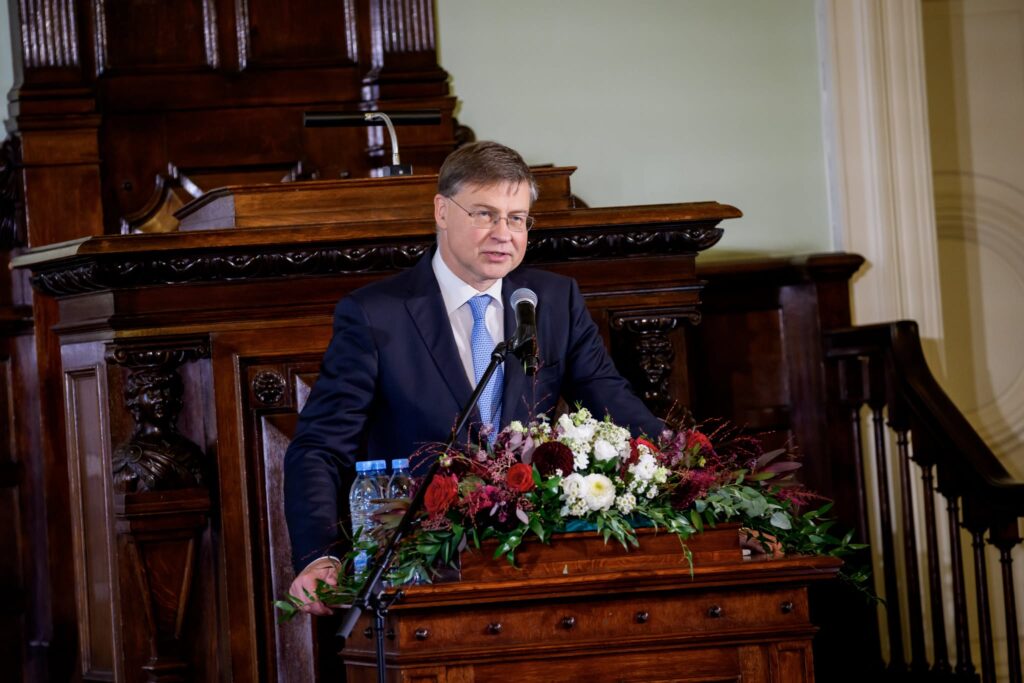
Speaking at a simplification event at the University of Latvia on Friday, Mr Dombrovskis said he was less worried about the time it takes to pass legislation than about what survives the process. “My concern is not about the timing, but about the content,” he said during a discussion after his keynote speech.
The Commission has put forward 12 packages of proposed rule changes, known as omnibuses. Mr Dombrovskis said Parliament and EU governments could remove or narrow measures as they negotiate, leaving businesses with less relief than the Commission envisaged.
He rejected the suggestion that the packages were moving unusually slowly: Parliament had chosen its ordinary legislative process despite a Commission request to speed up the work, he said.
Support for simpler rules meets disagreement over details
Mr Dombrovskis described a familiar problem in EU negotiations. Ministers support simplification when discussing it broadly, he said, but national experts can resist changes to the rules they oversee. Parliament faces its own divisions, including concern that lighter requirements could weaken environmental and social protections.
The environmental simplification package offers an example of the risk he identified. In June, governments stopped work on two proposed changes to producer responsibility rules after a large majority expressed strong reservations. They kept negotiating other parts of the package, which the Council said largely preserved the Commission’s approach.
My concern is not about the timing, but about the content. — Valdis Dombrovskis, Commissioner for Economy, Productivity, Implementation and Simplification
Mr Dombrovskis also pointed to a case where changes have passed. Asked what simplification means in practice, he cited sustainability reporting: fewer companies must report, and the revised rules limit the information that larger firms can demand from smaller businesses in their supply chains. The EU adopted those changes in February.
National rules could limit the savings
The Commission aims to cut administrative burdens by 25 per cent for businesses overall and 35 per cent for smaller firms by 2029. It puts the corresponding annual savings target at €37.5 billion. Mr Dombrovskis said reaching it would require further proposals as well as agreement on those already under negotiation.
He urged governments to look beyond EU legislation when assessing the burden on businesses. Member states can add requirements as they apply EU rules nationally, he said. A company operating across borders may therefore face different demands in each country, even after Brussels has simplified the underlying rules.