The world still has no clear picture of how much it spends preparing for the next pandemic. The EU wants to change that, pushing for a global spending tracker as countries struggle to agree on a new UN declaration on pandemic preparedness.
How much does the world spend on preparing for the next pandemic? “We still do not have a clear picture of how much the world spends on preparedness, where that money goes, and where the biggest gaps are,” EU Commissioner for Equality, Preparedness and Crisis Management Hadja Lahbib told a G20 High Level Independent Panel on Financing Pandemic Preparedness and Response in New York on 24 September.
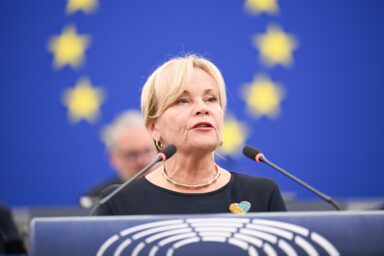
A day later, she criticised the draft UN pandemic declaration for failing to address the issue. “We regret the declaration’s silence on the global financial tracker,” she told world leaders at the UN High-level meeting on pandemic prevention, preparedness and response. World leaders left without adopting the document.
The money question is pressing
The funding gap is particularly acute in low-income countries, where around three-quarters of pandemic preparedness financing comes from official development assistance, according to the OECD. The organisation expects aid for infectious diseases to fall by 40% between 2024 and 2026.
Meanwhile, the risks remain. COVID-19 has caused more than 7.1 million reported deaths worldwide, while an Ebola outbreak that began in the Democratic Republic of the Congo has resulted in more than 7,800 cases and 3,700 deaths across Africa.
When infections slow, commitments start to wane.
— António Guterres, UN Secretary-General
World leaders met in New York on 25 September to change that. They renewed their commitment in their speeches. But they left without adopting the declaration meant to put it in writing.
The UN Secretary-General António Guterres warned of a familiar cycle. “When a virus first hits, money flows and promises are made. But when infections slow, commitments start to wane,” his message said. “We cannot allow this cycle to continue.”
Serious shortcomings
COVID-19 “revealed serious shortcomings” in preparedness, according to the resolution that set up the meeting. The UN’s concept note lists the gaps that remain: unequal access to vaccines and medicines, fragmented funding and weak surveillance and laboratories.
The meeting was meant to end with a political declaration. This is not a law or a treaty. It is a joint statement in which countries promise what they will work on.
The resolution, adopted a year earlier, set three goals. Countries would review what they had done since the first declaration in 2023. They would take stock of the gaps and renew their commitment. And they would approve a new declaration.
The meeting met two of its goals in the speeches. It missed the third.
“While there is broad support for the text, there continue to be some observations,” General Assembly President Khalilur Rahman said as he closed the meeting. “The document will be considered further by the Member States in the General Assembly.”
The EU says yes, with red lines
Lahbib spoke for the EU and its member states. The declaration “falls short of our goals”, she said. But “the EU remains fully committed” to its objective. In short, the EU supports the promise. But not every word in it.
The declaration falls short of our goals. But the EU remains fully committed.
— Hadja Lahbib, EU Commissioner for Equality, Preparedness and Crisis Management
She welcomed the text’s emphasis on national responsibility for pandemic preparedness and its recognition of the WHO as the central pillar of global health governance. However, she identified three areas where the declaration fell short of the EU’s position: financing, technology transfer and the recognition of key institutions.
Realistic and clear funding
The first is money. Lahbib said the EU welcomes the declaration’s push for countries to fund their own preparedness and rely less on aid. But she wants international funding to count as well.
“While we value the declaration’s emphasis on health sovereignty, domestic financing and reduction of aid dependency, complementary international financing should be reflected in a balanced manner,” Lahbib said.
The EU’s written statement adds that funding commitments “should be realistic and respect decision-making processes in different jurisdictions”. It also says estimates of funding gaps “should be up-to-date and accurate”.
The EU is already a major donor. Through the Team Europe approach, the EU and its member states have provided 42% of the Pandemic Fund’s budget, Lahbib told the G20 panel.
Bulgaria, an EU member, asked for “balanced, complementary international financing focused on accountability, efficiency and resource mobilisation”.
Brussels wanted the UN declaration to back a global spending tracker. The EU is already working with the OECD and WHO “to improve the tracking of pandemic preparedness spending”, Lahbib told the G20 panel. A pilot with several countries will follow in the coming months she said.
Sharing know-how
The second red line is about know-how. To make vaccines and medicines, companies need know-how, such as production methods, data and patents. Poorer countries want that knowledge shared more easily, so they can make their own products. A process known as technology transfer.
The EU says it should only happen voluntarily. “Technology transfer must be voluntary,” Lahbib said, on “mutually agreed terms”.
The EU’s written statement explains why. Voluntary sharing is needed to “foster innovation and research, enhance equitable access, and secure a quick and efficient response to future pandemics”, it says.
The EU also wants any mention of global patent rules to match those rules exactly. “References to the TRIPS Agreement and Doha Declaration must be comprehensive and fully aligned to its text,” Lahbib said.
TRIPS is the World Trade Organization agreement on patents and other intellectual property. The 2001 Doha Declaration says it should not stop countries from protecting public health.
Developing countries have called for fewer restrictions on technology transfers. Speaking on behalf of the African Group, Burundi called for “unhindered technology transfer”.
Who is left out
The third red line concerns who the text leaves out. According to Lahbib, the declaration does not mention the WHO’s outbreak intelligence centre in Berlin. “There is no reference to the key actors like the WHO hub for pandemic and epidemic intelligence,” she said. The WHO set up the hub to detect health threats early.
The United States also expressed reservations about the text, saying it was “not in a position to support this text in full”. Washington objected, among other things, to references to the unfinished negotiations on the pandemic treaty’s vaccine-sharing annex and to what it called “divisive ideologies”.
The annex holding everything up
That annex belongs to a separate text. The WHO adopted a pandemic treaty in May 2025. But no country can sign it until governments agree an annex on sharing dangerous viruses and the vaccines made from them. Those talks are still stuck, and the new deadline is May 2027.
The two are separate. The declaration is a political statement negotiated at the UN in New York. The treaty and its annex are negotiated at the WHO in Geneva.
The annex is known as PABS, short for pathogen access and benefit sharing. Under the annex, countries would share dangerous viruses and their genetic data quickly. In return, they would get fair access to the vaccines, medicines and tests made from them.
WHO Director-General Tedros Adhanom Ghebreyesus had one request. “Get [PABS] done as soon as possible,” he said. Delays “cost all countries dearly”.
The talks are stuck on two questions. Who may receive virus samples, and on what terms? And can private companies be bound to share what they make?
The deadline has slipped once already. In May 2026, the World Health Assembly gave negotiators until its next session in May 2027, or an earlier special session.
On 10 September, EU Perspectives reported that the talks were going nowhere. The EU’s negotiator, Americo Zampetti, did not expect a solution “in the next few months”.
Earlier this month in Brussels, member of the European Parliament Vytenis Andriukaitis (S&D/LTU) said: “I see lack of leadership in this situation.”
What happens next
Now, the declaration goes back to the General Assembly.
The treaty annex is due by the World Health Assembly in May 2027. Until then, no country can sign the Pandemic Agreement.
The UN’s next health summit, on universal health coverage, is due next year. The General Assembly President said it “offers an opportunity to build on this agenda”.