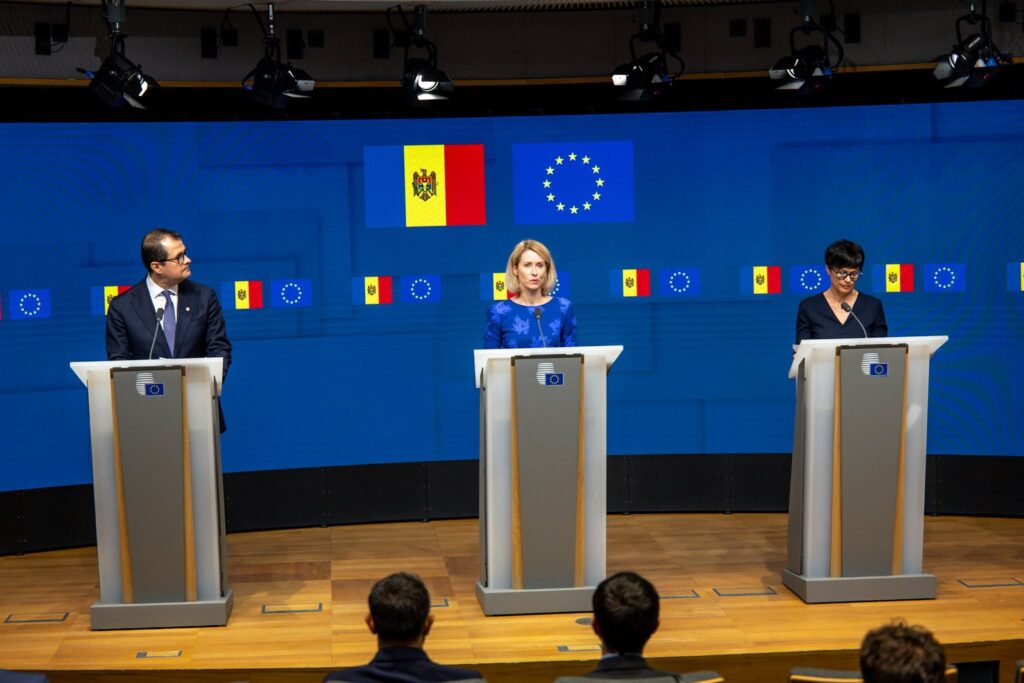
The EU released €157 million to Chișinău after the country completed 18 reforms. Prime Minister Vasile Tofan said the money would help fund roads, schools and hospitals, but stressed that Moldova must do its part to turn EU support into better services.
The Commission announced the payment at the 10th EU–Moldova Association Council in Brussels, bringing total funding under the Growth Plan to €661 million. Enlargement Commissioner Marta Kos also raised the prospect of opening the next stage of membership talks as early as next week.
We are not asking for lower standards or shortcuts. — Vasile Tofan, Moldovan Prime Minister
“It’s a historic mission of our whole generation. Such opportunities are rare,” Mr Tofan said of bringing Moldova into the EU. “Moldova’s European path is irreversible,” EU foreign policy chief Kaja Kallas added. But she stressed that the country must sustain its reforms as it moves towards membership.
From European funding to projects at home
Mr Tofan said the new payment would increase Moldova’s capacity to invest in transport, energy, water, health and education. He also acknowledged that receiving funding was only part of the job.
“Brussels cannot make our institutions work better,” he said. “It cannot implement the projects instead of ourselves. It cannot simplify our procedures.” The €1.9 billion Growth Plan for 2025–27 is the largest EU financial support package since Moldova’s independence. It combines grants and loans to support economic development and prepare the country for membership.
Further payments depend on Moldova completing agreed reforms. Enlargement Commissioner Kos urged the government to turn that progress into visible improvements: modern roads, investment in schools and jobs that allow young Moldovans to build their future at home.
Talks could take another step next week
The financial support comes as Moldova seeks to accelerate negotiations to join the EU. Ms Kos said talks on two more groups of policy areas could open next week, with the aim of starting negotiations on all remaining areas before the end of the year.
“Yes, it is possible that we would open the next two clusters for Moldova and Ukraine next week,” she said. These are groups of subjects on which candidates must bring their laws and institutions into line with EU requirements. Ms Kos linked the possible advance to legislation on minorities passing Ukraine’s parliament and further action by EU governments.
Mr Tofan said Moldova wanted to complete the technical work needed to conclude negotiations by early 2028 and prepare for membership by 2030. “We are not asking for lower standards or shortcuts,” he said. “We believe in a predictable, merit-based process in which progress on reforms is followed by progress in negotiations.”
Moldova’s European path is irreversible. — Kaja Kallas, the EU’s High Representative for Foreign and Security Policy
Asked about possible restrictions on the rights of future EU members, he said his government would examine the Commission’s proposals before responding. “Our commitment is full membership indeed,” he added.
Winter bills remain an immediate test
Alongside the longer-term investment plans, Mr Tofan raised a more immediate concern: helping households afford energy this winter. Moldova had prepared to secure supplies, he said. As in EU countries, the harder task was keeping energy affordable.
Ms Kos said the Commission was discussing how to help Moldova with future energy imports. She announced no additional winter funding, leaving those discussions open as the government prepares its household support scheme.
“The harder issue this winter will be affordability,” he said, adding that his government’s responsibility was to protect the most vulnerable households from the energy price shock.
The Commission’s discussions with Chișinău have yet to produce a new winter support package.