EU finance ministers have agreed to deepen the bloc’s capital markets and give its financial markets watchdog greater supervisory powers, but stopped short of the European Commission’s ambitions for a more centralised system. The deal is part of a broader push to channel European savings into investment, cut barriers to cross-border financial activity and help European firms compete globally.
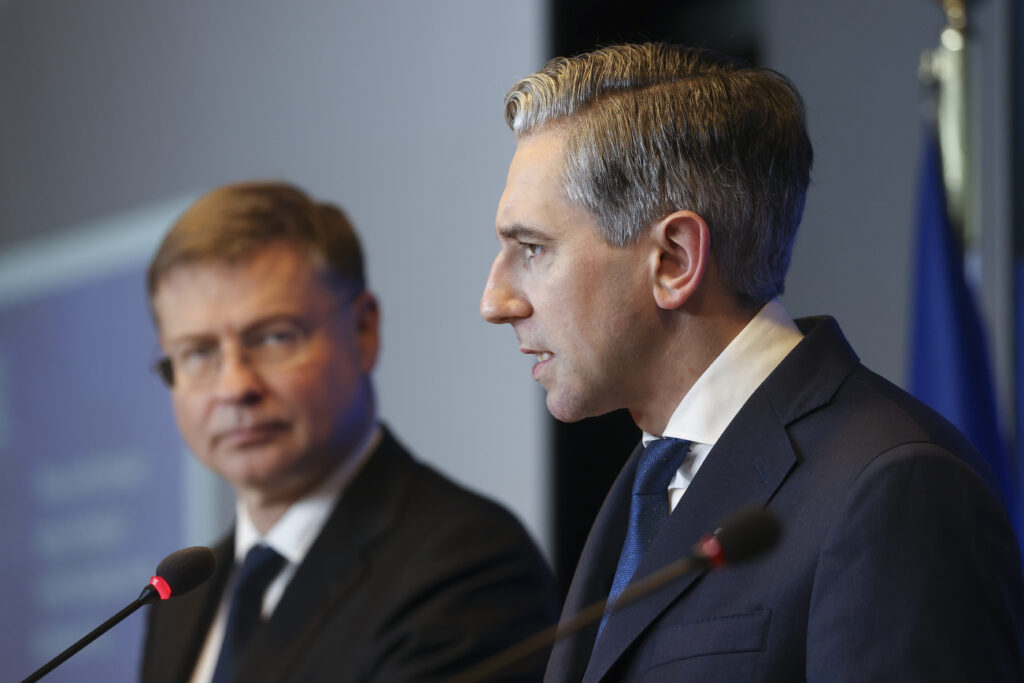
“Europe has the savings. Now it’s time to put them to work,” Irish Finance Minister Simon Harris said on Friday after a meeting of the EU Council.
Ministers agreed on the key elements of the Council’s negotiating position on the savings and investments union (SIU), a flagship initiative to strengthen EU capital markets and make it easier for private savings to finance businesses.
The agreement centres on a package of measures to integrate financial markets and reform supervision, reducing regulatory fragmentation and the costs faced by firms operating across borders.
“Today’s agreement is a major step forward for a deepened savings and investments union, with significant added value for the EU’s longer-term competitiveness,” Harris added.
The shadow of 2008
The push to strengthen Europe’s financial sector comes as the EU seeks to improve its competitiveness while preserving the safeguards introduced after the 2008 financial crisis.
The SIU aims to channel more European household savings into productive investment. The Council estimates that around €10 trillion in household savings remains in low-yield bank deposits rather than being invested in capital markets, limiting the funding available to businesses.
Alongside this initiative, the Commission has pursued measures to improve the competitiveness of European banks, including removing barriers that prevent them from operating more easily across national borders.
In July, the Commission set out plans to tackle persistent obstacles to cross-border lending, including differences between national markets and regulatory frameworks.
European banks should compete “on a level playing field with their international rivals” and support Europe’s long-term growth, innovation and strategic priorities, Commissioner for Economy Valdis Dombrovskis said at a press conference after Friday’s meeting.
Competitiveness can be achieved while obviously preserving at all times the resilience of the banking sector and maintaining financial stability.
— Simon Harris, Finance Minister of Ireland
But efforts to make the financial sector more competitive have raised concerns that simplifying rules could weaken safeguards. Harris stressed that cutting red tape should not mean deregulation.
“Proposals to enhance banking competitiveness are in no way a return to light-touch regulation, you know, the scars of which we’ve all lived through,” he said, referring to the lessons of the 2008 financial crisis.
“Competitiveness can be achieved while obviously preserving at all times the resilience of the banking sector and maintaining financial stability,” he added.
Three laws, one goal
The SIU agreement centres on the market integration and supervision package (MISP), which consists of three legislative proposals designed to reduce fragmentation across European capital markets.
A key element is strengthening the European Securities and Markets Authority (ESMA), the EU’s financial markets watchdog.
Under the Council’s position, ESMA would directly supervise the most significant cross-border trading venues and key post-trading infrastructure, including central securities depositories and central counterparties. These responsibilities currently lie with national authorities. The aim is to make supervision more consistent across the bloc, reduce compliance costs and make it easier for financial firms to operate across borders.
The Council has nevertheless narrowed the criteria determining which market operators would fall under ESMA’s direct supervision. It also wants the European Commission to review the criteria for trading venues after two years.
The agreement retains a proposed framework for pan-European market operators, which would allow eligible trading venues to operate across the EU under a single licence and voluntary direct supervision by ESMA.
A hard-won compromise with limited ambition?
The Council has also limited the Commission’s original plans for EU-level oversight of crypto-asset service providers. Only the most significant cross-border providers would immediately fall under ESMA’s supervision, rather than all such firms.
The governance reforms would establish a new full-time executive board at ESMA, consisting of a chair and five independent members. The board would manage the authority’s operations and make decisions concerning firms under its direct supervision.
National authorities would retain an important role through ESMA’s existing board of supervisors, which would remain responsible for regulatory decisions, strategy, budget and supervisory convergence.
The transfer of supervisory tasks would take place over a two-year transition period, with EU and national experts working together to ensure continuity.
The package also seeks to simplify cross-border asset management. It would introduce a new depositary passport, allowing investment funds to appoint a depositary in another member state, although countries would be able to choose whether to apply the regime.
Separately, the Council wants to expand the EU’s existing regulatory sandbox for distributed ledger technology, allowing a broader range of financial activities to be tested under controlled conditions.
Hopes for more
The agreement reflects divisions among member states over how far financial market supervision should shift from national authorities to the EU level.
Countries including Germany, France, Italy, Spain, the Netherlands and Poland have called for ESMA to become a “true European supervisor”. Smaller financial centres, including Ireland and Luxembourg, have traditionally been more cautious about transferring supervisory powers to an EU authority.
German Finance Minister Lars Klingbeil and French Finance Minister Roland Lescure both welcomed the agreement as a compromise that takes those differences into consideration.
The Commission, however, had hoped for a more ambitious outcome. “From the Commission side, we would have wished for a more ambitious outcome,” Dombrovskis said. “But while there is still some way to go, today’s agreement is an important step in the negotiations.”
The agreement therefore advances the EU’s effort to create a more integrated financial market, while leaving member states with considerable influence over how supervision is organised.
The Council will now finalise its negotiating position ahead of formal adoption. Talks with the European Parliament can begin once lawmakers have agreed on their own position.
The EU institutions aim to advance the wider market-integration agenda under the “One Europe, One Market” initiative, with the goal of reaching an agreement on the package in line with the roadmap’s deadlines.
“More progress has been made now in the last ten months on deepening capital markets in the European Union than has been made in the last decade,” Harris said.