As US drug pricing policy raises concerns over Europe’s access to new medicines, lawmakers are urging member states to pool their bargaining power. The biotech industry, however, sees the pressure from Washington as a short-term shock and wants Europe to focus on its own competitiveness.
On Thursday, the European Parliament’s Committee on Public Health (SANT) voted on two questions for oral answer on US pharmaceutical policy. One goes to the European Commission, the other to the Council of the EU.
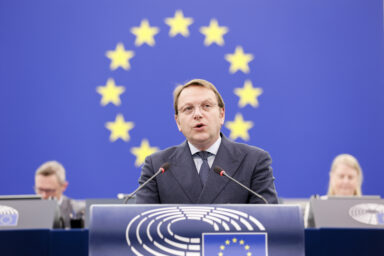
Stine Bosse (Renew/DNK) sponsors both. She admitted the EU executive has limited power here. “It is a pity the Commission cannot lead on this issue. Pricing and reimbursement belongs to member states. But indeed, that makes this a catalyst for change,” she said. “Postponing action and waiting for the effects of the US administration policies to become even more devastating is not what citizens expect from us,” she added.
It is a pity the Commission cannot lead on this issue. — MEP Stine Bosse Renew/DNK)
EuropaBio, the biotech industry group, takes a longer view. On 12 October, it told EU Perspectives that US investment announcements “haven’t necessarily broken ground anywhere”. Its message was that the current pressure is a short-term geopolitical shock, while biotech and healthcare are long-term games.
Fewer new medicines reach Europe
The questions name three US measures: the most favoured nation (MFN) pricing policy, new US tariffs and incentives to pull drug production to the US, and a Section 301 investigation into Germany’s pharmaceutical pricing.
Under MFN, lower European prices could affect US reference prices, the committee’s text says. “When a European drug price can pull down an American price, companies will delay launching in Europe. It is already happening,” Ms Bosse said.
New medicine launches across Europe fell by 35 per cent in the ten months after MFN started, according to the committee’s text. Smaller, lower-priced member states face the biggest risk. “Today it is Germany. Tomorrow it could be any of us,” Ms Bosse noted.
Parliament asks countries to pool their power
The question to the Commission focuses on how the EU executive assessed the impact of US pricing and trade policy on patients, health systems and industry. It also asks what steps the Commission will take “beyond the proposed European Biotech Act and the recently agreed Critical Medicines Act”.
We are 450 million people. Divided, we accept others’ terms. But united, we set the terms. — MEP Stine Bosse Renew/DNK
The text addressed to the Council goes further. It asks whether member states will use “their combined purchasing power” to secure access and more sustainable prices.
It points to existing groups such as BeNeLuxA and the Nordic Pharmaceutical Forum, and asks whether parts of their work could be applied across the EU. “We are 450 million people. Divided, we accept others’ terms. But united, we set the terms,” Bosse said.
Industry: urgent on the Biotech Act, calm on Washington
EuropaBio’s members took a long view when they discussed the US measures, said Claire Skentelberry, Director General, EuropaBio. “These are short-term geopolitical shocks,” she said. “Biotech and healthcare is a really long-term game.”
Vlad Olteanu, Healthcare Public Affairs Director at EuropaBio gave similar advice. “We need to let it go. Watch it carefully, of course, but focus on ourselves,” he said.
EuropaBio’s urgent call is for the Biotech Act. “We need to press ahead as rapidly as possible with the Biotech Act,” said Hugh Pullen of Novartis, who chairs EuropaBio’s Healthcare Biotechnology Council.
These are short-term geopolitical shocks. Biotech and healthcare is a really long-term game. — Claire Skentelberry, Director General, EuropaBio
Its main ask is 12 extra months of supplementary protection certificate (SPC) protection, a form of extended patent protection. “If we end up with less than 12 months, then I think that will be problematic,” Mr Pullen said.
EuropaBio also wants faster clinical trial approvals. Europe’s share of global trial starts fell from about 22 per cent to 12–13 per cent over a decade, Mr Pullen stressed. Trial approval now takes 116 days. The Biotech Act targets 75. China approves orphan drug trials in 30 days. Patients already wait “nearly 600 days, I think 597 days” on average between approval and access, Mr Pullen said.
Both sides name joint clinical assessments (JCA) under EU health technology assessment rules. The SANT text calls for streamlining them. Pullen warned they risk adding “another layer of bureaucracy on top of everything that we already have.”
Germany: A US probe and a rebate law
The US Trade Representative opened the Section 301 investigation into Germany on 18 June 2026, according to the committee’s text.
Germany also came up at the EuropaBio briefing. Mr Pullen named Germany’s statutory health insurance stabilisation law, which he said “imposed a very significant additional mandatory rebate”. “Things like that factor into decisions around investments as well,” he said.
Ms Bosse will present the questions in plenary if the Conference of Presidents puts them on the agenda. The questions lapse on 6 January 2027.
Before that, the pharma package returns to SANT. The committee votes its recommendation for second reading on 10 November.