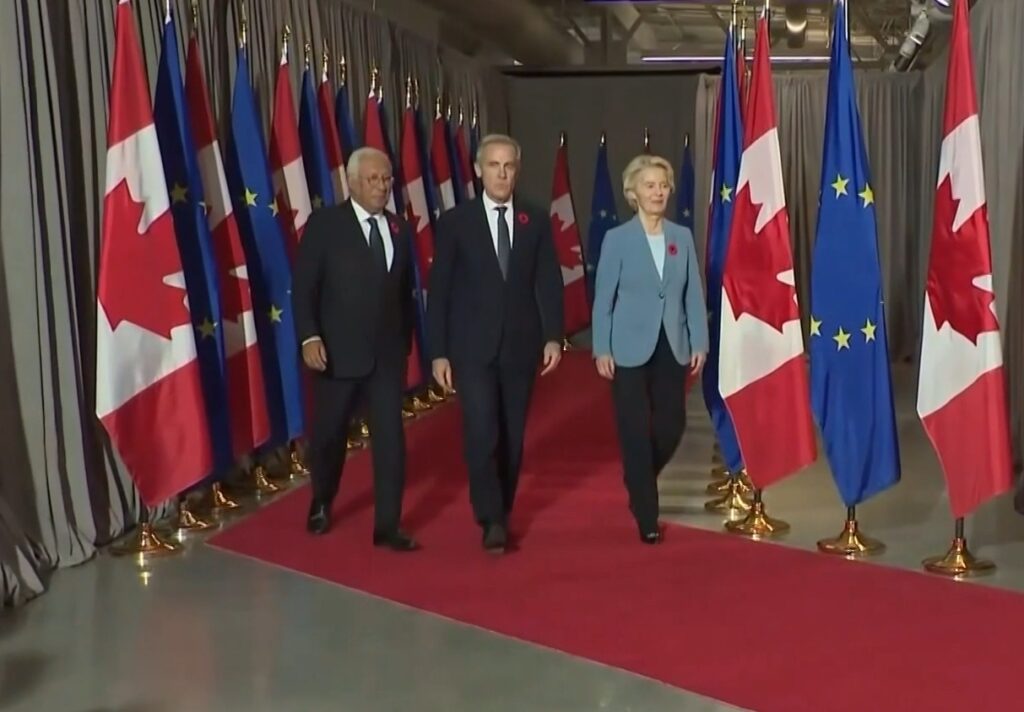
What ‘associate membership’ means is still unclear, even to those promoting it. Ursula von der Leyen and António Costa appeared not to be on the same page on Friday.
The labelling uncertainty over Canada’s associate EU membership just won’t go away. Canadian PM Mark Carney repeated the term three times at the Friday press conference after the EU-Canada summit in Montreal. “With Canada becoming the European Union’s first associate member, in the coming months, we will determine the full substance, scale and scope of this new form of membership,” he said.
Ursula von der Leyen, the Commission president, acknowledged how thin the ice is: “Yes, the concept of an associate member is uncharted territory, but we have the ambition, trust and creativity to shape it together.”
Before the leaders took the floor, European Commissioners Henna Virkkunen, Andrius Kubilius, and Maroš Šefčovič signed five agreements with Canada on behalf of the European Commission. (The latter must have experienced a pleasant surprise at the hosts’ correct pronunciation of his name — something most of his Brussels colleagues, supporters, foes and bystanders alike steadfastly deny him.)
The agreements cover the following areas: the treaty framework with the EIB establishes a legal framework for cooperation between the European Investment Bank (EIB) and Canada. The cooperation is to facilitate funding and investment projects that support sustainable development and economic growth.
A digital flurry
The initiative European High-Performance Computing Joint Undertaking (EuroHPC JU) aims to enhance Europe’s capacity in high-performance computing. It should do so by fostering collaboration between the EU and Canada in research and development of supercomputing technologies.
The IRIS2 Cooperation – Administrative Agreement outlines the framework for administrative cooperation between the EU and Canada in the IRIS2 satellite-based communication initiative. The main goal is to enhance connectivity and data exchange.
The EU Galileo Program Letter of Intent expresses the intention of both parties to collaborate on the Galileo satellite navigation program. This should encourage the development of global navigation satellite systems and their applications for various sectors.
The Document for conclusion of the Digital Trade Agreement (DTA) signals the successful conclusion of negotiations for a Digital Trade Agreement. Is it designed to promote trade in digital goods and services between the EU and Canada.
A name for a new club
The summit was about more than labels. Mr Carney opened with a declaration of intent. “Today, the European Union and Canada are launching the alliance for the Future,” he said. He described it as a partnership of like-minded nations, built on variable geometry.
Ms von der Leyen tackled the membership puzzle head on. “Our idea is simple. It is an association without accession because the treaties are clear and don’t allow it,” she said. The treaties bar any country outside Europe from joining the Union. The phrase is an attempt to turn a legal barrier into a selling point.
With Canada becoming the European Union’s first associate member, in the coming months, we will determine the full substance, scale and scope of this new form of membership – Mark Carney, Canada’s prime minister
She then raised the ambition. “We can build a sharp partnership that comes closer to membership than anything we’ve done before,” she said. She also admitted that full membership is impossible. She cited broad support among member states and a vast majority in the European Parliament.
Ambition without a blueprint
Details of the association remain scarce. Ms von der Leyen said it rests on three pillars. The first is policies, meaning closer alignment on matters from climate and energy to AI and security. Consultation would run from inception to implementation.
The second pillar is programmes. Canada would take fuller part in Horizon Europe and Erasmus+. It would build on its role in SAFE, the EU’s defence programme. The third is governance, where parliament-to-parliament, court-to-court, and business-to-business links are all possible.
The timetable is firmer than the substance. A joint meeting of the College of Commissioners and the Canadian cabinet is planned in Canada this spring, in March according to Mr Carney. He will then attend the European Council in June. He hopes to conclude the discussions there.
The wording gap is visible in the speeches. Mr Carney and Ms von der Leyen said associate member. Costa preferred ever closer association, the phrase the capitals accepted, and said the 27 member states approved the joint declaration. Asked by a Polish broadcaster about German pushback, neither leader addressed Germany directly.
Skies, soldiers, and fires
Space cooperation took the form of an administrative arrangement between the Commission and the Canadian Space Agency on secure space connectivity. Mélanie Joly and Mr Kubilius signed it. Mr Carney said Canada is starting negotiations to join Galileo. Work may extend to IRIS² and a possible direct transatlantic data cable.
Defence has a first commercial result. Canada’s participation in SAFE advanced, including a contract worth more than C$44m for Montreal-based Galvion to supply military helmets to Latvia. The summit also backed closer defence-industrial cooperation and continued assistance to Ukraine.
Our idea is simple. It is an association without accession because the treaties are clear and don’t allow it. — Ursula von der Leyen, European Commission president
Wildfires produced the most tangible headline. Canada and the EU plan to buy 50 water bombers jointly, with delivery expected by 2030. Canada also announced up to C$2.5bn in financing to expand production. On energy, the sides will assess what infrastructure and market conditions more Canadian LNG exports to Europe would need.
The summit thus produced a framework, not a treaty. The most concrete outcomes—the digital-trade conclusion, the EIB framework, defence-industrial measures, and the wildfire-aircraft initiative—sit beside items that remain negotiations or implementation work.