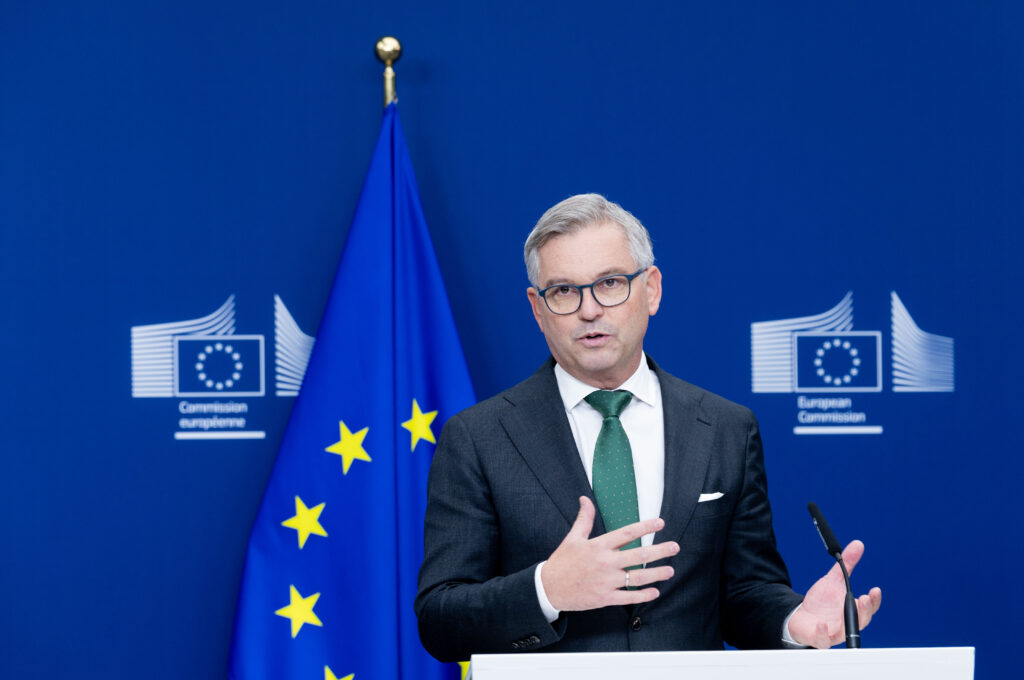
The EU’s approach to irregular migration over the past year “is yielding the hoped-for results”. Presenting an overview of the bloc’s migration and asylum situation, European Commissioner for Migration Magnus Brunner outlined which countries are eligible for migration solidarity and which may qualify for reduced contributions to the scheme.
“Our reforms are working. Irregular migration is on the decline, as are asylum applications. Unauthorised movements within the EU have also decreased, while the number of returns is rising,” Brunner told journalists.
The findings are set out in the European Commission’s 2026 Annual Asylum and Migration Report. The document examines the EU’s migration management cycle and the implementation of the Pact on Migration and Asylum.
According to the Commissioner, irregular migration to the EU has fallen by 55% over the past two years, with a further decline of around one third this year. Arrivals along the Western Balkans route have declined by 95% since 2022. Similarly, the Western African and Central Mediterranean routes have dropped by 80% in the last few years.
“Irregular migration is on the decline, as are asylum applications.”
— Magnus Brunner, European Commissioner for Migration
However, the overall improvement does not mean that all member states face the same challenges. The Commission has identified four countries under migratory pressure. Others are considered at risk or face the cumulative effects of migration over several years.
The assessment will determine which countries can benefit from the EU’s 2027 Solidarity Pool and which may request reductions in their contributions.
Who is under migratory pressure?
Greece, Spain and Cyprus are considered under migratory pressure due to the disproportionate number of arrivals over the past year. Italy has also been included in this category, primarily because of the high number of people arriving following search and rescue operations at sea.
These four countries will therefore be eligible to receive support through the Solidarity Pool.
The Commission also identified 15 countries at risk of migratory pressure. These are Belgium, Czechia, Germany, Estonia, Ireland, France, Croatia, Latvia, Lithuania, Luxembourg, the Netherlands, Poland, Romania, Slovenia and Finland.
“Under the new rules, no Member State is left alone to deal with illegal migration.”
— Magnus Brunner, European Commissioner for Migration
Their situation may be linked to relatively high numbers of irregular arrivals, unauthorised movements within the EU, asylum applications or beneficiaries of temporary protection. The risk of migration being instrumentalised, potentially creating disproportionate obligations in the coming year, is another factor.
These countries will have priority access to the Permanent EU Migration Support Toolbox, with their situations subject to further monitoring and reassessment if necessary.
Who can request a reduction in their contributions?
A separate category covers countries facing a significant migratory situation due to the cumulative effects of migration over the past five years.
This group includes Bulgaria, Czechia, Estonia, Croatia, Austria and Poland. The assessment takes into account factors such as sustained high numbers of beneficiaries of temporary protection and asylum applications, pressure on return systems and responsibilities related to protecting the EU’s external borders.
These six countries may request a full or partial deduction from their contributions to the 2027 Solidarity Pool.
This means that Poland, which was granted an exemption from contributions in the previous cycle, could once again benefit from a reduction. However, the decision is not automatic and will depend on the Council’s assessment.
How will the Solidarity Pool work?
The Solidarity Pool is designed to distribute responsibility for managing migration more evenly across the EU. With that, it aims to ensure that countries facing disproportionate pressure receive support from other member states.
Under the mechanism, all member states are required to contribute, but they can choose how they provide their solidarity.
Options include relocating asylum applicants from countries under pressure, providing financial support, offering alternative measures such as staff and in-kind assistance, or using so-called responsibility offsets. Under the latter arrangement, another member state takes responsibility for certain asylum applications that would otherwise be handled by the country receiving support.
The Commission has already proposed the second Solidarity Pool, covering 2027. However, its proposal is not public, in line with the rules of the Pact on Migration and Asylum.
It will now be up to the Council to agree on the size of the Pool and the contributions expected from each member state. Once adopted, national commitments will become public and legally binding.