European leaders want a say in Ukraine’s future and the shape of continent’s security, but cannot agree on who should speak for them. They tried to find common ground in Dublin. As the Commission prepares a 22nd sanctions package against Russia, they insist Kyiv must remain strong enough to resist a peace dictated by Moscow.
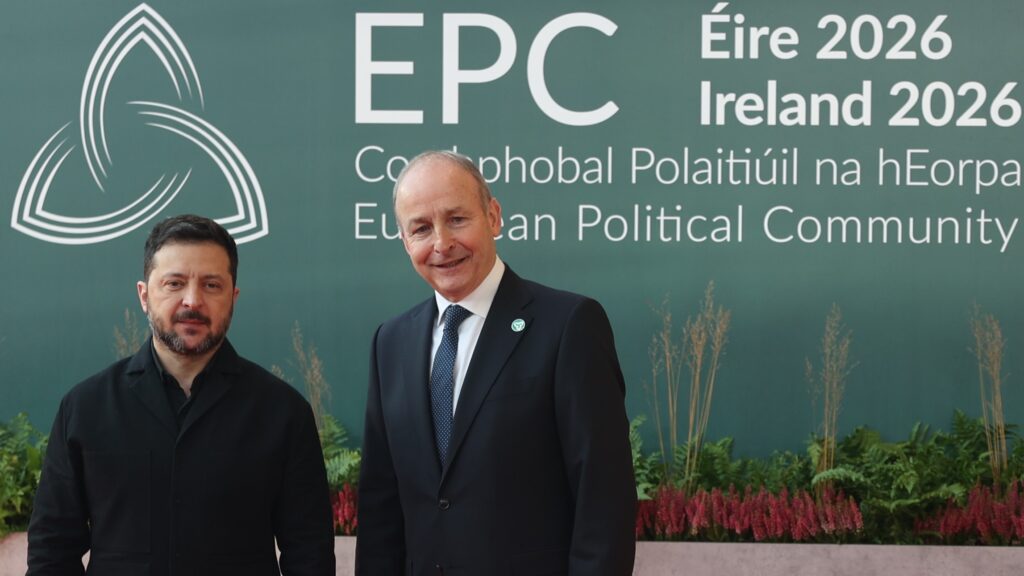
Europe does not want to stand on the sidelines while decisions about its own security are being made. That was one of the main messages from Thursday’s European Political Community (EPC) summit in Dublin. The meeting followed two days of talks between Ukraine, Russia and the United States in Abu Dhabi. They ended with an agreement on a prisoner-of-war exchange, but territorial issues remain unresolved.
Amid broader efforts to strengthen alliances beyond Washington, summit host Irish Prime Minister—or Taoiseach—Micheál Martin also highlighted closer ties between Europe and Canada. He warmly welcomed Canadian Prime Minister Mark Carney as a guest of honor and noting that the former Bank of England governor is no stranger to Europe and “never left”.
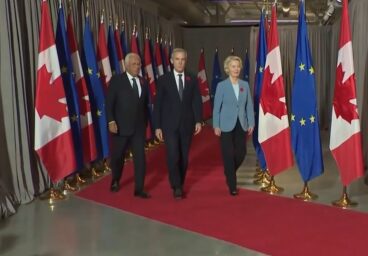
European representatives also took part in the Abu Dhabi talks. But they were not at the trilateral negotiating table. Instead, they held separate discussions with US and Ukrainian officials. After meeting Ukrainian President Volodymyr Zelenskyy in Dublin, European Council President António Costa and Commission President Ursula von der Leyen stressed that the EU had been involved. They said it intended to remain part of the process.
You might be interested
A face for Europe’s voice
Mr Zelenskyy reiterated in Dublin that Europe must take part in future talks. The outcome, he argued, will affect not only Ukraine’s future but the security of every European country.
“When the Americans and Russians talk about this, it’s not just about security guarantees for Ukraine. It’s more about some kind of new security framework between Europe and Russia, and we find this approach a bit strange,” Mr Zelenskyy said. He questioned why Washington and Moscow should discuss Europe’s security without Europe having a direct voice.
Europe’s security cannot be discussed without a European voice at the table. That European voice needs to be a team effort between European nations, the EU and NATO. — António Costa, European Council President
Mr Costa struck a similar note. „ Europe’s security cannot be discussed without a European voice at the table. That European voice needs to be a team effort between European nations, the EU and NATO,“ he said. He also stressed that Ukraine’s security cannot be separated from that of the rest of the continent.
The search for a European envoy
Most leaders agree that Europe needs a voice of its own. They are far less certain about who should speak for it, or what mandate that person should have.
The debate over a possible European negotiator has been running for weeks. In October, five names emerged: Czech President Petr Pavel, Finnish President Alexander Stubb, Danish Prime Minister Mette Frederiksen, Italian Prime Minister Giorgia Meloni and Norwegian Prime Minister Jonas Gahr Støre.
Some have already distanced themselves from the prospect. Mr Pavel said he had no ambition to become Europe’s negotiator, although he was willing to draw on his experience in NATO. Ms Frederiksen has also made clear that she does not want the role.
Ms Meloni, by contrast, is among the strongest advocates of a common European presence. She argues that Europe loses influence when individual countries and their leaders deal with Moscow separately. But she has said she is not seeking a place at the negotiating table for herself or Italy.
Czech Prime Minister Andrej Babiš also floated several names in Dublin. Alongside Ms Meloni and Ms Frederiksen, he said he could imagine Polish Prime Minister Donald Tusk or Britain’s Andy Burnham taking on the role.
The name matters less than the message
Ms Frederiksen, for one, believes the substance matters more than the identity of the person representing Europe. „For me, the substance is the most important thing,“ she said. „Helping Ukraine is the most important task, and then we will figure out who will represent Europe.“
French President Emmanuel Macron made a similar argument. Europe must first agree on its goals, he said, before deciding who should represent it and in what format. „Content determines the format,“ he said.
Estonian Prime Minister Kristen Michal proposed a solution rooted in the EU’s institutions. He suggested that European Council President António Costa and EU foreign policy chief Kaja Kallas should represent Europe. They would need a clear mandate, rather than a role that changes with every meeting.
Lithuanian President Gitanas Nausėda voiced a similar concern. Constantly changing Europe’s representatives would send Moscow the wrong signal, he argued. „If the other side, and I mean Russia, will see constantly changing faces representing Europe, I don’t think it will lead to a better result.“
European Parliament President Roberta Metsola stressed that a united and consistent European voice mattered more than any individual name.
Europe’s security cannot be decided over its head
Choosing a European negotiator is not the only challenge facing the leaders. More important still is the position that person would be expected to defend. Mr Costa set out three principles that should underpin any future agreement. Ukraine must be free to choose its own partners, allies and future. Europe’s security cannot be discussed without European involvement. Any new arrangement must respect existing international rules, above all the 1975 Helsinki Final Act.
If the other side, and I mean Russia, will see constantly changing faces representing Europe, I don’t think it will lead to a better result. — Gitanas Nausėda, Lithuanian President
The act affirms, among other principles, the sovereign equality of states, territorial integrity and the inviolability of borders. For Mr Costa, these rules rule out a return to a Europe divided into spheres of influence by great powers. „The time of zones of influence in Europe has long gone,“ the European Council president said.
Yet the question of who gets to shape the continent’s security remains a source of tension with Moscow. Russia has long demanded limits on NATO’s influence and changes to Europe’s security architecture.
Some European leaders warn that wider discussions about the continent’s future must not distract from the war itself. Mr Michal described that risk as a trap. „Russia wants Europe to be talking about European security architecture and so many things. (…) But not about the main topic, which is helping Ukraine and pushing back Russia.“
The Estonian prime minister warned Europe against being drawn into a debate that could ultimately serve Russia’s interests. The priority, he argued, must be helping Ukraine defend itself and push back Russian aggression. Only then can Europe turn to the shape of a lasting security order.
Kyiv must negotiate from a position of strength
Europe’s search for a common position does not mean it can put military support for Ukraine on the back burner. Quite the opposite. The country’s ability to keep defending itself will be crucial to the outcome of any future peace talks, the leaders agreed.
In Dublin, Mr Zelenskyy called for more air defence. Ukraine also needs equipment to repair its energy infrastructure. Alongside military support, the Commission is promising practical help to get Ukraine through another winter of war.
It is mobilising 500 generators from its rescEU reserves, helping set up emergency support centres and supporting the delivery of four floating bridges from Norway and 200 buses. Mr Costa and Ms von der Leyen said their teams were working with Ukrainian authorities to ensure the aid reaches those who need it.
We need to make sure that Ukraine can get through winter and is as strong as possible in the negotiations with Russia. It all depends now on the Russians whether they are willing to play ball. — Mark Rutte, NATO Secretary General
Ms Frederiksen highlighted another essential part of modern defence: satellite capabilities. „Ukraine and Europe, we are simply not able to protect our citizens and Europe without these satellites,“ she said. „It is part of our deterrence when it comes to Russia.“
Keeping Ukraine strong through winter
NATO Secretary General Mark Rutte stressed that Ukraine must get through the winter and enter future negotiations from the strongest possible position. „We need to make sure that Ukraine can get through winter and is as strong as possible in the negotiations with Russia.“
According to Mr Rutte, the US, Europe and Ukraine are aligned on the main objectives. But the outcome will also depend on whether Russia is genuinely willing to negotiate. „It all depends now on the Russians whether they are willing to play ball.“
The European Commission is preparing further steps. Soon it will present its 22nd package of sanctions against Russia. It is also preparing a proposal to meet Ukraine’s financing needs for 2027. EU leaders will discuss it at their next European Council meeting on 26–27 November.
Mr Rutte also confirmed that US military equipment continues to reach Ukraine through the PURL mechanism. It allows European allies to fund purchases of American weapons and technology for Kyiv. Air defence remains among the priorities.
Russia’s reach goes beyond NATO’s eastern flank
Mr Rutte warned that Russian aggression and its consequences affect more than the countries bordering Russia. Moscow is deepening its cooperation with Iran, China and North Korea, he said. European countries and Canada must therefore invest not only in new weapons, but also in defence industry and the ability to withstand hybrid attacks.
These can take the form of cyber operations, arson attacks or sabotage targeting critical infrastructure. Resilience cannot be the responsibility of governments alone, the NATO chief argued. Businesses and wider society must also be prepared. „It’s not just the governments, it’s the whole of society,“ Rutte said.
To explain why the threat should not feel remote to western European countries, he offered a striking comparison. Russian missiles, he said, would take just five minutes longer to reach Dublin, Amsterdam, Madrid or Rome than Tallinn or Vilnius.
NATO needs more weapons systems, greater production capacity and faster defence build-up, Rutte argued. European allies and Canada have already increased their spending significantly. But money alone will not be enough unless it translates into equipment that can actually be deployed.
Europe’s wider agenda
Alongside Ukraine and defence, leaders in Dublin discussed economic security, energy, strategic raw materials and links between European infrastructure. They also addressed EU enlargement and relations with the bloc’s neighbours. The presence of Canadian Prime Minister Mark Carney underlined efforts to deepen cooperation with Canada on trade, energy and security.
Competitiveness and artificial intelligence also remain high on the agenda. EU leaders are expected to discuss these issues in greater detail at Friday’s informal summit.
The Dublin meeting covered a wide range of issues. But one message stood above the rest: Europe wants a say in decisions about its future. To make that happen, it must first agree on what it wants to say. Then it needs someone who can say it on behalf of all.