Europe’s car industry is struggling to keep factories busy and jobs afloat. Steering company-car incentives towards electric vehicles made in Europe could help turn the tide, supporting up to 344,000 jobs by 2030, a new study estimates.
The Fraunhofer ISI study, commissioned by Transport & Environment and published alongside its briefing on Wednesday, examines how company-car policy could stimulate vehicle assembly and battery production. “Company cars are the quickest way to turn Europe’s EV transition into European jobs,” said Sofie Grande y Rodriguez, T&E’s clean fleets policy manager.
The incentive matters more than the target
The proposed Clean Corporate Vehicles Regulation would set national targets for zero- and low-emission vehicles among large companies’ new registrations from 2030. Corporate buyers account for around 60% of new passenger-car registrations, giving their purchasing decisions considerable influence over what manufacturers produce. The proposal remains under negotiation.
Fraunhofer’s central finding is that the minimum targets alone would add relatively little to electrification already expected under its baseline. The larger industrial opportunity comes from combining financial incentives with production requirements. From 2028, the Commission proposes limiting company-car support to qualifying zero- and low-emission vehicles made in Europe, with the Industrial Accelerator Act defining requirements for assembly and key components.
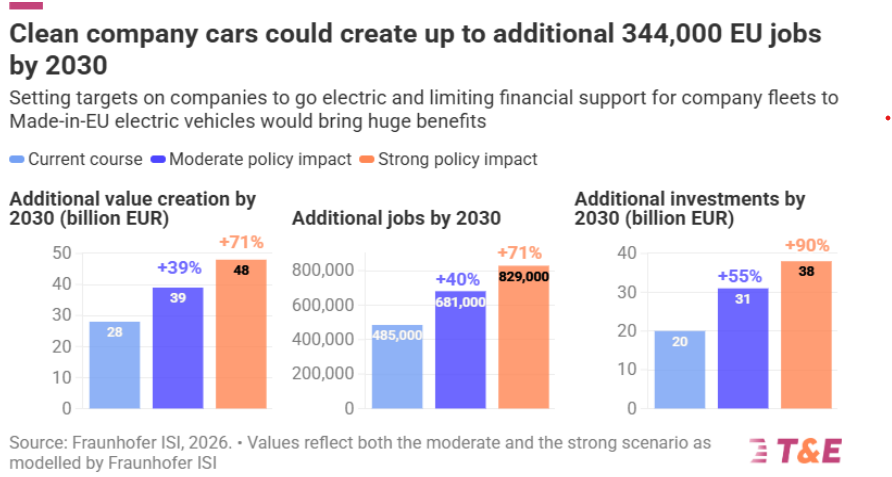
Under the study’s moderate scenario, the combined measures support around 196,000 additional full-time-equivalent jobs by 2030. The stronger scenario reaches 344,000, alongside approximately €20 billion in additional annual value creation and €18 billion in extra investment over 2026–30. Germany and Poland capture the largest employment gains in T&E’s country breakdown. These are modelled outcomes compared with a baseline, rather than announced hiring or investment commitments.
The policy would also affect buyers beyond company fleets. As EU Perspectives previously reported, company cars enter the secondhand market relatively quickly, potentially expanding access to used electric vehicles. That earlier parliamentary debate also exposed concerns about business costs and uneven charging infrastructure.
More European production does not guarantee a jobs recovery
The findings arrive amid competing approaches to protecting automotive employment. In their 16 October joint statement, France and Germany backed incentives for European production alongside greater regulatory flexibility. Carmakers’ association ACEA has questioned the fleet proposal’s reliance on mandates. In March, it warned that additional industrial requirements could push up vehicle prices and shrink the market.
That concern highlights an important assumption in the modelling: the total company-car market does not shrink because of the measures. The study also assumes the rules work without avoidance through alternative registration or purchasing arrangements. Its employment figures include manufacturing jobs, supply-chain jobs and employment supported by workers’ spending. They exclude losses in combustion-engine production and developments in private-car sales, vans, trucks and exports.
Company cars are the quickest way to turn Europe’s EV transition into European jobs.
— Sofie Grande y Rodriguez, T&E’s clean fleets policy manager
The geographical definition also matters. For this study, “Made-in-EU” includes the EU, the UK and EFTA countries. The figures therefore concern a wider European production area, not exclusively employment within the bloc. Production location matters more than ownership: a factory operated by a non-European company can contribute to local manufacturing and employment.
Finally, bringing selected production stages to Europe would not eliminate dependence on imported components. Manufacturers are assumed to meet the requirements through the least additional localisation necessary. Fraunhofer concludes that “full value chain sovereignty and resilience seems unlikely”. The study makes a case for using company-car demand to sustain European production, while leaving a harder question unresolved: how much of the wider automotive industry’s employment decline those gains could offset.