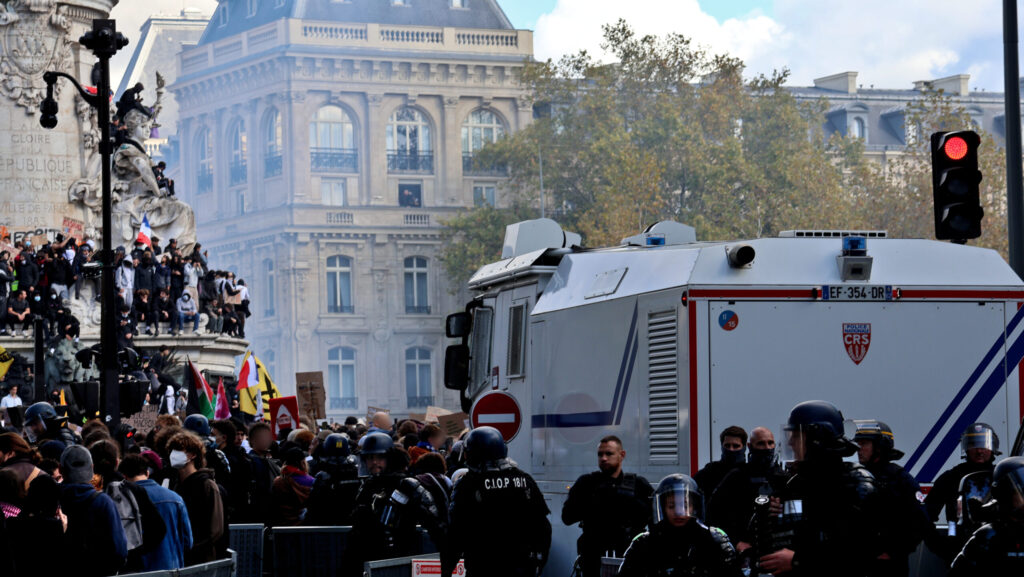
After last weekend’s violence, France is bracing for another round of Saturday demonstrations. More police will be deployed and fewer marches allowed. Unions warn that restoring order must come hand in hand with answers on wages, living costs and public services.
Nearly 400 events had been announced nationwide by Thursday. Plans extend beyond city-centre marches to roundabout gatherings, slow-moving road protests and possible actions near petrol stations and fuel depots. The announcements indicate continued mobilisation, although they do not establish how many people will participate.
More police, fewer permitted marches
President Emmanuel Macron announced tighter restrictions on Thursday after meeting intelligence officials. Only union-organised demonstrations would be considered, potentially on alternative routes designed to protect shops and public buildings. Authorities would seek to ban other gatherings. “This is not the time. We want a return to calm,” the president said, according to Le Parisien.
The government is also preparing a larger police deployment. La Dépêche reported that nearly 80,000 police officers and gendarmes could be mobilised, compared with 60,000 last Saturday. Specialist intervention units, armoured vehicles, water cannon and helicopters could support operations in sensitive areas.
Soldiers from Operation Sentinelle would protect selected buildings, allowing police to concentrate on public order. These were reported preparations ahead of the demonstrations, rather than a final deployment tally.
Restrictions are already affecting the weekend’s cultural programme. Art Basel Paris confirmed that its fair at the Grand Palais would close on Saturday and Sunday, ending its public programme on Friday evening.
Organisers said visitors’, exhibitors’ and staff safety, alongside the protection of artworks, remained their highest priorities. Reuters also reported planned closures at museums and other cultural venues as businesses prepared for possible further disorder.
The distinction between union-organised demonstrations and other gatherings has drawn political criticism. Government spokesperson Maud Bregeon said bans would be decided individually and could be challenged in administrative courts. Éric Coquerel, the France Unbowed lawmaker chairing the National Assembly’s finance committee, warned in a post on X that the approach could produce more fragmented gatherings and make policing harder.
Grievances have not disappeared
The renewed mobilisation brings together overlapping demands. Student organisations continue to protest teaching shortages and deteriorating educational facilities, while Yellow Vest activists focus on fuel prices and household purchasing power. Reuters reported that UNEF and Yellow Vest organisers intended to proceed with rallies despite the tighter restrictions.
We want a return to calm. — Emmanuel Macron, French President
A Yellow Vest mobilisation website is promoting Saturday as “Act II” and distributing graphics for supporters to share online. “We will not be made to go home,” its appeal says, translated from French.
The campaign links living costs and public services with demands for political change and criticism of police conduct. Its map and publicity material demonstrate organising activity, but its participation claims are the campaign’s own estimates.
The CGT, one of France’s largest trade union confederations, has called for peaceful demonstrations and is preparing for a broader strike alongside other unions on 5 November. With hundreds of actions announced, Saturday’s mobilisation could extend well beyond the authorised marches. Authorities are preparing to protect city centres, while organisers also plan gatherings at roundabouts and near fuel depots.