Where will Brussels get the money for all of Europe’s priorities? Today’s Council summit debates that — but whatever the agreement is, it will face intense parliamentary scrutiny.
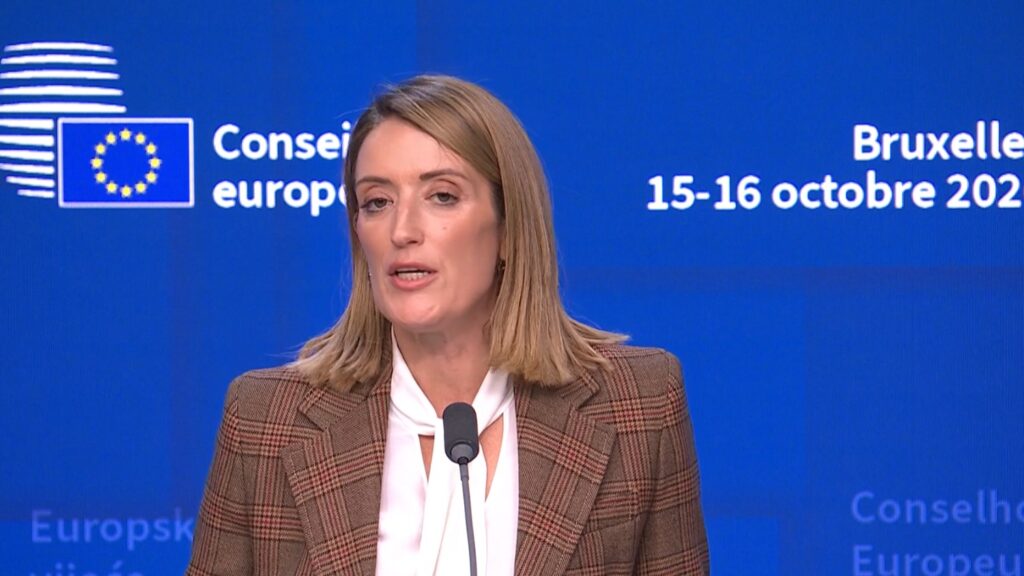
As European leaders met in Brussels to discuss a number of pressing issues of the day, the European Parliament president was mostly preoccupied by the relevance of — the European Parliament. Roberta Metsola met EU leaders before the European Council summit on Thursday morning. Afterwards she issued a polite warning: the Parliament will help find compromises, she said, but it will not follow the Council blindly.
She said she had raised three topics with leaders: Ukraine, competitiveness and the next long-term budget. On Ukraine, she was firm. “Now is not the time to waver, but to stand firm,” said Ms Metsola. She wants more pressure on Russia, including targeted visa restrictions. The Council’s draft conclusions point the same way. They list tighter visa rules for Russian nationals among measures to consider urgently.
Ms Metsola also welcomed the opening of new accession clusters for Ukraine and said she had reassured leaders of strong majorities in Parliament. Asked about Washington, she did not criticise it directly. “And when things really get hard, as they are understandably hard right now, this is when Europe is put to the test and we absolutely cannot fail at it,” she said.
Fast, but not at any price
On competitiveness, the draft conclusions set a deadline. “It invites the co-legislators to conclude negotiations on all these files from the roadmap, as well as the automotive package, by the end of the year and to keep up the momentum for 2027.”
We cannot agree on Europe’s ambitions and then cut the means to achieve them. — Roberta Metsola, European Parliament president
Ms Metsola accepts speed, with a condition. “Yes, you can be fast, but you also need to be good,” she said. She wants the Commission to carry out proper impact assessments and meet its deadlines. She cited the packaging waste regulation as a source of unintended consequences.
The overlap matters. The draft names the Industrial Accelerator Act, the automotive package and the market integration package. Ms Metsola named the same files. She said Parliament’s concerns about them will carry into talks with the Council. That is the first friction point.
Two signatures needed
Methane is the second. The draft welcomes the Commission’s proposal to postpone some obligations under the Methane Regulation. Ms Metsola said it reached Parliament the day before, and she sent it to committee. A reporter said she had celebrated its opening. “I think celebrate is a big word,” she replied.
The budget is where the gap is widest. Ms Metsola said the Irish presidency’s proposal keeps some funding for people-focused policies. She objected to the cuts: 35 per cent for civil protection, 10 per cent for Horizon, and 14 per cent for strategic infrastructure and defence. “We cannot agree on Europe’s ambitions and then cut the means to achieve them,” she said.
The draft conclusions look at the calendar. “An agreement before the end of 2026 would allow for the adoption of legislative acts in 2027, which is necessary to ensure that EU funding reaches beneficiaries without interruption in January 2028.”
Asked whether the delay worried her, Ms Metsola declined to dismiss it. “I can always be worried, but I’m not going to be worried yet,” she said. She hopes for progress by year-end. She added that the Council needs 27 member states, while Parliament needs 361 votes, which she called hard to reach.
The draft invites European Council President António Costa to take the talks forward. It does not mention Parliament’s consent. Ms Metsola, for her part, said she has full trust in Mr Costa. She said he reaffirmed his approach to her at the meeting.
The missing bridge
Own resources, meaning bloc-wide taxes, form the third friction point. The draft does not mention them. A reporter pointed out that France demands them and Germany refuses. Ms Metsola did not take sides.
“If we want to have a discussion on how to reduce national contributions, you’re going to need own resources,” she said. She prefers to focus on areas where France and Germany agree.
She did not say whether Parliament would reject a leaders’ deal. She said only that it is not a rubber stamp and never will be. She also said the divisions run between member states, not just between institutions. “I don’t think it’s only the position between the Parliament and the Council that is far, but it’s also between member states,” she said.
If we want to have a discussion on how to reduce national contributions, you’re going to need own resources. — Roberta Metsola
She also wants a shared starting point. Parliament and Council, she said, should first agree on the framework and the overall number. Otherwise the institutions will talk past each other. “If we have different numbers that are being discussed in the different institutions, we’ll find ourselves in silos that cannot be matched,” she said.
A rare agreement
A December deal, if leaders reach one, may still face a Parliament that wants changes on cuts and own resources. The draft sets the timetable but does not say how Parliament fits in. Ms Metsola’s message suggests it will insist on a role.
She also noted that Parliament hosts a speakers’ conference with Gulf countries, and said freedom of navigation will top that agenda. The draft likewise condemns acts that threaten navigation in the Strait of Hormuz. On that, at least, the two institutions agree.