The operational solution to one of the world’s most dangerous chokepoints has been designed. It would take seven days to deploy. Expertise and resources are in place. What is missing is political will.
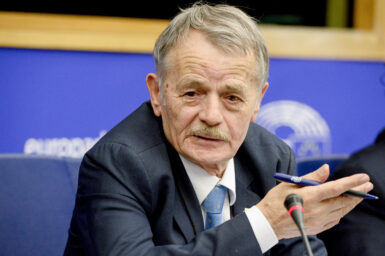
Energy may dominate headlines the world over, but the gravest implications of the Hormuz crisis concern food. This was the message that Jorge Moreira da Silva, UN’s go-to man on the Strait brought to the European Parliament’s foreign affairs committee on Thursday.
The UN under-secretary-general (and an ex-Member of the European Parliament) heads both the United Nations task force for the Strait of Hormuz and UNOPS, the UN’s agency for operations and infrastructure. The consequences of the food aspect of the Strait’s disruption, he argued, are far graver and far less visible than most Europeans realise.
The more those countries express their concerns about the lack of access to fertilizers, the greater will be the chances for the parties (…) to understand that a humanitarian crisis is approaching and can be prevented.
— Jorge Moreira da Silva, UN Under-Secretary-General
“The food security dimension has been somehow overlooked in this conversation,” he told European lawmakers. “We tend to look more into the energy. Obviously the energy dimension is critical, but it is very important to take into consideration that some of the most dependent countries from fertilizers from the Gulf are at the same time some of the most vulnerable economies in the world.”
Hidden in plain sight
The numbers Mr Moreira da Silva presented were stark. The Gulf supplies 38 per cent of global crude oil, 33 per cent of fertilizers, and 20 per cent of gas. Countries such as Sudan, Somalia, Mozambique, and Tanzania depend on Gulf fertilizers for between 50 and 60 per cent of their supply. When the crisis began, fertilizer prices surged, usage fell, and agricultural productivity began to decline.
The World Food Programme projects that 45 million people face acute food insecurity as a result, and 30 million face extreme poverty. Mr Moreira da Silva stressed that these figures do not yet include the compounding effect of the Black Sea disruption.
“If we put in combination the impact of the Black Sea disruption in the last few weeks on grain, on fertilizers, on energy, if we put this with the Strait of Hormuz disruption, plus Bab al-Mandab, we are witnessing unprecedented impact on the entire supply chain of fertilizers, food, and energy,” he said. “And we have not yet seen the consequences.”
The lag between cause and effect, he argued, is precisely what makes the fertilizer crisis so dangerous. Unlike grain shortages, which show up immediately in food prices, fertilizer disruptions take months to translate into lower harvests and then into hunger. “The fact that there is a time lag,” he said, “shouldn’t allow us to overlook the scale of what is coming.”
A mechanism ready to go
Mr Moreira da Silva described in detail the mechanism his task force has designed. It draws on three existing UN models: the UN 2720 mechanism in Gaza, which monitors and approves aid consignments; the UN Vessel Inspection Mechanism in Yemen, which has cleared more than 3,000 vessels over a decade; and the Black Sea Grain Initiative.
The proposed Hormuz mechanism would register shipment requests, approve them against agreed criteria, and operate a joint coordination centre in Salalah, Oman. GPS tracking and on-board monitors would verify each transit. The scale is modest: before the crisis, three to seven fertilizer vessels passed through the strait daily, out of a total of 130 ships covering all commodities.
We are witnessing unprecedented impact on the entire supply chain of fertilizers, food, and energy. And we have not yet seen the consequences.
— Jorge Moreira da Silva
“We are not asking something that is rocket science or extremely difficult,” Mr Moreira da Silva said. “The mechanism is pretty simple, and we are not talking about a significant number of vessels. That’s why it’s important that we focus on the consequences of inaction.”
He was emphatic that the mechanism does not replace freedom of navigation. It is, he said, a confidence-building measure — a way to allow fertilizers to flow while broader negotiations continue. “We are not presenting this mechanism as an alternative to freedom of navigation,” he told the committee. “We are basically letting the parties know: please continue your negotiations, because you are negotiating a very comprehensive package that includes everything. But don’t wait for the full negotiation to allow at least the fertilizers to flow.”
Diplomacy without a mandate
MEP Davor Stier (EPP/HRV) asked what specifically was blocking agreement and what Parliament could do to help. MEP Nacho Sánchez Amor (S&D/ESP) pressed on the nature of Mr Moreira da Silva’s engagement with Iran and the United States. The answer, in both cases, was the same: the UN has the support of an overwhelming majority of member states, in both the General Assembly and the Security Council. What it lacks is a mandate from the two parties to the conflict.
The key to unlocking agreement, Mr Moreira de Silva argued, lies in making the consequences of inaction impossible to ignore. African countries, Latin American states, and Southeast Asian nations all have a direct stake. “The more those countries express their concerns about the lack of access to fertilizers,” he said, “the greater will be the chances for the parties in the conflict and the parties in the region to understand that a humanitarian crisis is approaching.”
MEP Marc Botenga (The Left/BEL) argued bluntly that the root cause was the US-led war against Iran and that European governments bore responsibility for supporting it. Mr Moreira da Silva declined to engage with the political framing, citing the neutrality essential to UN operations.
The UN envoy did, however, address the underlying point. Peace, he said, is the ultimate goal; but waiting for peace before acting on fertilizers is a choice with a human cost. “We are being put very often into a dilemma, which is: we have to wait for peace to start having something,” he said. “And the idea of this mechanism is precisely to ensure that even in the middle of the war, we can still allow some transit of fertilizers.”
Lessons for the future
MEP António Tânger Corrêa (PfE/PRT) asked why no preventive mechanism existed before the crisis, given that the Strait of Hormuz has long been identified as a critical vulnerability. Mr Moreira da Silva acknowledged the point and drew a lesson from the UN’s experience in Gaza and Yemen: transparency is the foundation of trust. The UN 2720 mechanism in Gaza, he noted, made public for the first time exactly which aid consignments Israel approved and which it rejected. Accountability, he argued, changes behaviour.
We are not asking something that is rocket science or extremely difficult. The mechanism is pretty simple, and we are not talking about a significant number of vessels.
— Jorge Moreira da Silva
He also addressed the question of replicability. The monitoring-and-verification model, he said, could in principle apply to other conflict zones, including the Black Sea. The logic is the same: when lasting peace is out of reach, confidence-building measures can still save lives.
Mr Moreira da Silva saved perhaps the most striking comment for his final warning. The 45 million people the World Food Programme projects into acute food insecurity were counted before the Black Sea disruption, before the full fertilizer supply-chain collapse, and before a Super El Niño year. And the planting season, he reminded lawmakers, does not wait for diplomats.