Gaza, Ukraine, and a diplomatic service some capitals want to cut down to size. Kajsa Ollongren faced all three in her first hearing before European lawmakers as that service’s new Secretary-General. Some of them told her that calling Gaza a catastrophe is no longer enough.
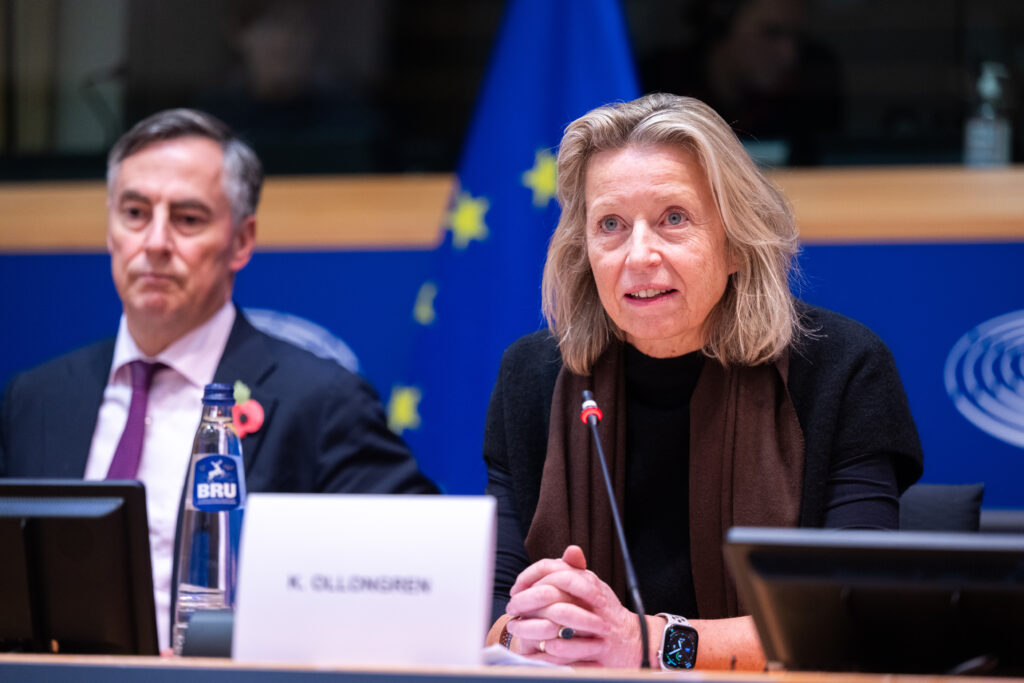
The EU cannot afford to become a “bystander” in an increasingly unstable international order. That was the message Kajsa Ollongren brought to her first appearance before the European Parliament’s Committee on Foreign Affairs (AFET) on Monday 9 November. But the EU’s credibility as a global actor, she added, will depend on its ability to defend its principles consistently.
The former Dutch defence minister took over as Secretary-General of the European External Action Service (EEAS), the diplomatic service led by High Representative Kaja Kallas, on 1 September. Facing lawmakers, she pledged closer cooperation with MEPs and answered questions on Gaza, Ukraine, and the EU’s ambitions as a geopolitical power.
The timing made the hearing more than a courtesy visit. Paris and Berlin want options to restructure the EEAS by the end of the year, and one of them would hand a large part of Ms Kallas’s to the Commission. Separately, 11 member states, France and Germany among them, have called for a move from unanimity to qualified majority voting in foreign policy, so that a single country could no longer block decisions.
You might be interested
Gaza and charges of double standards
Lawmakers from across the political spectrum pressed Ms Ollongren on some of the world’s most urgent crises, from Russia’s war against Ukraine to Gaza, where she called the humanitarian situation a “catastrophe”. The latter emerged as one of the most politically contentious issues of the hearing.
One of the sharpest criticisms came from Marc Botenga (The Left/BEL). He questioned the consistency of European foreign policy and accused the EU of applying different standards to comparable violations of international law. “Violations like the illegal occupation of land should not be treated differently in Ukraine than they are in Lebanon, Syria, or Palestine,” he said. In his view, the EU’s failure to apply its principles consistently was undermining its credibility.
Mr Botenga also challenged Ms Ollongren’s willingness to engage with Israel’s incoming government. He warned against normalising relations with political figures accused of war crimes, calling it another case of European double standards.
Words without action
Ms Ollongren called for “full, immediate, safe, and unhindered humanitarian access” to Gaza. She also condemned the expansion of illegal Israeli settlements in the West Bank, warning that it undermined the viability of a two-state solution. But for some MEPs, acknowledging the scale of the humanitarian crisis is no longer enough.
We are not able to take decisions that really put the pressure on where it should be put. — Villy Søvndal (Greens/EFA/DNK), former Danish foreign minister
Villy Søvndal (Greens/EFA/DNK), a former Danish foreign minister, agreed with Ms Ollongren’s assessment but criticised the EU’s inability to translate its concerns into political action. “You used the words a catastrophe. I fully agree. But I think it’s also shameful,” he said. “Everyone who can see and hear knows what’s going on. And we let it happen. We are not able to take decisions that really put the pressure on where it should be put.”
Israel’s next government has yet to emerge from coalition talks after the 27 October election. Responding to concerns about it, Ms Ollongren said the EU hoped for a more constructive relationship with the new administration, particularly on settler violence, humanitarian access, and the future of the Palestinian population. However, she stressed that the EU could not directly interfere in Israel’s coalition-building process. “What we can do, of course, is to continue to underline the things that we find are important, and which we would like to engage with, with a new Israeli government,” she added.
The debate exposed a familiar dilemma for European foreign policy. How can the EU uphold international law and human rights while maintaining diplomatic relations and securing political influence in an increasingly fragmented world?
Ukraine and pressure on Moscow
Russia’s war against Ukraine was another central focus. MEPs questioned whether diplomatic efforts were likely to deliver progress and whether European countries would have a meaningful role in potential negotiations.
Michael Gahler (EPP/DEU) expressed doubts about the prospects of the trilateral talks between the US, Ukraine, and Russia, due to open in Abu Dhabi the following day. He pointed to Moscow’s apparent unwillingness to move towards an agreement. He also raised concerns about the possibility of Washington increasing pressure on Kyiv rather than Moscow.
We believe that the only way in which there will be an outcome is if Russia feels pressured and feels that it needs also to stop this war. — Kajsa Ollongren, EEAS Secretary-General
Ms Ollongren was cautious about the prospects of negotiations, acknowledging that the EU had yet to see any indication of a serious shift in Russia’s position. While noting increased US engagement following the US midterm elections, she insisted that pressure on Moscow remained essential to any potential diplomatic breakthrough. “We believe that the only way in which there will be an outcome is if Russia feels pressured and feels that it needs also to stop this war,” she said.
Grain corridors and sanctions
On food security, Ms Ollongren highlighted the wider consequences of Russia’s disruption of Black Sea trade routes, particularly for countries dependent on Ukrainian grain exports. She said the EEAS was engaging “with partners in Asia and Africa, including Egypt, to explore ways of restoring grain corridors”.
Towards the end of the hearing, MEPs from both The Left and the European Conservatives and Reformists (ECR) argued that the adoption of 21 sanctions packages was not enough if enforcement remained weak, pointing to the continued operation of Russia’s shadow fleet and persistent circumvention. They called for an annual EEAS report assessing both how sanctions are implemented and the humanitarian consequences of the EU’s restrictive measures.
For her part, Ms Ollongren defended sanctions as an essential instrument of European diplomacy. She described them as the “stick” in the EU’s diplomatic toolkit.
The EU as a geopolitical power
The hearing also went beyond individual conflicts. It raised broader questions about the EU’s institutional capacity to act as a unified international player.
Ms Ollongren described multilateralism as a strategic necessity for the EU. But it would require a more flexible approach based on coalitions and partnerships around specific issues. “The political divide over the war in Ukraine can be big, but the divide over its consequences is not so big. And we should use that, we should capitalise on that,” she said.
And we are the first violating the treaties when we talk about who is doing what regarding foreign policy. — Nacho Sánchez Amor (S&D/ESP), member of the Committee on Foreign Affairs
The new Secretary-General also defended the role of the EEAS amid ongoing discussions about the EU’s institutional architecture and decision-making in foreign policy. Nacho Sánchez Amor (S&D/ESP) went further and warned against weakening the diplomatic service, arguing that its independence was part of the institutional design set out in EU treaties. “We are praising the rule of law all over the world. We are praising the rules-based order. And we are the first violating the treaties when we talk about who is doing what regarding foreign policy,” he said.
Enlargement and the budget
Mr Sánchez Amor also called for the European Parliament to play a more active role in election observation missions in EU candidate countries. Ms Ollongren agreed that enlargement should be understood not only as an economic and political process but also as a “security instrument”, particularly in the case of Ukraine.
The debate also touched on the resources available to the EEAS. Ms Ollongren warned that reductions in the next Multiannual Financial Framework (MFF), the EU’s long-term budget for 2028–2034, “could weaken the EU’s international influence”. She argued that even relatively limited budget allocations could make a significant difference to European diplomatic operations. “Cuts would weaken our global role and undermine our ability to address these changes,” she said, urging MEPs to support an ambitious Global Europe instrument, the bloc’s main funding tool for external action.
She promised that this would be the first of many meetings and that she would engage MEPs more closely on EU diplomacy. “I think it is the time to show that diplomacy matters and that it should make the difference,” she said.