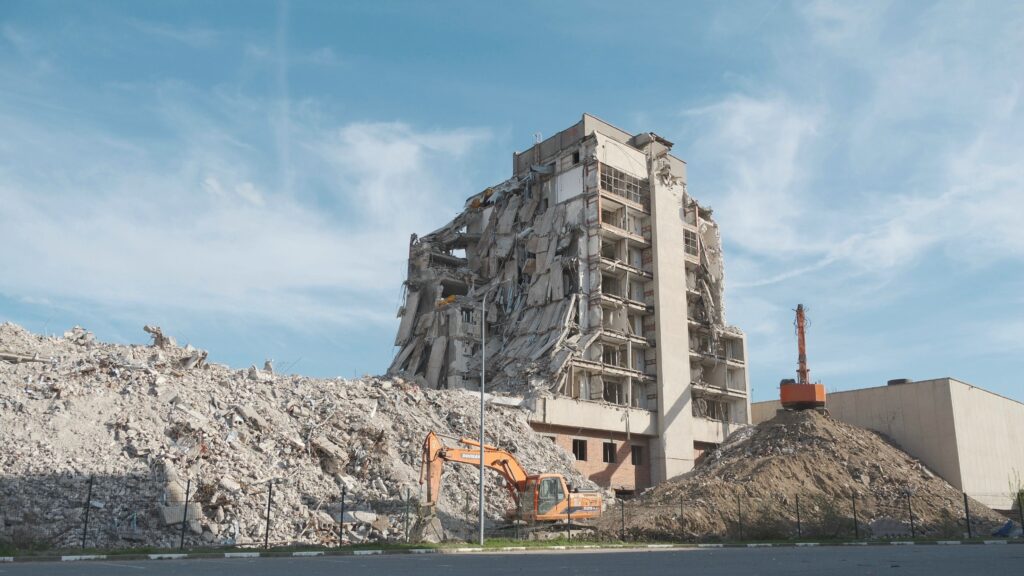
Europe keeps buying the same raw materials twice. New research from the European Environment Agency shows what that habit costs: almost one billion tonnes of CO2 a year and a deepening dependence on suppliers the continent can no longer afford to trust. The fix is already sitting in its buildings, roads, and machines.
The numbers are hard to dismiss. A set of 17 actions across housing, mining, food, and mobility could cut the EU’s climate impact by 22 per cent, reduce biodiversity loss by 19 per cent, and lower air pollution by a quarter.
The resource security case is equally compelling. A more circular economy would reduce EU dependence on aluminium, nickel, and platinum group metals by around 20 per cent, and copper by 12 per cent. Europe consumes 14.4 tonnes of material per person per year. More than six of those tonnes end up locked in buildings, roads, and machines. That is not waste. That is a stockpile.
The foundation is laid
The EU has not been idle. The Circular Economy Action Plan, launched in 2020, set out 54 actions. The Commission says virtually all have been delivered or are under way. The Ecodesign for Sustainable Products Regulation now sets binding design requirements across product categories. The Critical Raw Materials Act, in force since March 2024, goes further still: by 2030, the EU must mine at least 10 per cent of its strategic raw materials domestically, process 40 per cent within the bloc, and recycle 25 per cent internally.
The scale of the challenge is clear from one number. Europe’s circular material use rate stands at just 12.2 per cent. The target is to double it to 24 per cent by 2030. These are legal obligations with a deadline, not aspirations. The Circular Economy Act, expected in the third quarter of 2026, is supposed to get Europe there.
Industrial policy by another name
The new Commission has repositioned circularity as a pillar of industrial and security policy. The Competitiveness Compass, built on Mario Draghi’s landmark report, frames reducing resource dependence as a precondition for keeping European industry competitive and out of the reach of political pressure. The logic is blunt: every tonne of aluminium reclaimed from a demolished building is a tonne that does not need to be imported from a supplier that may not be reliable next year. Circular economy, in this framing, is industrial policy by another name.
The transition is not something that happens to Europe. The transition is the way in which Europe actively shapes its own future. — Teresa Ribera, Executive Vice-President for a Clean, Just and Competitive Transition
That argument gained fresh political weight this week. At the European Economic and Social Committee’s plenary session on 17 and 18 June, Executive Vice-President Teresa Ribera put it plainly. “The transition is not something that happens to Europe,” she said. “The transition is the way in which Europe actively shapes its own future.”
The €82bn question
The EEA puts the annual investment gap at €82bn, the difference between current investment and what the EU needs to meet its own targets by 2040. The largest gaps sit in construction, textiles, and batteries and vehicles: the backbone of European industry, not its periphery.
Private investors struggle with circular projects for structural reasons. Returns are long-term, risks are hard to price, and secondary raw materials compete with virgin materials on price and often lose. Public funding, the EEA argues, is not a nice-to-have. It is the catalyst without which private capital will not follow.
The Circular Economy Act’s central ambition is to create a single market for secondary raw materials. Today that market does not really exist. It is fragmented across 27 member states, each with different rules, quality standards, and incentives. A builder in Germany and a manufacturer in Poland operate in different realities. That fragmentation keeps the price of recycled materials high and demand low.
Three problems, one deadline
The first problem is price. Virgin materials are still cheaper than recycled ones in most sectors. Without tax reform, green procurement rules that actually bite, or a carbon price that reflects the true cost of extraction, firms will keep choosing the cheaper option. That is not a failure of ambition. It is a failure of price signals.
Price is only part of the problem, however. Companies switching to recycled materials also need to trust that they will receive consistent quality next time, that supply will be reliable, and that the material will pass certification. Until secondary raw materials can offer that kind of predictability, price alone will not shift purchasing decisions.
Relying exclusively on the internal market legal base fundamentally misrepresents the environmental objectives and historical context of Circular Economy policy. — European Environmental Bureau and 55 co-signatories, letter to the Commission
The second problem is fragmentation. The EU can write a law. It cannot force 27 member states to implement it identically. In January 2026, a coalition of 56 civil society organisations, including the European Environmental Bureau, wrote to the Commission warning that “relying exclusively on the internal market legal base fundamentally misrepresents the environmental objectives and historical context of Circular Economy policy.”
They are pushing for a dual legal basis, one anchored in both internal market and environmental law. The legal basis matters because it determines whether environmental standards are negotiable. Under a purely internal market basis, they are. Under a dual basis, they are not.
Rules without teeth
The third problem is enforcement. The CRMA’s targets are legally binding. But binding targets without functioning enforcement have a poor track record in Brussels. Member states that fall short need to face real consequences, not infringement proceedings that take a decade to resolve.
The EEA’s reports show what is possible, where the gaps are, and what the barriers look like. What they cannot do is close those gaps. That requires political decisions on price signals, legal decisions on the Act’s scope, and enforcement decisions that 27 capitals have historically been slow to take. The materials are already there. The question is whether the politics can match them.