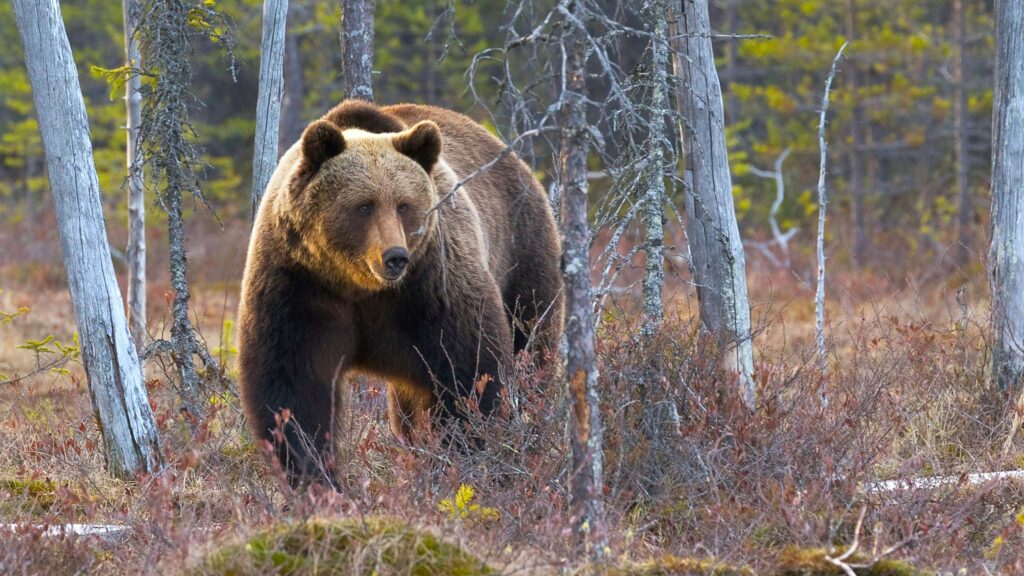
Deadly attacks, mounting losses for farmers and a growing political backlash: Romania and Slovakia, backed by three other EU countries, want Brussels to weaken protections for brown bears.
The debate over the protection of large predators in the EU is gathering pace. Less than a year after the bloc moved to downgrade the wolf’s protection status, group of states led by Romania and Slovakia are now calling for a similar approach to brown bears. The countries argue that growing bear populations are leading to an increasing number of conflicts with people in forests and rural areas and causing significant economic damage.
The initiative, discussed by EU agriculture ministers in Luxembourg on Monday, is also backed by the Czech Republic, Croatia and Finland. In a joint document, the countries describe the brown bear as an apex predator with no natural enemies and argue that the current situation requires “effective and urgent” population management.
Several deaths per year
Romania and Slovakia say public safety is at the heart of their concerns. According to figures provided by the governments, bears have killed 18 people in the two countries combined and seriously injured more than 200 others over the past five years. Romania alone estimates its bear population at around 11,500 animals, making it one of the largest in Europe.
Alongside attacks on humans, the countries point to the economic impact of expanding bear numbers. Since 2023, large carnivores have killed more than 2,000 farm animals, including cattle, sheep, goats, pigs and horses, they say. Rising losses for farmers have become one of the key arguments for easing restrictions on population control.
Seek for majority
Supporters of the proposal openly draw parallels with the recent case of wolves. Last year, the EU reduced the wolf’s protection status from “strictly protected” to “protected”, giving member states greater flexibility to manage populations. Romania and Slovakia are now urging Brussels to apply the same principle to brown bears.
Any change, however, is likely to face an uphill battle. A majority of EU member states would need to support the proposal before the European Commission could begin the legislative process. While Germany has reportedly backed a targeted exemption that would allow Romania to cull a greater number of problem bears, other countries remain cautious. France, home to around 90 bears in the Pyrenees, has taken a more reserved stance.
Dangerous precedent?
Environmental groups have long opposed any further weakening of protections for Europe’s large carnivores. Following the decision on wolves, conservation organisations warned that it could set a precedent for other species. In their view, the latest push over bears is proving exactly that. Similar calls have also emerged in recent months over great cormorants, which some member states argue are harming fish stocks and the fishing industry.
The row over bears is therefore about more than the future of a single species. It has become part of a broader European debate over how to balance wildlife conservation with public safety and the interests of farmers as populations of large animals continue to recover across the continent.