The future of work is arriving faster than Europe’s rulebook can keep up. As artificial intelligence is reshaping the labour market, the European Commission is turning to experts to assess its impact on jobs, skills and inequality. It is the first step in a wider effort to prepare the EU’s social model for a new technological era.
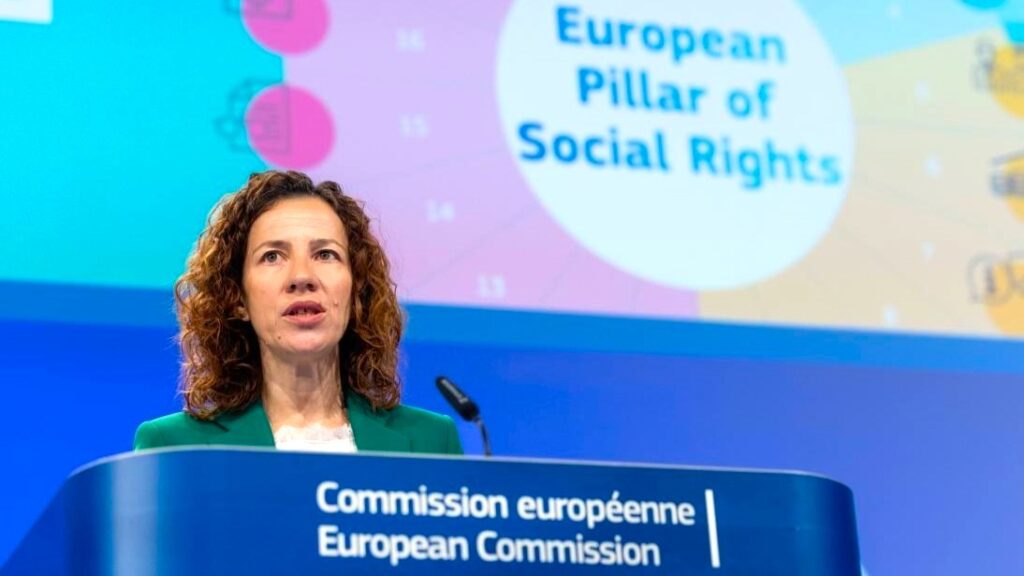
The EU will establish a high-level group to examine and understand the impact of AI on work. On Wednesday, Commissioner for Social Rights and Skills, Quality Jobs and Preparedness Roxana Mînzatu announced the priority themes for the European Pillar of Social Rights, first introduced in 2017: care work and AI.
While the Commissioner could not provide a precise timeline for the group’s formation or specify its members, she clarified that the goal is not only to define AI’s medium and long-term impact on the labour market but also to outline the necessary rules and support for human and AI collaboration. Furthermore coming in 2027 is the European Care Deal which will focus on the care workforce to “improve working conditions and the sector’s attractiveness”, she said.
Creating an expert group to analyze AI’s impact on the labour market is one measure within the broader review of the EU’s social strategy. This strategy also includes a law on job quality by year-end, new initiatives to tackle the cost of living, and actions to reduce inequality. Ms Mînzatu drew inspiration from the high-level group on online child safety, noting, however, that “this group will require more time to assess the situation and deliver results”.
Brussels wants answers
Brussels will therefore set up an expert group to study the consequences of AI for the labour market and plans to assist companies in the responsible implementation of algorithmic management tools. “Things have changed and continue to change at such a pace over the last two years that I can say we will move very quickly to set up this structure so we can get to work,” Ms Mînzatu explained.
The Commission acknowledges that the rapid adoption of AI can foster innovation, productivity, learning, and growth. But warns that it also raises questions regarding the future of work, professional skills, education, social inclusion, and public services.
“Now that artificial intelligence is transforming the world of work, driving up the cost of living, and exacerbating inequalities, we must renew our commitment to the principles of the Social Pillar: we reaffirm our commitment to a social Europe that prepares people for change, protects them from new risks, and creates opportunities for all,” the commissioner said.
In this regard, the EU will be supported by the various tools at its disposal and by EU bodies that gather data, such as the Joint Research Centre (JRC) and AI observatory platforms. “We need not only to integrate this data but also to secure support and expertise regarding various scenarios and potential responses to the unprecedented or entirely new situation facing humanity,” Ms Mînzatu concluded.
The skills race begins
The EU maintains its 2030 goal of reaching an employment rate of 78 per cent, up from the current 76.3 per cent. I also aims to ensure that 60 per cent of adults participate in training activities annually, a figure that currently stands at 39.5 per cent.
However, according to Ms Mînzatu, fifty million Europeans are outside the labour market, 33 million of whom are women. “These are not unemployed people, but rather individuals who are not actively seeking work. For various reasons and in different contexts, they do not believe they can work or face numerous obstacles preventing them from doing so,” she noted.
In particular, among the 33 million women outside the labour market, many are parents or single mothers kept out of the workforce by the need to care for their children. “Accessible and affordable childcare is essential for women working in research, in agriculture, and in any sector: a point that emerged clearly during the debate among the College of Commissioners.”
There is also a proposal to reduce the number of people at risk of poverty or social exclusion by at least 15 million compared to 2019 levels. Although the reduction achieved so far stands at 3.5 million, according to data published by the Commission itself.
Building a fairer Europe
In its assessment covering the period since 2017, Brussels highlights that in-work poverty fell from 9.6 per cent in 2016 to 8.3 per cent in 2025. Ten million people received training through the Pact for Skills, 185,000 workers across twenty countries received support to re-enter the labour market via the European Globalisation Adjustment Fund.
In latter, the plan also includes specific support particularly for small and medium-sized enterprises implementing the Pay Transparency Directive. Another element is a future “right of residence” strategy, through which Brussels aims to make it easier for citizens to live where they choose.