How flexible can Brussels be if it wants to win over a strategically important Arctic partner in an era of geopolitical upheaval?
Iceland is edging closer to the European Union again after more than a decade. But before Reykjavík is even willing to sit down at the negotiating table, it is sending a clear message: membership is up for discussion. Giving up control over fisheries is not.
“When it comes to fisheries, we are a superpower in Europe,” Icelandic Foreign Minister Þorgerður Katrín Gunnarsdóttir told the British daily Financial Times. “The EU has to take that into account. If they are not doing that, then it will be very difficult for us to negotiate.“
When it comes to fisheries, we are a superpower in Europe. The EU has to take that into account. — Þorgerður Katrín Gunnarsdóttir, Foreign Minister of Iceland
On 29 August, Icelanders will vote on whether to resume accession talks with the EU. This is not yet a referendum on EU membership itself. If voters say yes, the process could finally get moving. Its outcome would then have to go back to the people in a separate vote.
If the answer is “no”, the current government is ready to call the whole process off.
For the EU, however, the Icelandic vote matters for a bigger reason. Fisheries could become the first test of whether the bloc can offer a candidate enough flexibility in the new geopolitical reality without undermining its own rules.
Not the first time at the doorstep
Iceland applied for EU membership in 2009, shortly after the financial crisis battered its banking sector. Accession talks began in 2010 and moved relatively quickly. By 2013, negotiators had opened 27 of the 35 negotiating chapters and provisionally closed 11.
But Iceland’s new government suspended the talks in 2013. In 2015, it asked the EU to stop regarding the country as a candidate for membership.
Fisheries were one of the most sensitive issues. Even during those earlier talks, the European Parliament described the fisheries chapter as one of the most important, and most difficult, areas of the island’s accession.
Today’s Iceland, however, is not the country that entered those negotiations after the financial crisis. Its economy has recovered, while the security landscape around the North Atlantic has shifted dramatically.
Following the rules, but having no say
Iceland is hardly cut off from Europe economically. For decades, it has been part of the European Free Trade Association (EFTA) and the European Economic Area (EEA), giving it access to the single market. It has also been part of the Schengen area since 2001.
That unusual position is one reason why Iceland’s membership debate looks different from that of most candidate countries. Reykjavík already shares much of the EU’s economic rulebook. Unlike EU members, though, it has no seat at the table when those rules are decided. And, crucially, it sits outside some of the EU’s common policies, including the Common Agricultural Policy and the Common Fisheries Policy.
We are living a different life here in Iceland than on the mainland in Europe. Fisheries are part of our national identity. — Þorgerður Katrín Gunnarsdóttir, Foreign Minister of Iceland
Membership would give Iceland political influence and a full say in joint decision-making. At the same time, it would mean accepting rules from which it can currently stay outside.
When Iceland applied in 2009, the financial crisis was a major factor. The collapse of several major banks had shaken confidence in the Icelandic króna. For some voters, adopting euro and moving closer to the EU looked like a route to greater stability.
Today’s debate is unfolding in a very different setting. Alongside the economic arguments, security is becoming increasingly important. The war in Ukraine, the growing strategic importance of the Arctic and uncertainty over the future role of the United States in the region have all raised Iceland’s value to Europe. That includes US President Donald Trump’s threats towards Greenland.
All this gives Reykjavík a sense that it is entering the talks from a stronger position than it did back then.
Fisheries are about more than money
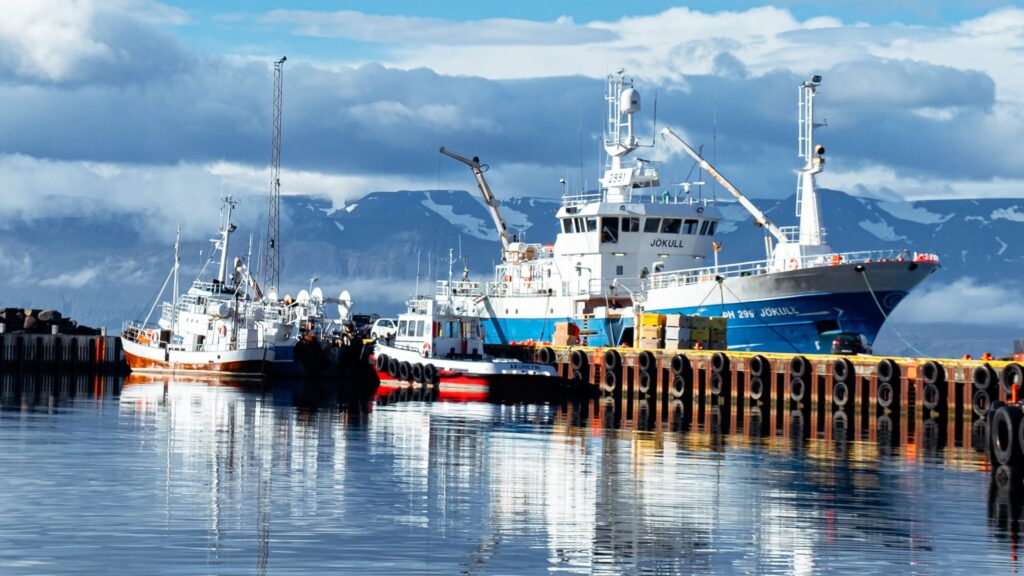
So why are fisheries such a red line? The numbers offer part of the answer. In 2024, Iceland exported around ISK 347bn (roughly €2.3bn) worth of seafood. Cod alone accounted for ISK 143bn (€958m).
But fishing matters to Iceland for reasons that go well beyond its share of exports. It is woven into the country’s history, its economy and its sense of national sovereignty.
The so-called Cod Wars with Britain are a case in point. In the 1950s, Iceland gradually expanded the waters where it claimed exclusive fishing rights, triggering a bitter dispute with Britain. London responded by sending warships to protect its fishermen, while clashes between British trawlers and the Icelandic coast guard became known as the First Cod War.
The dispute resurfaced as Iceland expanded its fishing zone further. By the 1970s, Reykjavík had secured international recognition of its new territorial waters and achieved major restrictions on British fishing activity within them.
It is therefore no coincidence that Iceland’s foreign minister talks about “sovereign control” over fisheries. “We are living a different life here in Iceland than on the mainland in Europe. Fisheries are part of our national identity,” she stated. “I will not sign an agreement that is not good for Iceland.”
Today, Iceland operates a system of individual transferable quotas. Fishing vessels receive quotas which can, under certain conditions, be transferred between them. Ms Gunnarsdóttir therefore wants Iceland to keep its own quota system if it joins the EU. More importantly, she wants Reykjavík to retain the power to decide how its fisheries resources are managed.
What would membership change?
This is where Iceland’s demand runs into one of the foundations of European integration. The EU’s Common Fisheries Policy sets the rules for managing fisheries, including catch limits, conservation measures and access to waters and resources. Every year, member states jointly agree total allowable catches for different fish stocks. These are then divided among countries as national quotas.
Member states still decide how to distribute their share of those quotas among their own fishing fleets. Joining the EU would therefore not automatically mean the end of Iceland’s quota system. But it would change the fundamental question: who gets to decide the rules.
Today, Reykjavík has much greater control over Iceland’s fishing resources. As an EU member, some of that authority would move to the European level. And that is exactly the part Iceland is resisting.
How far can Brussels bend?
The European Commission has so far kept the door open. Its basic argument is straightforward: no two accession negotiations are identical, and conditions can be adapted to the specific circumstances of each candidate country.
That does not mean Iceland can expect an exemption from EU rules simply because it is strategically important. Accession talks are built around accepting the EU acquis — the body of common rights and obligations that candidate countries must bring into their legal systems before joining.
Exceptions do exist. But according to the EU’s official position, they are limited and granted only in extraordinary circumstances. Accession treaties can also include transitional periods or safeguard clauses. That is where a compromise could emerge.
Iceland may not necessarily seek to be completely excluded from the EU’s fisheries rules. Instead, it could try to negotiate terms that protect its current system and limit changes to access to its waters. The political distinction, however, is crucial: a transition period is not the same as a permanent exemption from common rules.
And according to the Financial Times, European officials have warned that a formal, full exemption from the Common Fisheries Policy would be highly unusual.
It is not just about Iceland
Any potential deal would therefore matter beyond Iceland’s own accession. Brussels has long insisted that candidate countries must accept the acquis. At the same time, accession treaties regularly include transitional arrangements and country-specific provisions.
Iceland could become a test of where the line lies between legitimate flexibility and an exception that starts changing the very meaning of EU membership. Other European countries with sensitive natural resources would be watching closely. The most obvious comparison is Norway, which, like Iceland, remains outside the EU while being part of the EEA.
Norway has also rejected EU membership twice in referendums.
Icelanders woud have to say yes
The first step in deciding Iceland’s European future comes in just a few weeks: the referendum on 29 August. According to a poll published by Icelandic outlet DV, 53per cent of voters supported restarting negotiations last week, while 47 per cent opposed it. The gap is narrow enough to keep the outcome uncertain.
Even if the yes camp wins, the island nation would still face a long road ahead. It would have to work through the different areas of the EU acquis, and the process would eventually produce an accession treaty setting out the specific terms. Icelanders would then vote on that agreement in a second referendum.
That means the real fisheries battle would come later.
But the first vote could reveal something even more important: whether Icelanders are willing to find out what price they would have to pay for closer European ties. And whether Brussels is prepared to negotiate that price.
For the EU, this could also become the first test of whether its new geopolitical need for a stronger northern partnership can reshape the way it approaches the old rules of enlargement.