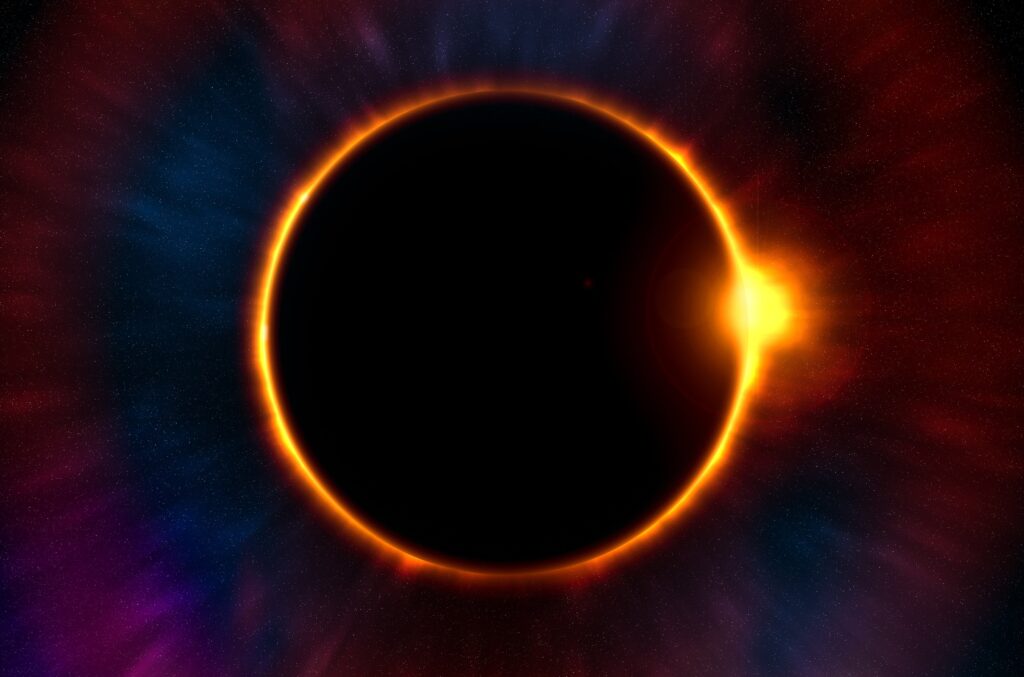
Millions are eager to witness the Moon’s shadow on Wednesday; all eyes will be on the sky. Hotel prices got there first.
Iceland’s city of Grundarhverfi satisfies most people’s ideas about what the middle of nowhere is. Yet tonight, a stay at a local 14 square-metre studio will set you back about €700. It is because the Kjalarnes peninsula, where the lodging is available, will be one of Europe’s few places where a total solar eclipse will be visible.
Hotel rooms in Reykjavík cost more than $1,000 on average on the night of the eclipse, up more than 140 per cent on the same date in 2025, according to data group Lighthouse. In northern Spain, prices in A Coruña more than doubled. Rates in Bilbao and Santiago de Compostela rose 59 per cent and 31 per cent respectively. In Mallorca—where the eclipse will be visible low on the horizon at sunset—rates were up by a fifth.
Frantic and full
Hotels.com data shows lodging searches were up 245 per cent year-on-year for destinations along the path of totality. Demand climbed fastest in Valencia, Mallorca, and Reykjavík, with average daily rates standing at approximately $285, $405, and $610 respectively.
Short-term rentals have also surged. Rates on Airbnb-style platforms rose 53.7 per cent year-on-year for Icelandic properties in areas in question on the night of the eclipse, according to analytics company AirDNA. In Spain, which has a much larger supply of properties, rates within the path of totality were still up an average of 15.8 per cent.
“There has been excessive demand and it’s been coming from everywhere,” said Helga Maria Albertsdóttir, managing director of Reykjavík’s Sky Lagoon. The establishemnt’s guests will watch the solar eclipse while sitting in geothermal pools.
Ryan Connolly, co-founder of luxury travel company Hidden Iceland, told Financial Times he took his first booking for the eclipse back in September 2024. He had to start turning down further reservations in March, as it was already “frantic and full across the whole country”, he said.
Airlines, cruise lines cash in
Airlines moved quickly to meet demand. Icelandair had added flights to cater for the surge, particularly from the US, and would be operating at “full peak capacity”, according to chief executive Bogi Nils Bogason.
Rival airline Delta also added flights from New York to Reykjavík. Mr Bogason said the airline had prioritised routes from North America, where interest in the eclipse has been especially strong.
There has been excessive demand and it’s been coming from everywhere.
— Helga Maria Albertsdóttir, Sky Lagoon, Reykjavík
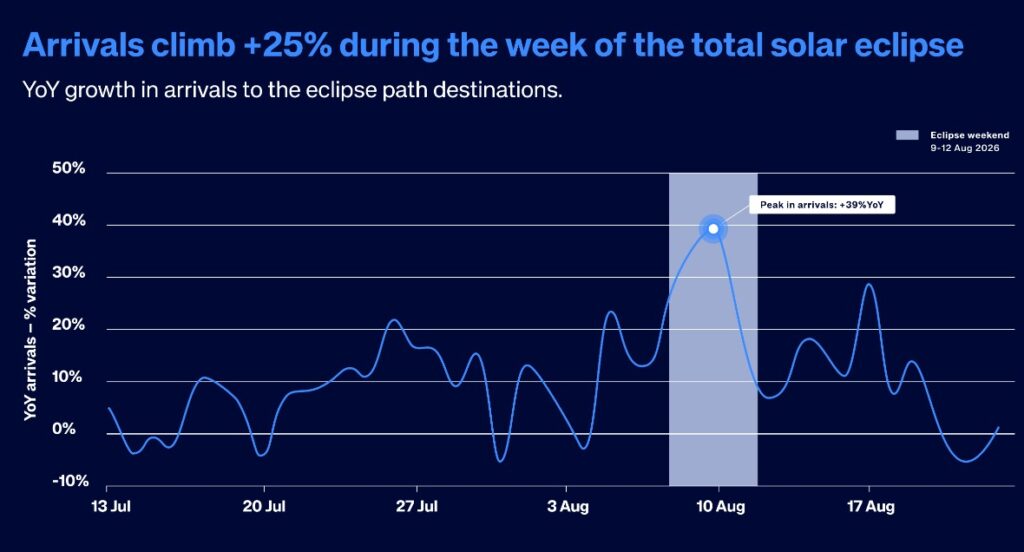
The tourism surge extends beyond dry land. Cruise lines including Princess Cruises and Virgin Voyages launched sold-out trips to view the eclipse off the coasts of Spain and Iceland. Scheduled airline seats for the week of the eclipse rose 7.9 per cent compared with the same period in 2025, while hotel bookings for August 2026 rose 17.8 per cent against August 2025.
Spain counts its gains
Spain’s government—with Prime Minister Pedro Sánchez at the helm of a special Three Eclipses committee—has done the arithmetic. An economic impact study presented by the Ministry of Economy, Trade and Business estimates a net contribution of €347.60m to the Spanish economy. The eclipse is to generate an influx of 446,700 tourists during the reference week of 10–16 August across the 36 provinces within the path of totality and nearby areas of interest. Additional tourism spending is to clock in at €342.19m.
The study highlights that the region affected by the eclipse has sufficient capacity to meet this additional demand, with over one million available accommodation spaces across hotels, apartments, campsites, rural lodgings, and tourist rental properties. Some of that demand is flowing to rarely visited parts of the country—including the depopulated interior known as “empty Spain”—drawing travellers away from the southern holiday hotspots.
The eclipse is also pulling tourism away from Spain’s battered coastline. After the country’s tourist industry was hit by some of the worst wildfires in 30 years, parts of Aragón remain under extraordinary restrictions on motor vehicles, and some natural parks in Valencia are closed.
Clouds and caveats
Not everything is guaranteed. Tourists, particularly those opting for Iceland over Spain, face the risk of cloud cover, which can drastically reduce the eclipse’s visibility. In thick cloud, the effects of an eclipse are limited to general atmospheric darkness. Ms Albertsdóttir said the forecast for Reykjavík was currently ideal, with only light cloud cover.
Most of Mr Connolly’s customers will watch the eclipse from the Reykjanes Peninsula, following a day of exploring the volcanic region. Even in the worst-case scenario, if clouds obscured the eclipse, “They’ll have other activities, so it’s still a worthwhile trip,” said Mr Connolly.
Tour operators are already looking further ahead. Bookings are rapidly rolling in, particularly in the Egyptian city of Luxor, for the solar eclipse next August. Dubbed the ‘eclipse of the century’, it will be the longest period of totality seen from land until 2114, FT remarks. For most of us, it is Luxor or nothing.