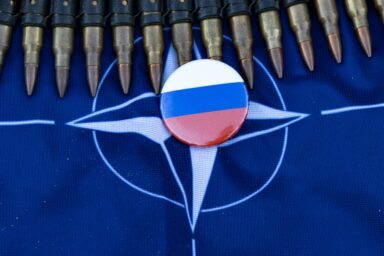
The Alliance council meeting produced strong language. Whether it carries any weight is another matter.
The North Atlantic Council convened on Wednesday morning to address a string of Russian provocations. It debated airspace violations over Poland and Romania, as well as a drone incident at Leipzig/Halle Airport in Germany.
“Allies reiterated that Russia bears full responsibility for the airspace violations, which are dangerous and unacceptable, and demonstrate Russia’s increasing tolerance for risk,” the Alliance said in a statement published the same day. Allies also “commended the swift actions of NATO and national authorities in responding decisively to the events.” The communiqué reaffirmed support for Ukraine and pledged continued resolve on the eastern flank, from the Baltic to the Black Sea.
Hybrid warfare, hard choices
The Leipzig incident is the most troubling of the three. An explosives-laden drone crashed into the wing of a Ukrainian An-124 cargo aircraft at the airport last week. The device did not detonate. Updated information suggests the explosives were found some distance from the drone, possibly separated on impact.
Retired Bundeswehr Brigadier General Klaus Wittmann, a lecturer in modern history at the University of Potsdam, called for a formal political response. He argued that Germany should invoke Article 4 of the North Atlantic Treaty—which allows any ally to request consultations when it believes its security is threatened—rather than wait for criminal-standard evidence.
The initiative to escalate should not always be left to Putin. — BrigGen a.D. Klaus Wittmann, University of Potsdam
“Whatever Putin wants to do against NATO states, he will do it in a way that creates disagreement within the North Atlantic Council over whether it already constitutes a military attack under Article 5 of the North Atlantic Treaty,” the Ukrainian Mezha-net portal quoted Mr Wittmann. That, he argued, is precisely the point: Russia probes, NATO deliberates, Moscow gains time.
Mr Wittmann’s diagnosis cuts to the heart of NATO’s dilemma. Russia’s hybrid tactics include misinformation, sabotage, and airspace incursions. Moscow calibrates them to stay just below the threshold that would trigger a unified military response. Each incident, taken alone, is deniable or ambiguous. Taken together, they form a pattern.
The threshold problem
“The initiative to escalate should not always be left to Putin. We need to consider how to demonstrate the consequences to him, threaten him with them, and, if necessary, actually carry them out,” Mr Wittmann said. He also called for more active countermeasures against Russia’s shadow fleet, the use of frozen Russian assets, and raising Russian attacks on Ukrainian civilians at the UN Security Council.
NATO, for its part, launched the multi-domain military activity Eastern Sentry in September 2025 in response to increasing airspace violations. NATO Air Policing includes a permanent, round-the-clock mission involving fighter aircraft ready to intercept unidentified planes. This contributes to Eastern Sentry and helps strengthen deterrence along the Alliance’s eastern flank. The Supreme Allied Commander Europe oversees the mission.
Here the communiqué’s confident tone meets a harder reality. NATO’s cohesion depends, in large part, on American commitment. That commitment is under strain. US President Donald Trump has repeatedly questioned the Alliance’s value, and his administration has shown little appetite for confronting Moscow. Mr Trump’s officials have at times blocked or delayed measures that European Allies sought to push through the Council.
An alliance under strain
The Alliance’s statement that it “stands ready to deter and defend against any aggression” carries less weight when its most powerful member sends mixed signals. Some European allies (Germany, Poland, and the Baltic states foremost among them) are spending more and building faster. But they cannot fully substitute for American hard power, not yet.
NATO insists “It does not seek confrontation and poses no threat to Russia.” Russia, it seems, has reached a different conclusion. It is testing that proposition, one drone at a time.