Gathered in Ukrainian capital, European allies turn political solidarity into concrete military commitments, from weapons to long-term security guarantees.
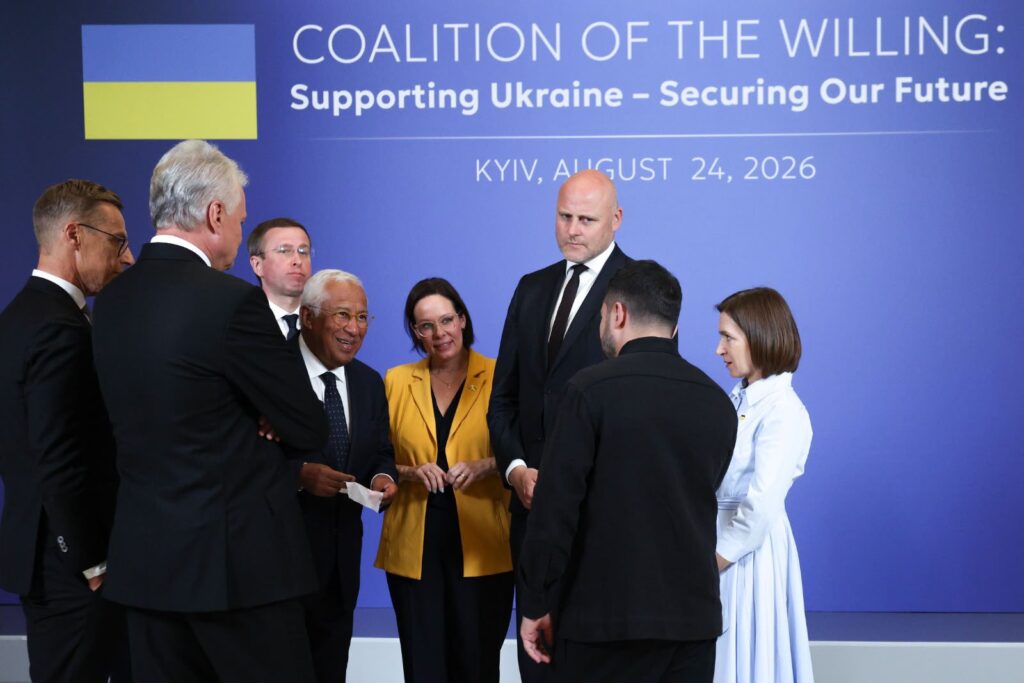
Kyiv hosted a new meeting of the Coalition of the Willing on the 35th anniversary of the declaration of independence from the Soviet Union. Before the meeting began, to show steadfast solidarity with Ukraine, the European Commission already approved €6.1 billion for air defence and missile defence systems.
The meeting was convened at a particularly delicate moment in the war. Russian attacks on civilian infrastructure and facilities resulted in more civilian casualties than at any time since the first months of the invasion. More importantly, it follows the plan developed by Ukraine, the US, and the EU—announced by Ukrainian President Volodymyr Zelenskyy on Sunday—to end the war, which has now been raging for over four years.
What Kyiv and Moscow asked for
The meeting was co-chaired by the leaders of Great Britain, France, and Germany. Many leaders joined online but the President of the European Council, António Costa, attended in person. He described on X the Ukrainian struggle as “ours”.
On this occasion, Mr Zelenskyy once again called on international partners for greater support for air defence. And Andy Burnham, following his predecessor Keir Starmer, reiterated Britain’s determination to support Ukraine. “Russia should be in no doubt of our resolve,” the British Prime Minister said in a statement.
Meanwhile, Moscow continues to demand territorial concessions and uncompromising policies, demands that Kyiv has rejected. Ukraine sees them as a capitulation that will leave the door open to a new Russian attack in the future. The leaders confirmed during the meeting that they will not be dissuaded from their support for Ukraine by irresponsible Russian threats.
British Prime Minister, opening his first meeting as co-chair of the Coalition of the Willing, urged Ukraine’s allies to provide more Patriot interceptor missiles, emphasising that Ukraine needs more help to protect its population at this time. It means “doing everything we can all do, and working with our allies as well, beyond this coalition, to dig into our own stocks and help others dig into their stocks” of air defence, Mr Burnham said. He called not only on European leaders but also on the US Congress to “intensify” economic pressure on Russia.
In addition to the requested joint effort, Mr Burnham announced a new British defence initiative: the defence company MBDA will be authorised to disclose classified information necessary to allow Ukraine and France to begin local production of the long-range SCALP missile, a project for which Paris has also announced increased support.
Tool? Sanctions
Sanctions appear to remain the EU’s main argument. EU High Representative Kaja Kallas announced that tougher sanctions against Russia are being prepared this autumn. But not only that: “We are further tightening the net around Russia’s shadow fleet to deprive Moscow of funds to wage war.”
Indeed, the leaders agreed to continue efforts to limit Russia’s military resources through sanctions, broader economic measures and the crackdown on sanctions evasion. Sanctions, as joint action, “to date has deprived Russia’s war chest of at least $495 billion since February 2022”, said the leaders.
From announcements to practice
This autumn will not only see a tightening of EU sanctions on the Moscow but also the beginning of the first joint military exercises by the Coalition of the Willing.
French President Emmanuel Macron has announced that the first exercises will take place in October–November of this year. “It is very important to continue to demonstrate our determination and readiness regarding the security guarantees we have decided to provide,” Mr Macron said.
More specifically, the exercises will focus on refining the methods of transferring troops and equipment.