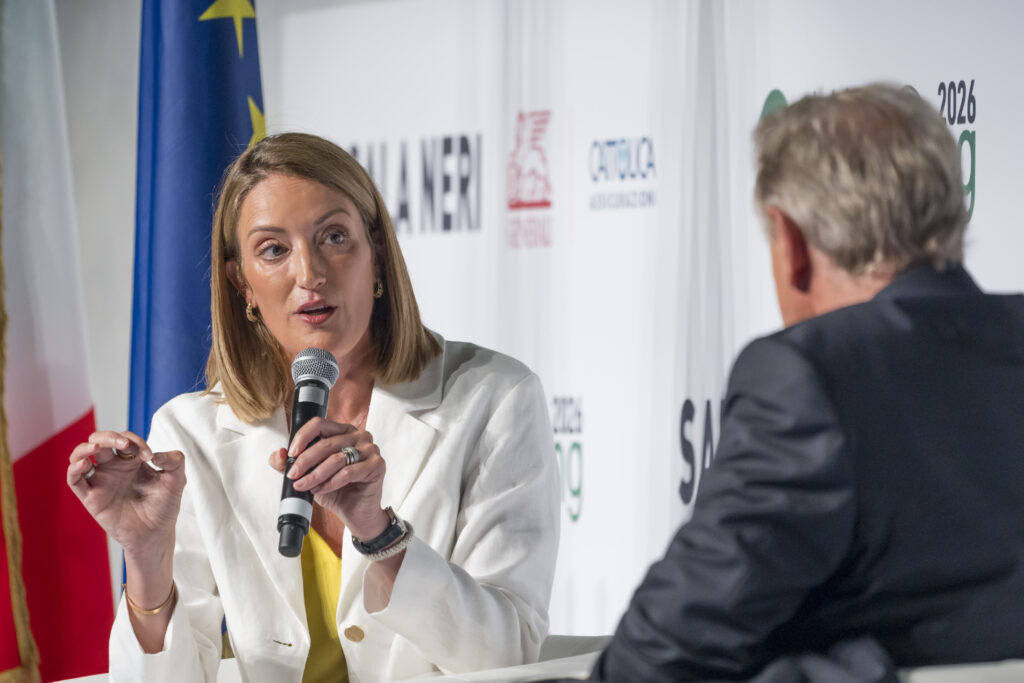
European Parliament President Roberta Metsola has criticised new packaging requirements for placing counterproductive burdens on smaller businesses. Speaking at a conference in Rimini, Italy, she said Parliament had taken the initiative and would address the problem within the coming weeks.
The Packaging and Packaging Waste Regulation started applying across the EU on 12 August. It introduces common rules on packaging design, labelling, recycling, and producer responsibility, but smaller companies have raised concerns about registration and reporting requirements.
“This is the exact opposite of what Europe should represent,” Ms Metsola said, adding that she was proud Parliament had taken the initiative to address the situation. She also supported Italian Prime Minister Giorgia Meloni’s recent appeal for more “common-sense solutions”.
Ms Metsola did not specify which provisions Parliament intends to change. However, the Commission has already proposed removing the requirement for EU-based companies selling packaged products across borders to appoint an authorised representative in each destination member state. The change still requires an agreement from the Parliament and the Council.
Europe must become less complicated
The packaging dispute formed part of Ms Metsola’s broader argument that the EU must become less complicated and more responsive to citizens and businesses. Speaking on the closing day of the “Europe, preserving root, accelerating future” conference, she recalled meeting small farmers and entrepreneurs worried about their future, as well as families struggling with the cost of living. They needed to know that Europe would support them, she said.
Ms Metsola acknowledged criticism that the EU appeared complicated and “soulless”. She argued that Europe’s identity remained rooted in its history, people, and solidarity, and that empathy was a strength rather than a weakness in a world increasingly shaped by authoritarian leaders.
She also defended freedom of expression and other fundamental rights while arguing that Europe must protect its security and prevent criminal networks from exploiting its systems.
Single market central to competitiveness
Ms Metsola called for deeper integration of the single market to help European businesses expand. Fragmentation was weakening the bloc’s productive capacity and benefiting China and other competitors, while member states pursued short-term national advantages, she argued.
“A more competitive and connected continent is the only way for Europe to remain a key player in the world,” she said. Artificial intelligence formed another part of that competitiveness challenge. Europe could not remain an observer in the global AI race and needed to compete more effectively, she said, pointing to Italy’s technology and research sectors as examples of European potential.
“We need to shape the future so that technology remains at the service of people, rather than the other way around.”
— Roberta Metsola, President of the European Parliament
However, she argued that economic and technological development should continue to serve people. Europe should shape AI so that technology remained at the service of humanity rather than the other way around.
Ms Metsola also argued that Europe could strengthen its external borders and act against traffickers and organised crime without abandoning its values. Her speech ultimately linked these questions to the same central argument: the EU must become more competitive and secure while remaining responsive to the people and businesses affected by its decisions.