“There’s no such thing as hybrid warfare, ladies and gentlemen, even though you all repeat it all the time.” Andrew Michta, director of the Scowcroft Strategy Initiative at the Atlantic Council, has a knack for counterintuitive phrasing.
The point is simple. “A rocket that flies into Holland is not a hybrid rocket. It’s a rocket and it’s going to kill people.” Leaders, he said, must take responsibility and “use the W word”. To Mr Michta, it is more than words. He called the present “phase Zero”. The Russians and the Chinese are shaping the geostrategic environment, he said.
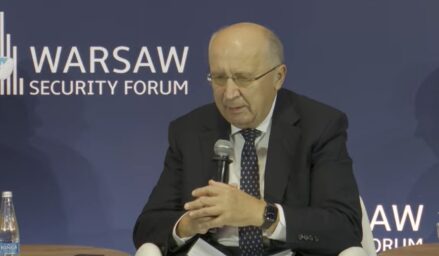
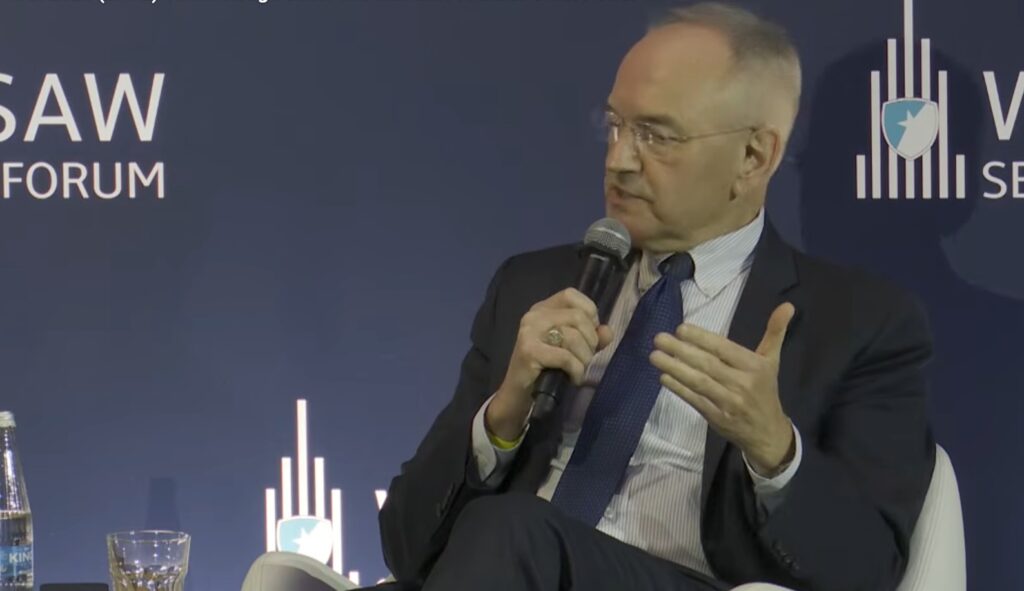
Mr Michta spoke at the Warsaw Security Forum on 13 October. The panel was called Rough Seas: The Maritime Front of Great Power Competition. Mr Michta is also a former dean of the College of International and Security Studies at the George C. Marshall European Center for Security Studies. His ability to present an articulate summary of the American strategic position made him a valuable asset in Warsaw.
Oana Lungescu, former NATO spokeswoman who moderated the panel, asked why Europeans had not gone out to help with freedom of navigation through the Strait of Hormuz. Was it capability or political will? Mr Michta blamed geography first. “A situation where you sit on the map defines your security optics. In Europe during the Cold War, you had consensus on the nature of the threat.” Wherever you stood, the same threat applied to you.
A map that shapes minds
Russia’s relative weakness has ended that, he said. In the northeast corridor, Russia is an existential threat. But “You start moving away from the border and things change,” the US security expert said. The fragmented threat assessment throughout Europe is, in fact, a function of a relatively weak Russia. It was one of a series of paradoxical, counterintuitive statements he made to the panel.
The second problem is the adversaries. “I call this the axis of dictatorships. It’s Russia, China, North Korea and Iran.” They span four critical theatres: Europe, the Middle East, the Korean Peninsula, and the Indo-Pacific. There, he said, “regional balances are very dangerously close to fracturing”. That taxes American resources.
My view has always been that there is no free lunch when it comes to defence. — Andrew A. Michta, Scowcroft Strategy Initiative, Atlantic Council
China’s navy illustrates the point. Mr Michta said it is numerically bigger than the American fleet and much newer, even if lesser in tonnage. “And it’s a very lousy navy in many ways.” Weakness, though, does not equal harmless. Russia depends on China for survival, he said. Iran draws on Chinese and Russian resources. North Koreans gain combat experience in Russia. “So there’s a level of cooperation because they’re united around the common purpose that’s creating a very dangerous situation for us.”
One problem set, not two
Ms Lungescu pointed to a mismatch. NATO says the Euro-Atlantic and Indo-Pacific theatres connect, she said. Washington, including Pentagon strategy chief Elbridge Colby, tends to see them apart. Mr Michta agreed. “I have always argued that you cannot disaggregate the Atlantic from the Pacific, that this is not an either/or proposition.”
He said talk of “leaving Europe to the fat Europeans is a political sleight of hand”, because resources for American naval power fall short. “I’m now criticising my own country,” he said. Then he turned on Europe. “But I also say to my European friends, the extent to which Europe has disarmed itself is simply unacceptable.”
Ms Lungescu said making a virtue out of necessity is not grand strategy. Mr Michta noted that the national security strategy lists the hemisphere, the Pacific, the Atlantic, and the Middle East. America now fights a war in a fourth-category priority theatre. Some Pentagon decision makers “skew in the direction of the Pacific”, he admitted. “My view has always been that there is no free lunch when it comes to defence,” meaning that one cannot neglect a defence area and hope it will go unnoticed.
Adversaries take notes
“We are suffering from a crisis of disbelief in the West because things used to be so good,” he said. Meanwhile, the Russians study the West. “They’re going to school on our procedures. The Russians are learning on NATO systems, on NATO weapons,” the academic said. “Every time they send a drone into Europe, they look at our defences, what radars light up, how do we respond, how quickly,” Mr Michta said, presenting this as a lesson in how the West’s own responses feed its rivals.
We need leaders to tell the citizens the truth about how dangerous the situation is becoming. — Andrew A. Michta, Scowcroft Strategy Initiative, Atlantic Council
He had just returned from Korea, where pressure is growing. “It’s now public knowledge that North Korea has 57 nuclear warheads.” Asked about the source, he answered: “The president announced this.” His own estimate is eight or nine new warheads a year. Its intercontinental missiles can reach at least Diego Garcia, a coral atoll in the central Indian Ocean that functions primarily as a joint UK–US military base.
Why does it matter? Mr Michta turned to history. “World War II didn’t start all of a sudden because Hitler and Stalin invaded Poland in 1939.” The war in Manchuria, the Spanish Civil War, Anschluss, and Czechoslovakia came first.
The crisis of simultaneity
System-transforming wars build up, he said. At some point the system implodes. Two of the four theatres already host full-blown wars. “During the Cold War we sequenced our conflict so we could plan. Right now we’re looking at a crisis of simultaneity that you can have war in more than one theatre at the same time with resources that are inadequate.”
Ms Lungescu added a crisis of capabilities, citing American cuts to the US Force Model. Later, an associate fellow at the Egmont Institute asked about industry. Adm Rob Bauer, a fellow panellist, had called for a defence industry for victory. Mr Michta took up the theme.
Once, he said, Washington could turn private industry to war work. “We could tell Chrysler to stop building cars and start building Sherman tanks. But we can’t do this anymore.” America has deindustrialised. Its share of global manufacturing is only 17 per cent, from over 30 per cent a decade ago. China’s is 35 per cent.
Europe’s industrial energy costs are four times America’s, he said. America has only five prime defence and space contractors. He blamed 30 years of just-in-time deliveries and consolidation, “all this nonsense that we listened to”. Some programmes were cut and never completed. The machines are gone.
The missing markets
“What we do have, however, is unparalleled capital markets.” He wants a formula that uses dual-use production capacity, not just dual-use technology, to channel that money into building output fast. “That’s the most important thing.”
Europe worries him if national priorities keep trumping wider needs. “You’ll get more of the same.” The West must learn to produce more cheaply, at scale, with redundancies, he said, assuming logistics will come under threat. Past wars were scheduled, so planners could count ordnance. “That time is gone.”
We’re looking at a crisis of simultaneity that you can have war in more than one theatre at the same time with resources that are inadequate. — Andrew A. Michta
Success takes close cooperation among financial markets, private industry—not just prime contractors—and governments. Governments, he said, must create conditions that let money flow into defence production. Some assessments, he added, show Beijing pushing towards close to 50 per cent of global manufacturing: “We built this monster.” The West, he said, was “drinking too much of our own Kool Aid”.
Leaders, not politicians
China’s navy may be lousy, but Russia has selectively modernised, he said. Its submarine propulsion is much quieter. A naval officer told him that as a young lieutenant he could trail Russian submarines for 72 hours undetected. “So if the Russians share their technology with the Chinese, they’re going to leapfrog.”
Ms Lungescu closed with a quick round on one priority each. She expected a negative note from Mr Michta. “No, I’m very positive. I’m always very positive.” His priority, he said, is leadership. “We don’t need politicians. We need leaders to tell the citizens the truth about how dangerous the situation is becoming.”
Then, he said, he is not worried. “I’ll put my money on mobilised democracies any day.” Politicians, he said, “know what needs to be done. They just don’t know how to get re-elected after they did the right thing.” The remedy, in his view, is simple — leaders who tell the truth.