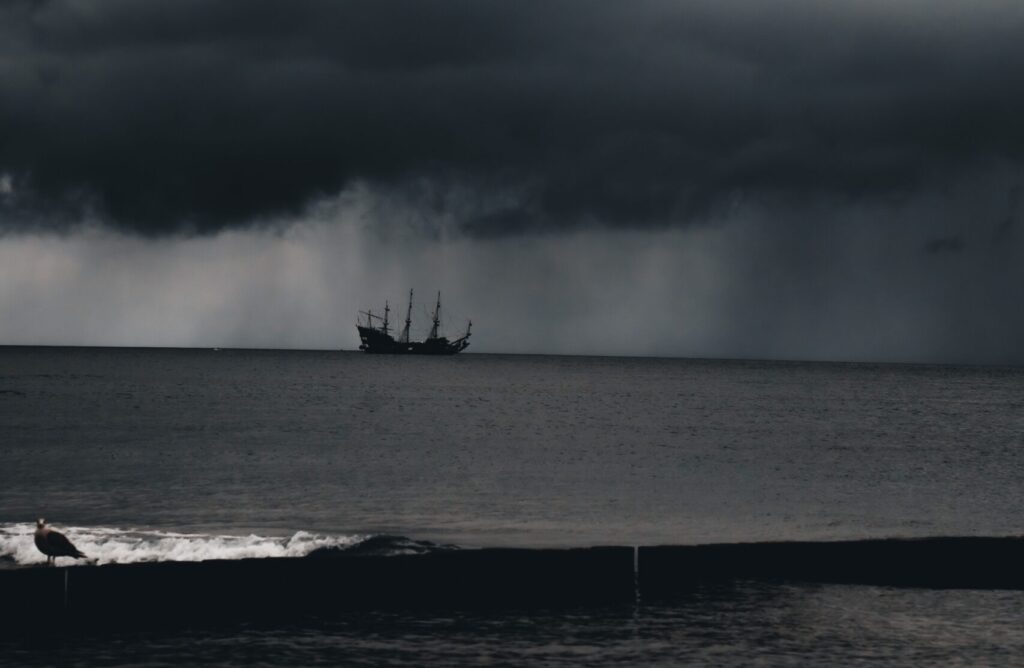
Russian drones are sinking ships off Romania. In Strasbourg, the plenary argued whether to arm Ukraine or focus on diplomatic efforts.
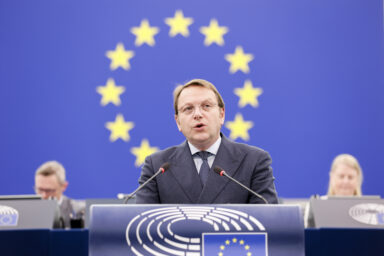
Five minutes spent in a conversation with an average voter is enough to make you an opponent of representative democracy, according to a saying often ascribed to Sir Winston Churchill. By that measure, the European Parliament represented its constituents well during Tuesday’s debate on the escalation of Russian attacks in the Black Sea.
“Good morning, colleagues, this debate is stupid,” MEP Petras Gražulis (ESN/LTU) summed things up neatly. “If we give up on Ukraine, we will have to give up on Europe as well,” he said in full accord with EU leadership. Mr Gražulis was responding to a barrage of complaints piled on Tuesday’s Strasbourg plenary session by an ad hoc coalition of Putin appeasers, all-round peaceniks, and nationalists.
No peace strategy?
After nearly two hours, Vice-President of the Commission Kaja Kallas, the EU’s top diplomat, had heard enough. MEPs had accused her of having no peace strategy. She hit back. “The only one who doesn’t want peace is Russia. Let’s be very clear eyed about this now,” she told them.
Ukraine wants peace, she said, and so does Europe. The High Representative also claimed a plan. “In February already I presented to (Marco Rubio, US) foreign minister a really maximalist plan how to enter into these peace talks.”
What we need is a strategy for peace, not escalation. — MEP Özlem Demirel (The Left/DEU)
Ms Kallas opened by describing Russian drone attacks. “Six attacks in ten days by suspected Russian drones mark a dangerous and unacceptable escalation in the Black Sea.” Ukraine, she said, loses an estimated €60m a day in export revenue.
Then the argument moved. About 70 MEPs spoke. By a rough count, a dozen sat firmly in the anti-escalation camp, demanding talks, diplomacy, and an exit from the war at any cost. The rest were realists, who spoke in favour of arming Ukraine, pressing Moscow, and defending Europe’s coasts.
Two camps, one war
The realists came from the EPP, S&D, Renew, Greens, and ECR benches, and occasionally from both the right and left fringe groups. Their case is simple. Russia attacks, so Europe must act. MEP Andrey Novakov (EPP/BGR) asked for a naval mission. “The EU should send a mission to the Black Sea to protect merchant shipping.”
MEP Thijs Reuten (S&D/NLD) blamed European hesitation for the attacks. “Fear of escalation enables escalation.” MEP Virginijus Sinkevičius (Greens-EFA/LTU) pointed to the Trump administration. “Washington is easing the pressure on Putin, but Europe has no choice. (… Mr Putin) deserves a cell in The Hague.”
Most of the appeasers came from the Left, the ESN, the PfE, and the non-attached. MEP Marc Botenga (The Left/BEL) said Europe had never tried to end the war. “No, people, what has been lacking is diplomacy. We will not die for your incompetence,” he added. MEP Stanislav Stoyanov (ESN/BGR), evoking the stance of his country’s pro-Russian president, agreed. “Europe needs diplomacy, not a war.”
Washington is easing the pressure on Putin. (He) deserves a cell in The Hague. — MEP Virginijus Sinkevičius (Greens-EFA/LTU)
Party lines did not hold. MEP Li Andersson (The Left/SUO) joined the realists on America. “Trump is no ally of Europe,” she offered an astute observation.
MEP Kristian Vigenin (S&D/BGR) backed air defences but added a warning. “Security will not come with more arms,” the Bulgarian said. “Enough death, enough destruction. Let’s make an effort to put an end to that war.”
Peace, but at what price?
The sharpest clash was over what peace means. MEP Özlem Demirel (The Left/DEU) said Europe had no plan. “What we need is a strategy for peace, not escalation.”
MEP Helmut Brandstätter (Renew/AUT) answered with a photograph from Ukraine, of a murdered infant. “Did you see that picture?” he asked the Kurdish-born MEP. “When are you going to come out and say that these are also war crimes?”
“We never do double standards,” Ms Demirel replied. She said children suffer in Russia as well as Ukraine. “And that’s precisely why we say that we need a strategy, a strategy for peace.”
It sounded like a call for moral equivalency, and Mr Brandstätter responded in that vein. “Are you saying that the EU is responsible for the fact that Putin is killing children on a daily basis?” he asked. Ms Demirel said Russia was responsible for its attacks. “(But) the EU strategy seems to be to supply more weapons to prolong this war.”
MEP Cristian Terheş (ECR/ROU) then put the realist question. “Peace is important. The question is, at what cost.” He said any deal that rewards an aggressor invites the next war. “Where do we stop this madness?”
MEP Sergey Lagodinsky (Greens-EFA/DEU) turned the argument round. Ukraine, he said, was ready to talk. “There’s only one person and one country that is saying no to peace negotiations, that doesn’t want to join in.”
The return of the swastika
The most bitter exchange came from the fringe. MEP Grzegorz Braun (NI/POL) called Ukraine’s government corrupt and neo-Nazi. He claimed that French and Ukrainian forces were amassing on Niger’s border. Then he challenged Ms Kallas. “Do you want us to subsidise wars that Ukraine is going to fight on different continents for our people’s money, our people’s resources?”
MEP Lukas Sieper (Renew/DEU) took a blue card, which lets one MEP question another. He began with a jibe. “How many buzzwords do you think you can fit into one speech?” He then raised reports of Russian mercenaries using swastikas in the Sahel. “And doesn’t that show us who the real enemy is?”
What has been lacking is diplomacy. We will not die for your incompetence. — MEP Marc Botenga (The Left/BEL)
Mr Braun’s reply caused the uproar. “The difference between us is that I don’t approve swastika symbols being used by anybody, including Ukrainians.” In response to the accusation that he approved of the symbol, Mr Sieper demanded the floor for a personal statement. “Don’t ever say again that I approve of swastikas. I’m a German. I grew up with the guilt of the Nazi terror. This is a grave insult to my history, to my culture, to my beliefs and to me as a person.”
Then he returned to his question. “How can it be that in your heart you cannot find the decency to support a country that is attacked by those very forces every day?”
The last word
Mr Braun did not answer it. He turned to WWII instead. “More than 100,000, maybe 200,000 Polish people were killed, were exterminated by Ukrainians during the Second World War.” Then he turned on Mr Sieper. “By the way, your country had something to do with the events of WWII.”
Ms Kallas closed the debate by addressing calls for a diplomatic solution. Negotiators have pushed Ukraine to surrender for almost two years, she said. It has not, because Europe supports it. “We don’t have a choice.”
If we give up on Ukraine, we will have to give up on Europe as well. — MEP Petras Gražulis (ESN/LTU)
Sanctions, she argued, work, and Russia wants them lifted. She said they had deprived Russia of €1tn. Europe must be at the table, because the decisions on sanctions are European.
She rejected the argument for concessions. “I’m sorry, but if we say that, then everybody is under threat.” A world where threats pay, she said, is far more dangerous.
Ms Kallas’s last words answered the question of who blocks peace. “Ukraine agreed to energy ceasefire. It was Ukraine who agreed to the Black Sea arrangement. Ukraine agreed to ceasefire.” Russia, she said, had agreed to none of them. The debate ended with seven motions for resolutions. MEPs vote on Thursday.