Marine Le Pen and Jean-Luc Mélenchon want a tougher France in Brussels. Both would face the same constraints. Neither scenario is pretty.
Marine Le Pen, France’s far-right firebrand, and Jean-Luc Mélenchon, the country’s far-left would-be leader, have little in common. Both want to bargain harder with Brussels than their predecessors, even as their methods and their aims differ sharply.
Ms Le Pen wants to stay inside with far less EU. That makes confrontation, not exit, her likeliest method. Her proposals would not amend the treaties automatically. They would create a crisis of vetoes and infringement cases.
We (the EU) have led an energy war against Russia, when we haven’t got any energy. It is not very smart. — Marine Le Pen, French presidential frontrunner
Mr Mélenchon proposes two stages. Plan A is to renegotiate the treaties collectively, through a ‘concerted break’ with the existing texts. Plan B is to apply his programme anyway. Any new treaty would go to a French referendum.
His aim is a different EU, not a smaller one. He says the treaties block public services, public investment, state control over finance, and ecological protectionism. “You do what you want, but so do we,” he said.
Shared tactics, shared walls
Both would use the EU budget as a weapon. Ms Le Pen wants to cap France’s net annual contribution at €5bn, against roughly €8bn now. Her party first proposed cutting about €11bn from the 2027 contribution. Mr Mélenchon also wants to cut the contribution and use it as leverage.
Ms Le Pen expects a fight. “We know there will be a tough debate, even a trial of strength,” she said. “But we have the will and the conviction that we will be able to do it.”
The law is against both. France’s contributions flow from the system that funds the EU budget. Changing that system needs unanimity in the Council and ratification by every member state. Neither president could replace the agreed formula by decree. The National Assembly has already approved the planned 2027 contribution of €30.9bn.
A rebate differs from non-payment. A rebate needs an EU-level agreement, normally with unanimity. Refusing to pay an agreed contribution would breach the treaty. The Commission could start infringement proceedings and take France to the Court of Justice of the EU (CJEU). The court could impose daily or lump-sum fines. Yet the EU has few direct enforcement tools. It cannot simply deduct unpaid contributions from French programme payments.
What the treaties allow
Other member states would have to cover any shortfall or cut spending. France would stay entitled to EU programmes unless a separate legal basis allowed suspension. The treaties contain no automatic expulsion mechanism. The EU could respond with talks, pressure over French farm receipts, or existing rule-of-law conditionality. It could not invent a new sanction.
Treaty change is the second shared wall. Article 48 needs agreement from every member state and national ratification. While France—just like any other member state—can block or delay a reform, it cannot impose one. That makes Mr Mélenchon’s Plan A politically hard.
Becoming a co-belligerent in Ukraine (…) is an immense danger that we do not want. — Jean-Luc Mélenchon, French presidential candidate
Both also eye the European Central Bank (ECB). Ms Le Pen wants it to finance large-scale borrowing. Mr Mélenchon wants to reform its mandate (and his Plan B targets its rules on public debt and monetary financing). The treaties, however, prohibit monetary financing. Either president would have to open a second legal front, a risky move at best.
Plan B would set French law against EU law. The programme says France would disobey blocking rules whenever necessary. Under such a scenario, financial markets would likely punish France, and disputes over ECB operations would widen the crisis. The official programme describes disobedience; even a sovereign exit remains on the table. The campaign line is not formally Frexit, but it keeps unilateral non-compliance as a fallback.
Where Paris can block
The paragraphs above deal with what either of the candidates could achieve in the Élysée. What should send shivers down Europe’s spine is the other side of the coin — what either of them could stop in its tracks.
Either president would hold a veto where the treaties demand unanimity. Elsewhere, qualified majorities decide. France cannot block laws alone; a blocking minority needs at least four states representing more than 35 per cent of the EU population.
The seven-year budget needs unanimity in the Council and the consent of the European Parliament. The Commission proposes about €1.763tn in 2025 prices, including a Ukraine reserve of up to €88.9bn. A single government could delay or block it.
A block would not collapse the budget. Existing ceilings would continue to apply, and annual budgets and commitments would still operate. New EU revenue sources also need unanimity and ratification by every member state. Speculation: Ms Le Pen would use the veto as her main lever. Mr Mélenchon would use both levers to demand concessions on fiscal rules.
Sanctions fall under the Common Foreign and Security Policy. Council decisions generally need unanimity. France could block the renewal or expansion of sanctions. It could also make new Ukraine-support instruments harder to agree. Existing sanctions would not lapse automatically. Many regimes need periodic renewal, which gives Paris leverage.
Russia and Ukraine
Here the two diverge. Ms Le Pen is sceptical about sanctions on Russia. “We (the EU) have led an energy war against Russia, when we haven’t got any energy. It is not very smart,” she said.
Asked whether Russia was the main threat to Europe’s security, she replied: “You know I’m not in Mr Putin’s head and I don’t know Mr Putin’s plans.” This suggests that under her presidency, France would likely drop its current hawkish line and seek distance from Moscow, Washington, and Brussels alike.
Ukraine would lose French money. Ms Le Pen says she would stop financial aid within six months of her election because France cannot afford it. She would keep some training for Ukrainian soldiers.
You do what you want, but so do we. — Jean-Luc Mélenchon
“The honest thing to do with Mr Zelenskyy is to tell him, to warn him in fact that, listen, we can’t do more, we can’t manage more,” she told the Financial Times. Member states control bilateral military aid, so France can stop that alone. Withdrawing money already committed through EU instruments would create legal disputes.
Different Europes
She also doubts further EU loans. “We’ve already done €90bn of loans, that’s €18bn for France. €18bn is really a lot,” she said. She opposes Ukrainian EU membership, which needs unanimity. Speculation: France could block it.
How Mr Mélenchon would vote on specific sanctions packages remains unclear. He rejects co-belligerence. “Becoming a co-belligerent in Ukraine (…) is an immense danger that we do not want,” he said. It was not obvious, however, where he draws the line of ‘becoming a co-belligerent’. Either way, a veto on financial aid to Kyiv can be bypassed. In December 2025, the EU used the enhanced-cooperation mechanism to finance Ukraine.
On the Commission, Ms Le Pen goes furthest. She wants a looser model of co-operation, with power flowing back to member states. She wants the Commission reduced to a secretariat serving national governments.
A growing problem
That needs more than ordinary law. The Commission’s right to propose legislation and its duty to apply EU law sit in the treaties. Speculation: a French attempt to downgrade it would meet resistance from the Commission, the European Parliament, and the Court. Infringement cases would follow if France stopped applying EU obligations.
Climate, rules, and trade
She also questions whether Ursula von der Leyen, the Commission president, can serve until 2029. The EU is racing to agree a seven-year budget before the French election. “In fact, I think it reveals the contempt the Commission has for democratic processes in Europe,” she said.
Ms Le Pen has pledged to stop the European Green Deal. France cannot do that alone. Much of that legislation passed by qualified majority in the Council and the European Parliament. France may, of course, refuse support for extra climate measures where unanimity applies.
Existing climate and energy rules stay binding until amended, repealed, or annulled. Paris can seek repeal through the normal EU process, not by decree. French courts and the Court of Justice could challenge contrary national law. Systematic refusal by a large state would undermine the EU’s rule-of-law structure. The remedy would still be infringement litigation.
Her cornerstone pledge, ‘national preference’, would give French citizens priority on social housing, welfare, and government jobs. It would probably need a constitutional change, perhaps by referendum. It would also contravene EU law. Mr Mélenchon has no equivalent pledge in the sources.
Money and markets
Fiscal policy splits them most clearly. Ms Le Pen promises €140bn in spending reductions by 2032 and at least €30bn in tax cuts. “We will do both massive state spending cuts, while also kick-starting the economy,” she said. “We will put an end to the fiscal plunder inflicted on the French by a profligate state.”
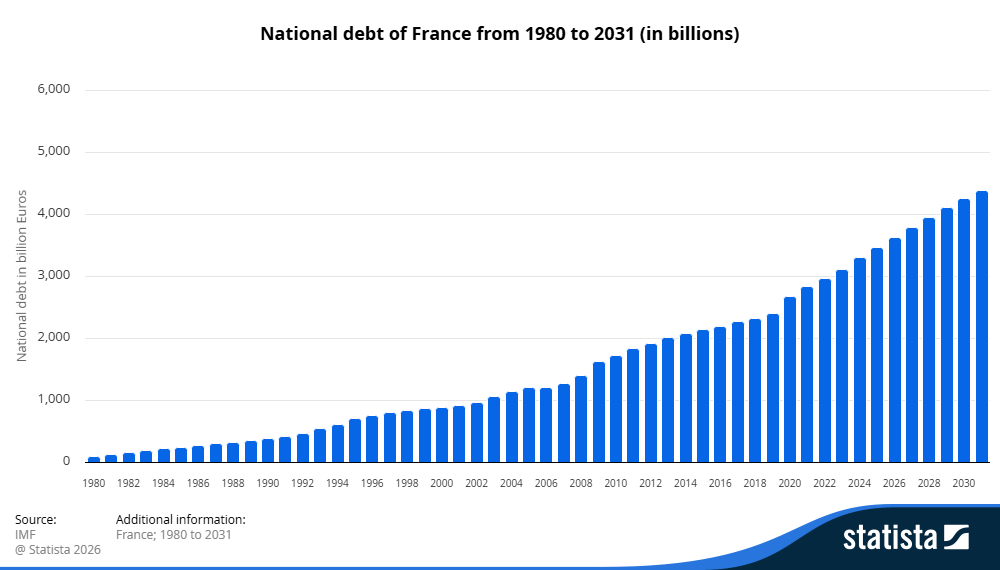
She admits that debt, at 119 per cent of GDP, is her biggest outside constraint. “Politics is in reality a question of conviction confronted by constraints,” she told the Financial Times. “I have no intention of losing my convictions.”
The honest thing to do with Mr Zelenskyy is to tell him, to warn him in fact that, listen, we can’t do more, we can’t manage more. — Marine Le Pen
Mr Mélenchon wants looser rules. Fiscal rules mostly pass by qualified majority. France could contest them, seek softer application, and build coalitions. It would have no national veto. Here his doctrine would collide most directly with EU law.
Trade is similar. Mr Mélenchon opposes the EU–Mercosur deal and wants a veto on new free-trade agreements. Qualified majorities mostly decide such deals. Paris could delay, press for farm safeguards, and use ratification rules if the deal is mixed.
The Assembly decides
Domestic arithmetic constrains both. The presidential election is slated to 18 April 2027, with a run-off on 2 May. The winner inherits the existing Assembly. No bloc holds the 289 seats needed for a majority. France elects its president and Assembly separately and the new president could, in theory, announce a snap parliamentary election.
Ms Le Pen has promised the prime minister’s job to Jordan Bardella, her popular number two. Her Rassemblement National has the largest bloc but no outright majority. As things stand, any new president would need alliances or constant bargaining to pass laws. Budgets and reforms would depend on partners. This may constrain what France does in Brussels. (For instance, Mr Mélenchon would struggle to deliver his Plan B at home, let alone abroad.)
Speaking about her ideological allies, Ms Le Pen has described Italian Prime Minister Giorgia Meloni as a politician of conviction who has never changed but works in a constrained environment. The French frontrunner herself would meet the same constraints. Debt, courts, and a divided Assembly would test her promises. “I have no intention to lose my convictions,” she told FT.
A muddy gridlock
The likely result would therefore be neither immediate Frexit nor effortless French control of the EU. It would be a prolonged constitutional confrontation: France could use unanimity vetoes to obstruct future decisions, while the Commission and CJEU could pursue breaches of existing law.
The greatest danger is political rather than automatic legal collapse, with budget gridlock, weakened sanctions, stalled climate policy, and a breakdown of the Franco-German compromise that has traditionally helped drive EU decisions.
Over one hundred years ago, a conflict between Paris and Berlin produced a prolonged stalemate in the muddy Belgian soil, with a terrible price paid in human lives. This time around, it threatens to have a similar effect; just the resulting loss of life would take place several hundred miles to the East.