A sweeping sanctions package moving through the US Senate would give President Donald Trump the authority to impose tariffs of up to 100% on countries that buy Russian oil and gas. Among them, Europe.
The Lindsey O. Graham Sanctioning Russia Act of 2026 approved by the Senate on 7 August in an 86-11 vote. The bill, which targets countries that continue to buy Russian oil and gas, now heads to the House. More than a year in the making, the package was championed by the late Republican Senator Lindsey Graham, who died shortly before the Senate vote.
The bill has drawn unusually broad bipartisan backing. After the first procedural vote in the Senate in late July, Republican Senator John Curtis, a cosponsor, framed the breadth of support as a signal of intent.
“It’s not very often that you see things here in the Senate that are that overwhelmingly bipartisan,” Curtis said. “And when you see that many of my colleagues on both sides come together, you should pay attention because that means we’re serious and something’s going to happen.”
Curtis, like many US legislators, is judging the bill off of its merits alone, not the context it’s crafted within. “Anybody who thinks that this is not a good versus evil argument is mistaken,” Curtis said. “And we know where Iran lines up on that side. We know where the dictators line up. We know where democracy lines up, and where freedom lines up. And the battle lines are very clear.”
The EU-US context
The context is Trump’s use of all tariff tools on the table against Europe. Trump threatened a 50% EU tariff in mid-2025, then struck the July 2025 “Turnberry” deal capping most goods at 15%, with steel and aluminium at 50%. He briefly hiked cars to 25% in spring 2026 before a May deal restored the 15% cap. Just a few weeks ago, he launched a Section 301 probe threatening a “substantial” tariff over the EU’s fines on US tech firms.
“This bill is clearly meant to provide a new discretionary, Congressionally approved tariff weapon — up to a rate of 100%. That should worry Europeans.”
— Nevada Joan Lee, policy fellow, European Council on Foreign Relations
Ukrainian President Volodymyr Zelenskyy, in Washington for Graham’s funeral, backed the legislation and watched the vote from the Senate gallery.
“This bill is very important. Sanctions, pressure on Russia is very important. And really it gives, it’s not all about money. It’s also a big signal to Europe, a big signal to Ukraine and big support for our people. So, I’m very thankful, I’m very hopeful,” Zelenskyy said.
Helpful tool, or a congresionally approved weapon?
But others see a different mechanism at work beneath the sanctions framing.
Nevada Joan Lee, a policy fellow at the European Council on Foreign Relations (ECFR), contends the administration already has ample authority to sanction Moscow and needs no fresh legislation to do it.
“This bill is clearly meant to provide a new discretionary, Congressionally approved tariff weapon — up to a rate of 100%. That should worry Europeans,” Lee said.
“(The bill) is also a big signal to Europe, a big signal to Ukraine and big support for our people. So, I’m very thankful, I’m very hopeful.”
— Volodymyr Zelenskyy, Ukraine’s President
Democratic Representative Gregory W. Meeks of New York, ranking member of the House Foreign Affairs Committee, has raised his own reservations.
“This is not so much a sanctions bill as it is a massive backdoor authority for President Trump to impose more tariffs, including on our European allies, that hurt American families,” he said upon reviewing the text. “The sanctions the bill does contain are entirely at Donald Trump’s discretion, and he has made clear repeatedly that he would rather waive sanctions on Russia than impose new ones.”
The bill’s sponsors reject the notion that allies are in the crosshairs. They note the duties fall on individual countries rather than the EU as a bloc, that a rule of construction in Section 113(h) bars tariffs on any country not meeting the bill’s criteria, and that the gas carve-out is designed precisely to shield European states still reducing their Russian imports.
100% for the top 5
Section 113 of the proposed bill authorises the president to impose tariffs of up to 100% on all goods from countries ranked among the five largest importers of Russian crude oil or natural gas, as well as on countries among the top five facilitators of Russian oil sanctions evasion.
The qualifying list is reassessed by the US Trade Representative every 180 days. The section carves out countries whose Russian gas imports fall below 15% of Russia’s total gas exports, provided they are taking significant steps to reduce them — a provision aimed at European states still weaning off Russian supply. A presidential waiver, subject to a national-interest certification to Congress, applies throughout.
Yet, Europe is still not in the clear.
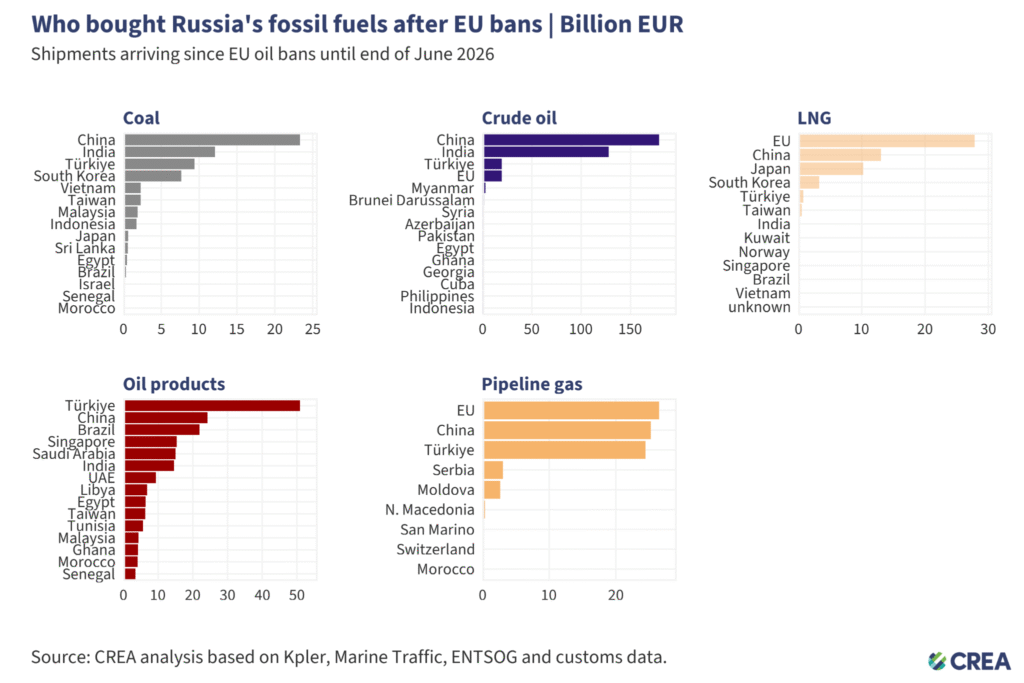
Despite the EU’s ban on imports of oil products made from Russian crude, eight shipments of oil products from refineries using Russian crude were unloaded at EU ports in June 2026, according to the Centre for Research on Energy and Clean Air (CREA).
China remained Russia’s largest single buyer of fossil fuels in June 2026, followed by India and Turkey. The EU ranked fourth, accounting for almost 11% — EUR 1.9 billion — of Russia’s export revenues from its top five importers, just over half of it LNG.
Hung(a)ry for Russian gas
Europe’s exposure is concentrated in a handful of member states. In June 2026, the five largest EU importers of Russian fossil fuels paid Moscow a combined EUR 1.7 billion.
Hungary was the EU’s largest buyer, importing EUR 591 million of Russian fossil fuels, consisting of pipeline gas and crude oil.
France was second, purchasing EUR 349 million of Russian LNG — a 34% month-on-month increase even as its total unloaded LNG fell by 35%. The French port of Montoir saw a fourfold increase in Russian LNG shipments in June compared with May.
Spain was third at EUR 258 million, all of it LNG, though its Russian LNG unloadings dropped 38% month-on-month.
Belgium and Slovakia rounded out the top five, the latter still receiving Russian crude via the Druzhba pipeline.
Ultimately, despite the bill targeting only individual states, the EU’s customs union could mean all its members could be affected.
If this legislation passes in the fall, and European member states still import Russian fossil fuels, the text hands President Trump a 100% tariff tool.