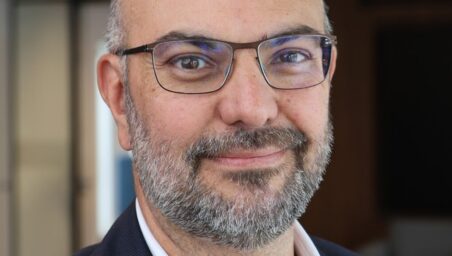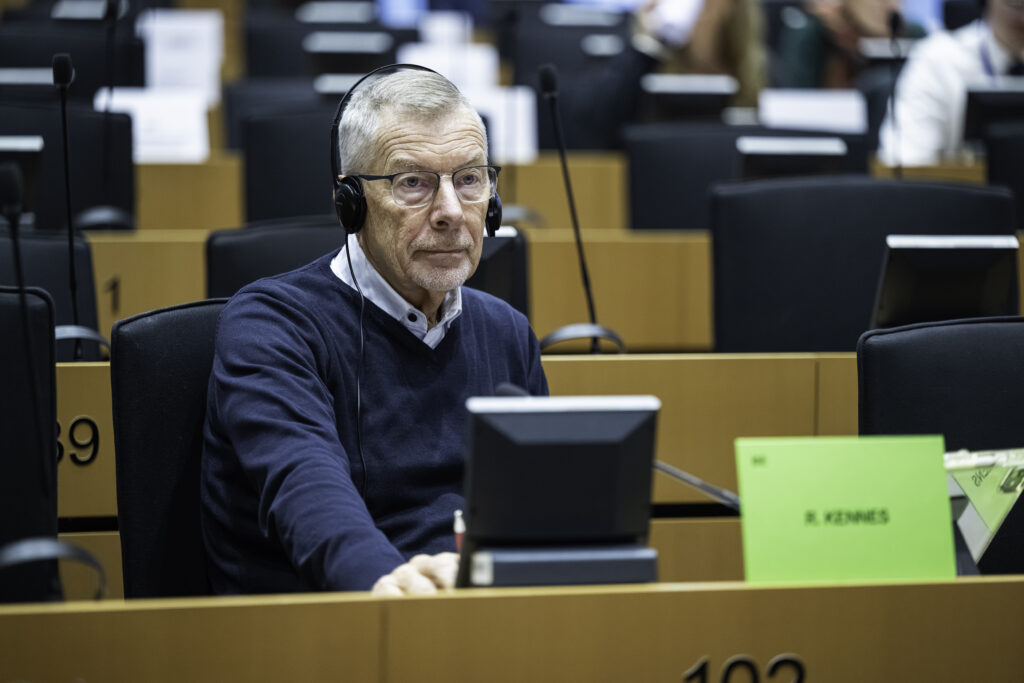
Rudi Kennes fought to save Opel’s Antwerp factory before entering the European Parliament. Now, as lawmakers negotiate the Industrial Accelerator Act, the former factory worker and trade unionist wants guarantees that supporting European industry will also benefit its workers.
The Belgian lawmaker represents The Left in negotiations on the proposal as a shadow rapporteur. The Industrial Accelerator Act seeks to strengthen European production, making the debate over what qualifies as “Made in Europe” particularly important to him.
I do not think this will be a long-term solution for Europe. We might buy ourselves some time by giving the industry another few hundred million or billion euros. Structurally, though, I do not think that solves the problem.
— Rudi Kennes (Left/BE)
In an interview with EU Perspectives, Kennes welcomed the ambition but questioned whether governments were ready to change how they support industry. Drawing on his experience of factory closures and union negotiations, he explained why he wants stronger conditions on public money and where he sees room for compromise.
You might be interested
You have worked in manufacturing and experienced a factory closure yourself. What do you think politicians without that experience fail to understand about the problems facing industry and its workers?
First of all, if we want to understand where we are today, we have to look a little backwards. Where did we come from?
I think politicians, and I give them the benefit of the doubt, listened to the industry when it said: give us the money and we will take care of it. There was this belief in the free market. The free market would solve everything. But we saw that it did not.
What I personally had a problem with was that whenever there was another plant closure, including my own in Antwerp, it was always blamed on the workers, high wages, the indexation system and so on. Yet some decisions had to do with politics and geopolitics, rather than the workers or even the business case.
At the time of our closure, I had discussions on television with professors who asked whether industry was still necessary in Europe because we were a service society. I could not believe my ears. Not just because I was a worker, but because I understood that industrial jobs also supported indirect jobs.
When a factory job goes, it is not only that job. It is everything around it, the supply chains and so forth. The damage is huge. I wanted politicians to draw lessons from that, because it was not a failure of the workers.
Where do you think those failures were?
I think companies did not want to invest enough in research and development. Of course, companies are there to make a profit. But the profit did not go into reinvestment. It went into shareholders’ pockets. On the other side, they were always looking for cheap labour. Somewhere in the world, there is always somebody who will do the work a little more cheaply.
I compare it with a football team. The sponsor comes and goes. The coach comes and goes. The CEO comes and goes. Who stays? The supporters. Who stays in the company? The workers.
The workers have every incentive to take care of the company, and they do that every day. But there are people who think only about the next quarter. The next quarter has to look good, no matter what happens afterwards.
We need long-term planning. Too often, big industry says what needs to happen and politicians listen. I do not think that is sustainable for the future.
What “Made in Europe” means
The Industrial Accelerator Act is supposed to address some of these problems. Do you see it as a possible solution? What do you welcome, and what is missing?
The first time I heard “Made in Europe”, it was music to my ears. Finally, I thought, they would come up with a real, sustainable European industrial policy.
But when I look at the discussions today, I already have doubts. For me, “Made in Europe” means made in Europe. Yet we are still discussing what that is.
For me, it means the 27 member states. Other people say we also have Switzerland, the UK and all these countries with which we have agreements. So what does it mean?
As somebody from The Left, I do not care who owns the money or where it comes from. I am interested in whether jobs come to Europe or remain in Europe. Quality jobs. That is not so certain from the discussions I see today.
What specifically do you think is missing from the proposal?
There are several negative points. The protections for workers are not there. The investment thresholds are too high. We want more large beneficiaries to be held accountable, but the thresholds as they stand capture only a few large Chinese investments. That is unacceptable.
First, we need to define what “Made in Europe” means and put in criteria that benefit people. How much of the investment has to be in Europe? How much of the actual work has to happen here? Those conditions are very important to us.
Industry has its lobbyists. I care about people, about workers, about ordinary people. This whole plan has to bring a future for working people in Europe. That is what is lacking now.
Lack of a future leads people to the far right
You link that lack of a future to growing support for the far right. Why?
People no longer see a perspective, and politicians are not giving them one. They see deindustrialisation, and nobody brings something to the table to solve their problems.
More and more people are voting for the far right. Why? They are not all fascists. They are desperate, they do not see a future. I think we need to address this from our perspective on the left. We have to put forward something that changes this feeling of hopelessness, of people no longer seeing a future.
But European production can be more expensive. If companies struggle to compete while maintaining good working conditions, what would be the fairest solution?
The market alone will not change it. But wrong political decisions will not make it right either.
When I speak to people in industry, to CEOs, the first thing they bring up is not labour costs. It is energy prices. We were told that the market would solve this, that competition would make energy cheaper. But when you get your energy bill, nobody even understands it. They understand the final figure, and that is far too high.
I want more public control over energy. We can do that. But we are still told that the market will fix it. I do not think this will be a long-term solution for Europe. We might buy ourselves some time by giving the industry another few hundred million or billion euros. Structurally, though, I do not think that solves the problem.
And what about subsidies? Are you against giving companies more public support?
I am not against supporting industry. Small and medium-sized companies deserve support too. But we love the free market when we are winning. When everything goes well, industry is liberal. When there is a crisis, everyone asks the state: save us, give us money.
If a company says it does not want any rules, that you should give it the money and let it do what it wants, then it does not need public money. It is taxpayers’ money. We have to see a return on the taxpayer’s investment. There have to be conditions.
European, not national approach
When a factory closes, we often hear a number of jobs lost without much explanation of what it means for the people or the region. From your experience, what needs to change in the way governments deal with companies?
We always talk about the European market. But to work in a European market, you need European politicians. What I still see is regions being played against each other.
A company comes to Belgium, for example, and says it is considering an investment but has not decided where. What do you offer? Then it flies to Germany and says it has just spoken to the Belgians. How much will you give?
Every government wants investment and jobs. If you have plant closures and unemployment, it is more difficult when you go into the next election.
But we need a real European industrial plan. I know it is difficult because politicians are elected in their own countries and have to take care of their voters. Still, we need to move beyond that.
So you would like more European cooperation, rather than countries acting separately?
Yes. We are not Europeans just to sit here in the European Parliament. We need to get away from this halfway position: with one foot I am European, and with the other I am still Belgian or German.
There are only a few big countries in Europe. I do not understand why smaller countries such as Belgium are not pushing harder for this. Nobody can fix it alone. We can fix it together, or we cannot. It is as simple as that.
We say a lot of things. Now we have to put our money where our mouth is.
Yes to industrial policy. But with consequences
What about cooperation inside Parliament? The Left is one of the smaller groups. How are the IAA negotiations going, and how willing are you to compromise?
We are small, you are absolutely right. But one advantage of being small is that it is easier to come to one opinion. I think The Left is one of the groups in Parliament that knows what it wants.
When I look at the biggest group, there is a lot of discussion. I see that as a shadow rapporteur. They still have 1 December as the date for a vote, which I do not think is realistic, but now they are putting on the brakes.
Of course we will have to compromise. We are used to compromise. I worked in the trade union for 30 years. Every day was a compromise. If I go home tonight to my family, I also have to compromise. That is not the issue.
But we have some red lines. We will support the points put forward by the trade unions. The main point for us is to stop throwing money around and at least make companies accountable.
They can have our support. We are not against companies. No companies, no jobs. We are in favour of an industrial policy, but with consequences. It cannot continue as it did in the past.
Which conditions would you insist on before supporting an agreement?
I do not think it would be wise to set out all the details publicly during the negotiations. We are a small group and they can ignore us if they want. Nevertheless, we have our points, and we will tell the public what we want and why we think it makes sense.
We want conditions for workers, but also for the public, because this is taxpayers’ money.
We do not want to damage industry. On the contrary. During my own plant closure, I tried everything. As I said, it is the workers who stay in these companies.
Some people put forward this idea that trade unions are against industry or against companies. Why would they be? They have no interest in that. The same applies to people from The Left.
But there need to be conditions. They can count on us, but on conditions.