Frontline European states want to design the next security order, not merely defend its edge. That is the message of the Warsaw Security Report 2026, published alongside the Warsaw Security Forum on 12–13 October.
The report Securing Europe from the Eastern Flank to the High North sets out a strategy for the Nordic-Baltic-Polish group: Denmark, Estonia, Finland, Iceland, Latvia, Lithuania, Norway, Poland and Sweden. Analysts at the Casimir Pulaski Foundation drafted it, with a working group of 27 contributors.
Prof. Katarzyna Pisarska, chair of the Warsaw Security Forum, frames it as a change of mood. Last year’s forum ran under the theme #DividedWeFall. She calls that “a warning”, not a prediction. This year’s theme is #UnitedWeStand.
A region that claims a leading role
“Europe is no longer merely promising to step up; it is already doing so,” writes Ms Pisarska in the introduction. She says Europe now finances the larger share of Ukraine’s defence. In her telling, it has mobilised resources, industry and political will faster than most expected a year ago.
Ms Pisarska argues that the war’s outcome will not settle the matter. “Europe’s future security order will not be decided by the outcome of the war in Ukraine alone,” she writes. It will also depend, she says, on whether frontline democracies can organise for long strategic competition.
The American guarantee remains indispensable, but it can no longer be treated as an unlimited substitute for European capability — Warsaw Security Report 2026
The region, she notes, holds the longest continuous stretch of Allied territory facing Russia and Belarus. She wants it seen as one of the principal architects of the post-war security agenda. A mere frontline, in her view, undersells it.
Ukraine as a strategic investment
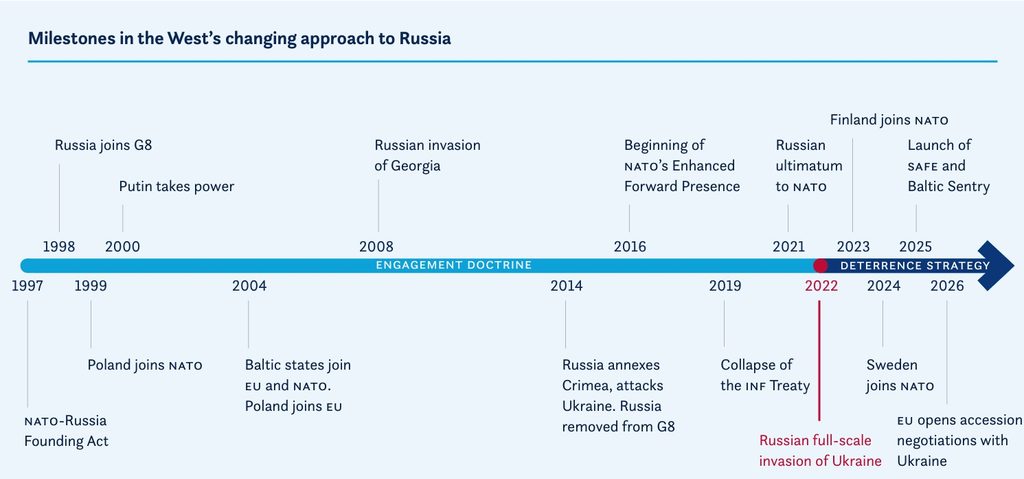
The report builds on six goals. The first is to rethink Russia. For three decades, the report says, policy managed relations with Moscow instead of addressing the threat Russia posed to European security. “Europe can no longer dismiss Russia while hoping for relations to improve, but should treat it as a structural threat around which Europe’s long-term security architecture must be organised,” the authors write. The region, they add, has long taken that view.
The second goal is to anchor Ukraine in the European Union and NATO. The authors call the usual solidarity argument understandable but incomplete. They see integration as a way to strengthen deterrence and add strategic depth. “The region should therefore support Ukraine’s integration not only because it is morally justified, but because it directly serves its own security interests,” the team wrote. A permanently unstable Ukraine, they warn, would invite outside interference.
The report adds more detail. Full NATO and EU membership should stay the declared objective. Interim guarantees should be built in layers, so that they support that goal and do not quietly replace it. The report also argues for the frontline states to hold a standing seat in every format that decides Ukraine’s security guarantees. Before any talks with Russia, they should agree common red lines and minimum terms.
Less American cover, more European muscle
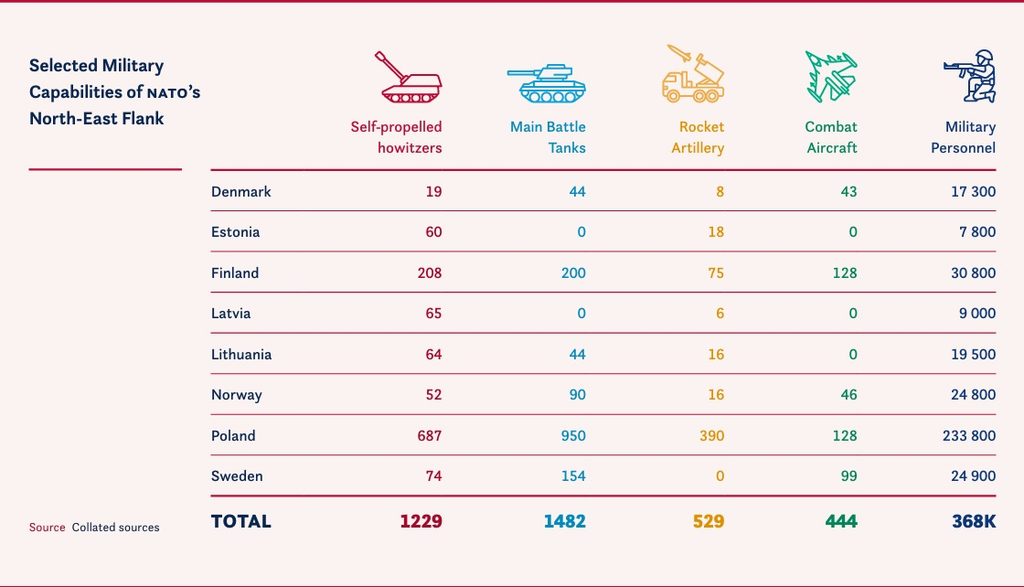
The two defence chapters get the report’s sharpest language. One of them speaks of a stronger European pillar of NATO. The authors note that about 80,000 US troops remained stationed across the continent in 2025. Washington, however, increasingly expects Europeans to carry more of the load.
“The American guarantee remains indispensable, but it can no longer be treated as an unlimited substitute for European capability,” the authors write. They say the shift reflects American attention moving towards the Indo-Pacific and other priorities.
Europe’s future security order will not be decided by the outcome of the war in Ukraine alone. — Katarzyna Pisarska, chair of the Warsaw Security Forum
The conclusion for the north and east is blunt. “The states on NATO’s northern and eastern flanks must therefore be prepared to shoulder a greater share of the burden for their own security,” the authors write.
Practical steps are listed neatly. They include a genuine operational framework for the Nordic-Baltic Eight and Poland, and control of the airspace over the Suwałki Gap. They also include making Poland’s accession to the Joint Expeditionary Force operational, and a North-Eastern Seaguard for undersea infrastructure and the shadow fleet.
The nuclear gap
The fourth goal turns to nuclear weapons. The authors argue that the old framework for managing nuclear risk in Europe has fallen apart. “Almost the entire arms-control architecture of the transatlantic area has largely unravelled,” they write.
The team itemises the losses. Russia has left or suspended the Conventional Armed Forces in Europe Treaty, the Treaty on Open Skies and the Intermediate-Range Nuclear Forces Treaty. New START expired in 2026. Meanwhile, Russia is modernising its strategic rocket forces and fielding new delivery systems.
Europe’s own position is weak, the authors say. After the Cold War, France and the United Kingdom cut their forces. The US sharply reduced its tactical weapons in Europe. That left Russia with a marked advantage in tactical nuclear arms.
“That dependence is most dangerous precisely where it is most complete,” the authors write. Ms Pisarska’s remedy has two parts. One is long-range conventional strike capability. The other is a joint push for a fairer regional share in NATO’s nuclear arrangements. This can be read as a recommendation that the conventional capability cover the gap while the nuclear question stays unresolved.
Infrastructure and industry
The last two goals move from the battlefield to the economy. On energy, the authors say Europe built its systems for markets and efficiency. “Resilience of energy systems has been a secondary priority at best,” they write.
Europe can no longer dismiss Russia while hoping for relations to improve, but should treat it as a structural threat around which Europe’s long-term security architecture must be organised. — Warsaw Security Report 2026
Since 2022, they add, hybrid tactics have increasingly targeted energy infrastructure, particularly around the Baltic Sea. Ms Pisarska’s answer is shared situational awareness of the sea. It would concentrate protection on the offshore nodes whose loss would hurt most.
The sixth goal links energy and defence through raw materials. The authors say the energy transition and rearmament now rely on the same industrial capabilities. Governments, they note, are rebuilding defence industry after years of underinvestment.
“The principal bottleneck is often not extraction but processing,” the authors write. A material mined in Europe can still pass through plants elsewhere. The real question, they say, is whether Europe has the capacity to turn resources into usable products.
Who stands behind it
Eight authors worked on the report. Besides Ms Pisarska, they include Maciej Dachowski, director of the foreign policy and European integration programme at the Casimir Pulaski Foundation. Tomasz Smura, a board member and director of the institution’s defence and international security programme, is another. So is Maciej Filip Bukowski, director of its energy and resilience programme, and four other authors.
The contributor list is political and diplomatic. It includes Norwegian Foreign Minister Espen Barth Eide, Estonian Foreign Minister Margus Tsahkna and Lithuanian Foreign Minister Kęstutis Budrys. Former Estonian President Toomas Hendrik Ilves also contributed, as did Gabrielius Landsbergis, Lithuania’s foreign minister from 2020 to 2024.
Defence figures feature too. They include Lt. Gen. Piotr Błazeusz, Poland’s military representative to the NATO and EU military committees, and Heikki Autto, chair of the Finnish parliament’s Defence Committee. Dovile Šakalienė, Lithuania’s defence minister from 2024 to 2025, also took part.
Analysts from outside the region add weight. They include Anna Wieslander of the Atlantic Council, Minna Ålander of the Stockholm Center for European Studies, and Pierre Thévenin of SIPRI. Polish voices include Krzysztof Bosak, deputy speaker of the Sejm, and Władysław Teofil Bartoszewski, secretary of state at the foreign ministry.
The breadth matters. The goals—recognise Russia as a structural threat, anchor Ukraine, build a European pillar—depend on one another. The report is also a bid for influence, since it asks for a seat wherever Ukraine’s future is decided. Whether Europe’s larger capitals agree is speculation, and the report does not (and cannot) say.