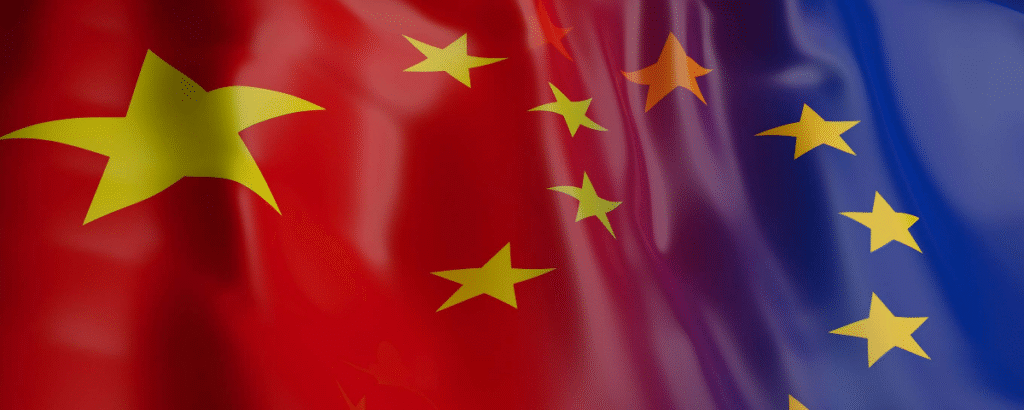
The recent EU–China trade deal has been hailed as a small but important step forward. Now, EU lawmakers want more. Negotiations must be backed by credible threat of measures to secure a fairer relationship with Beijing, they argue.
The European Union recently secured an agreement with China to curb hybrid-car exports and ease export approvals for rare earths and permanent magnets to Europe. But for European lawmakers, the deal should only be the beginning.
Next week, the European Parliament’s trade committee (INTA) will visit Beijing and Shanghai to address wider trade imbalances and industrial competition between the two economies.
Parliament hopes Brussels will soon reach a broader settlement covering other industries and investment. MEP Bernd Lange (S&D/DEU), INTA’s chair, said the EU should seek a comprehensive agreement with China soon. “Many issues remain on the table, from industrial overcapacity to access to rare earths,” he said. According to him, the EU currently faces a daily trade deficit of €1 billion with China, due in part to its import restrictions on EU companies.
Negotiation needs a credible alternative
Negotiations alone, however, would be naive, the lawmakers argue. The EU must also strengthen its ability to respond. Pascal Canfin (Renew/FRA), the Parliament’s standing rapporteur on China, said negotiations would be more effective if China knew the EU was prepared to take action in the absence of an agreement.
We are ready to negotiate, we are happy to negotiate, we are open for negotiation sector per sector. — MEP Pascal Canfin (Renew/FRA)
“If you do not negotiate, you just go instantly to the escalation, which is not what we want,” he said. “But if you just negotiate without the credible possibility to do something differently, then negotiation is not credible at all.”
Beyond cars
European manufacturers face heavy competition from Chinese producers in chemicals, machinery and other industrial sectors. The concern is not limited to individual products, but also to the effects of Chinese subsidies, industrial overcapacity and low financing costs across the European market.
Mr Canfin said the EU should be prepared to negotiate agreements sector by sector while addressing practices that affect industries more broadly. “We are ready to negotiate, we are happy to negotiate, we are open for negotiation sector per sector,” he said. “But at the same time, this is not a sectorial threat. It’s not just on chemicals or just on cars or just on machinery or just another sector. It’s the risk of horizontal unfair practices.”
The hybrid-car agreement, however, addresses only a specific part of the trade relationship. Extending the approach to other industries could prove more complicated, particularly where products and supply chains are difficult to separate.
Mr Lange said the EU should also examine investment restrictions on both sides as part of a wider agreement. Even if the EU-China Comprehensive Agreement on Investment, negotiated in 2020, remains “deep in the freezer”, investment provisions could be revisited as part of further negotiations.
It’s becoming serious
At the same time, it’s not a one-way street, as the EU also does have economic leverage over China. China relies on access to European consumers as part of its export-driven growth strategy.
The bloc has developed a range of trade-defence instruments in recent years, including measures to counter subsidies, dumping and economic coercion. But their effectiveness also depends on whether member states can agree to use them.
In that regard, the lawmakers also welcomed a recent call by French President Emmanuel Macron and German Chancellor Friedrich Merz. The two leaders want to strengthen EU trade-defence tools and enable a faster response to severe market distortions. A sign of growing unity behind a faster EU response to trade disputes and a signal to Beijing that “it’s becoming serious”, according to the lawmakers.
Whether the two sides can move from a deal focused on specific trade flows towards a broader agreement remains to be seen. The EU and China are due to hold another round of trade talks in March 2027.