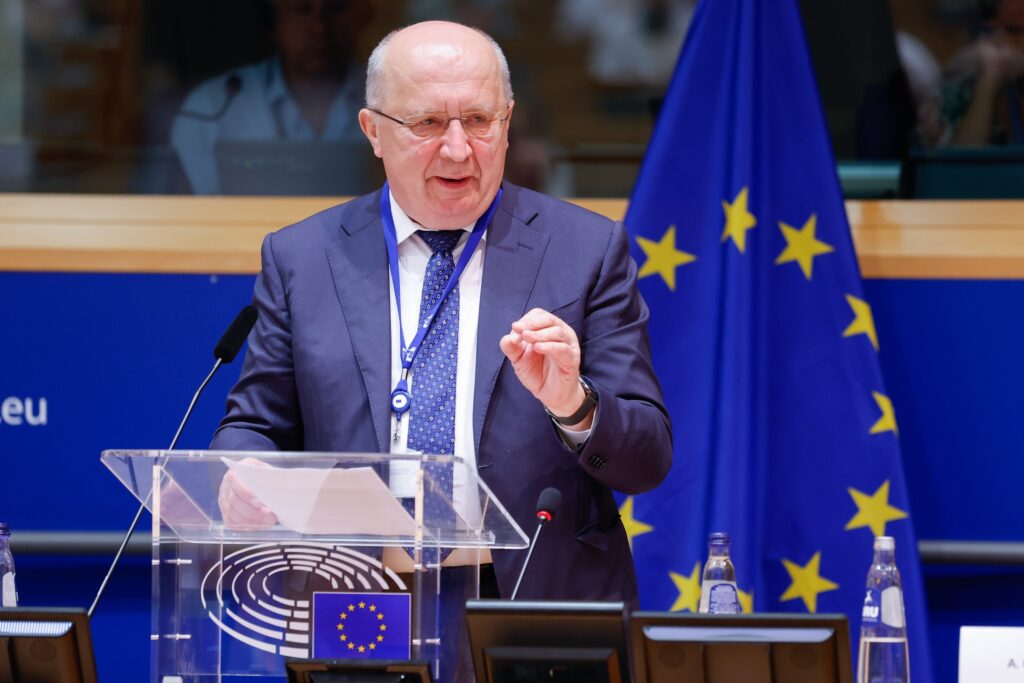
The long-term future of European defence architecture, Andrius Kubilius said in an interview with EU Perspectives, should partly build on existing rules on member states’ mutual assistance. But the commissioner dares to go much further than that.
Need to drive a very square peg into the roundest hole imaginable? Andrius Kubilius is your man. The Vilnius-born European commissioner for defence and space is no stranger to radical ideas: as Lithuania’s prime minister he once cut his own pay by 45 per cent and gained a reputation for hawkishness on Russia. In Brussels, however, he has turned incrementalism into an art form.
Wearing a long-sleeved shirt and dark-blue tie, his background blurred into anonymity as he spoke to EU Perspectives last week about the future of European defence, the 69-year-old commissioner looked every bit the consummate technocrat. His answers contained no ‘never-surrenders’; no blood, sweat, or tears. Yet, in the context of EU decision-making, the ideas he set out were nothing short of revolutionary.
From aid to defence
Asked how the Union should defend itself, Mr Kubilius said the promise of mutual aid must become a working guarantee. He was referring to Article 42.7 of the Treaty on European Union. Once an obscure clause—invoked only after the Paris attacks of 2015—it has now moved to centre stage. “I would say that at this stage there are very intensive discussions inside the EU—with member states and among EU institutions—specifically on this article,” he said. (In plain English: every idea for reorganising defence structures runs into a thicket of jealously guarded diplomatic, economic, and institutional prerogatives.)
“We are talking about a playbook, a clear collection of protocols. It must cover every form of assistance, from crisis management to military mobility.” Without such clarity, the commissioner warns, the next plea for help is unlikely to yield much.
To a casual listener, any mention of ‘a clear collection of protocols’ may sound about as exciting as watching paint dry. Yet behind the mind-numbing phrase lies a potential tectonic shift — the next plea for help could come amid a full-scale, ‘hot’ war.
“We discuss how that can be organised, what role EU institutions can play,” the commissioner continued. “And how important it would be to have an emergency protocol that lets us act before aggression actually starts. If we see things becoming more dangerous, we should have a preparedness stage even before Article 42.7 is invoked.” This suggests Mr Kubilius’s readiness to depart from the status quo cherished by pro-Kremlin self-styled ‘peaceniks’, who insist the Union, as a peace project, must never contemplate self-defence.
Beyond military threats
“We need to understand that Article 42.7 speaks not only about military mutual assistance but also about broader cooperation: crisis management, military mobility, and so on,” he added. Here the Treaty shows rare clairvoyance: drafted in 1992, long before ‘hybrid warfare’ became a catch-phrase, it nonetheless anticipates the need to defend against threats that are not purely military.
(It is) important to have an emergency protocol that lets us act before aggression actually starts, to have a preparedness stage even before Article 42.7 is invoked. — Andrius Kubilius, European commissioner for defence and space
The necessary reform, the commissioner believes, belongs inside a new body, a European Security Council. The body would formalise the current E-5 format of Germany, France, Italy, Poland, and the United Kingdom, add rotating members, and include the presidents of the European Commission and the Council.
The question is, of course, whether the EU in its current shape allows for any such changes. Here, Mr Kubilius goes further. Will the environment require, sooner or later, that the Union abandon unanimity in defence matters? “Absolutely,” he shot back. “One benefit of a European Defence Union is that it would allow us to abandon unanimity and use qualified majority voting,” he went on.
A European Security Council
“My proposal was that we can relate that with the development of new security architecture in Europe which we call European Defence Union,” the Baltic statesman explained. “This would allow really those countries which want to be more united politically. It means more united in defence, to go up to next level of integration. It would allow exactly the countries like Ukraine, United Kingdom, or Norway to be part of that architecture. And that European Defence Union would have as a leadership body this European Security—or Defence—Council,” he sketched out his vision.
Crucially, the commissioner insists, “we need a platform that allows top-down leadership on the big questions”. Whether governments agree is unclear. The very idea of a European power vertical is anathema to many; smaller countries are wary of being drowned out. Britain may balk at structures that look too EU-centric. Yet it is also necessary, as it is in the continent’s vital interest to defend its Eastern flank without being blackmailed by any would-be Turkmenbashi hoping for more Brussels cash. A very square peg, indeed.
Mr Kubilius is by no means the first politician to contemplate such a body. Ten years ago, Emmanuel Macron and Angela Merkel floated a similar idea. Their plan withered. Today the mood is different. EPP’s pre-summit communiqué backed a Security Council last week, and debates in the European Parliament have quickened.
Bin the veto!
In March, the group—which the commissioner himself belongs to—called for a review of decision-making to “improve our security and increase our influence”. Mr Kubilius sounds encouraged: “The discussion is moving ahead, and I hope it will come to a conclusion.” In Brussels, this passes off as optimism. Analysts will now watch who utters the U-word—unanimity—and who dares to bin it.
Critics sniff institutional turf wars between the commission and the European External Action Service. Its leader Kaja Kallas, the Union’s top diplomat, has proposed a European Defence Council, slightly different in both lineup and purpose. Mr Kubilius plays down this aspect of the story: “I do not see any problem that titles are different. We can call it the European Security Council.” He dismissed talk of rivalry as a sideshow. It was impossible to guess the degree of his openness at the moment. (Hint: No poker against the commissioner.)
We need a platform that allows top-down leadership on the big questions. — Andrius Kubilius
One question begets another. Would the council one day deploy troops without all capitals consenting? The EU defence point-man answers with caution. NATO will still run operations. But he also hints at deeper integration. “On the European continent, we need much more unity among member states to develop all the defence capabilities,” he said. That unity, he argued again, will not arrive while any single capital may veto action.
Under pressure
Article 42.7 also frames a wider project: building a European pillar inside NATO that is “separable but not separate”, as Friedrich Merz put it recently. The Bundeskanzler suggested extending the clause to Ukraine. Mr Kubilius approves. “Article 42.7 can be used for integrating Ukrainian defence capabilities with European ones,” he said. The recently-resurfaced idea enjoyed warm acceptance in the EPP statement as well.
Washington’s own plans push Europe towards self-reliance. Under a strategy known as NATO-30 the US will cut most conventional forces on the continent. “Americans will diminish their presence in strategic enablers and important military capabilities,” Mr Kubilius warned. “They ask Europeans to take primary responsibility for conventional defence and will stay with secondary responsibility and the nuclear umbrella.”
As that shift could start soon, he says, Europe must act fast. “Replacing those capabilities demands speed, bigger financial resources, and the capacity of our industry,” the commissioner hinted at yet another bottleneck. He concedes that the Union has moved, approving extra funds and safe loans, but production still lags. Yet he acknowledges that “we are not shifting towards a war economy like Russia. We still live in normal market times,” the incrementalist in him spoke.
Opening a Defence Single Market
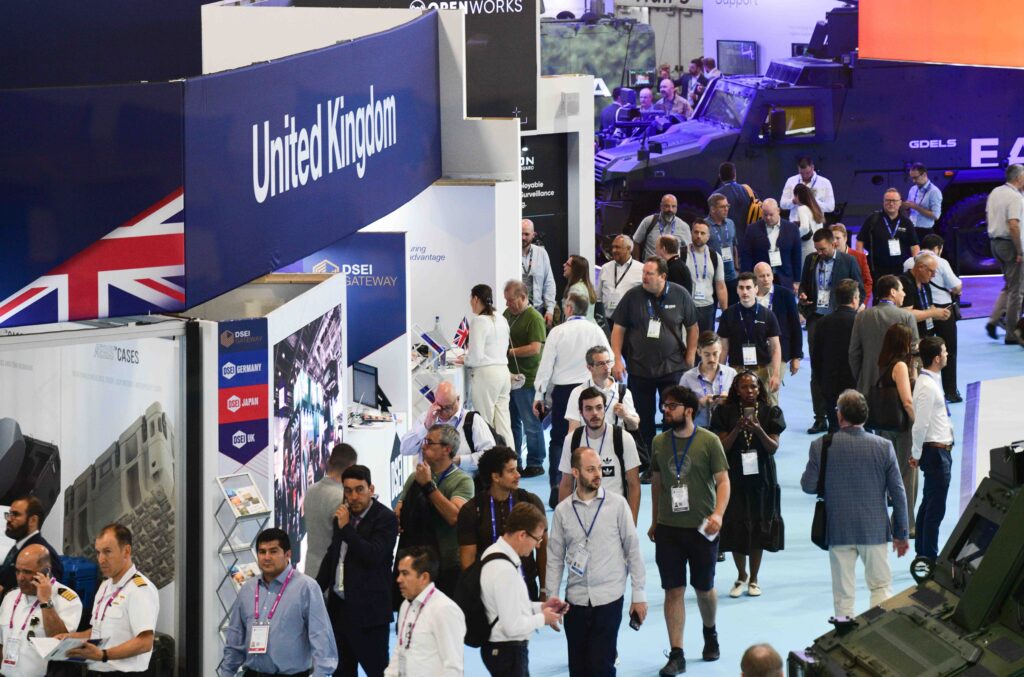
Executives at Eurosatory, last week’s industry show in Paris, moaned that the single market for defence remains a mirage. Mr Kubilius sympathises. “Very soon, in two weeks, we shall have a special communication on the development of an integrated and effective defence market,” he promised.
The document—Defence Single Market: EU technological base fit for future—should see publication by the end of this month. It pushes measures to pool demand, standardise kit, and lengthen production runs.
(A European Defence Union) would allow countries like Ukraine, United Kingdom, or Norway be part of the security and defence architecture. — Andrius Kubilius
The plan nests inside a larger package. Linked schemes include AGILE, a rapid-innovation fund that pays out within four months, and the European Space Shield, an ‘umbrella concept’ fusing navigation, surveillance, and secure links. To bankroll scale, the commission proposes a €125bn European Competitiveness Fund, while the parliament wants to add €30bn. A Defence Readiness Omnibus should arrive before 2027.
Institutional stamina
Material readiness is only half the task. “The second pillar is institutional defence readiness,” Mr Kubilius said. That means streamlining decision-making, hardening doctrines, and ensuring the aforementioned ‘top-down leadership’. Ursula von der Leyen, the commission president, recently told EU ambassadors that the Union needs to rethink peacetime institutions for a harsher world. Berlin openly echoed the sentiment; Mr Kubilius is hopeful that the message justifies the birth of his European Security Council.
Is there time for perfect blueprints? Is the snail pace of reform not infuriating the commissioner? “We are not at war, but we are not at peace either. Some ideas will fly, some will not. That is normal politics,” Mr Kubilius played his cards close to the chest once again.
How would he respond to the objection that Europe already owns too many councils, agencies, and steering groups? The commissioner retorts that none pulls leaders into one room with the mandate to debate missiles, money, and Ukraine all at once. Without that forum, fragmentation endures. A mother of all round holes, if you will.
No peace dividend
Yet the seasoned policymaker credits industry for bluntness. Firms lament multiple standards, small production lots, and unpredictable orders. A functioning market, he argues, could help out-produce Russia and replace American kit. If you allow for a bit of editorial speculation: should deliveries fail to scale by 2028, pressure will mount for a genuine war-economy command.
One benefit of a European Defence Union is that it would allow us to abandon unanimity and use qualified majority voting. — Andrius Kubilius
Behind the scenes, commission lawyers draft the Defence Single Market paper. One annex sketches emergency contracts for artillery shells. Another proposes common software for logistics. A third eye-catching idea would force governments to consider EU suppliers first.
The commissioner keeps a hectic schedule. “I was in Lisbon on Saturday and at NATO yesterday,” he said almost cheerfully, sounding more energised than alarmed. Yet his message underlines how fast the ground shifts. As Mark Rutte, NATO’s secretary general observed, while Europe enjoys no peace dividend, it also fights no declared war.
It starts on paper
Such ambiguity breeds drift. Mr Kubilius wants the Union to seize the moment, strip out vetoes, and build a council that can act. It is difficult to overstate how much of a novelty all this is. Similar ideas have been around for quite some time; but until now, they could not even begin to think of enjoying the necessary institutional background, the means to drive the hundreds of square pegs where they belong — and, if necessary, get rid of some of the round holes.
Today, Ukraine’s war and America’s redesign of NATO give Commissioner Kubilius some hefty leverage. The Alliance’s future hinges on a stronger European pillar. The Union’s credibility rests on turning Article 42.7 into muscle. A European Security Council could give the project a cockpit. For now it exists only on paper; but as the well-worn maxim has it, paper is where battles begin.