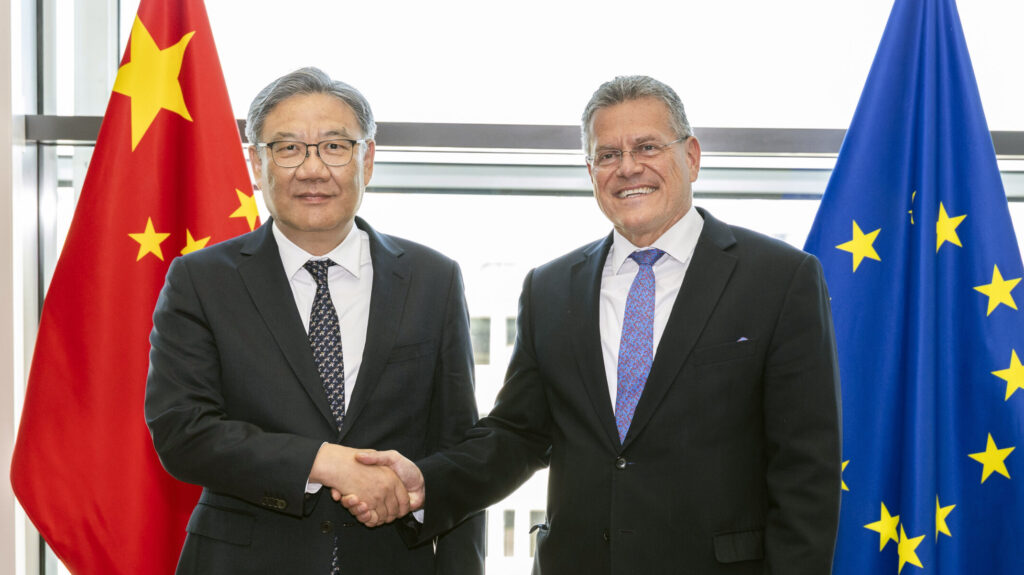
Europe could strike a narrow deal with China, but should not let Beijing dictate what other trade, investment and security measures it can take, says Tobias Gehrke, an ECFR geoeconomics expert. Ahead of Trade Commissioner Maroš Šefčovič’s visit to Beijing, he argues that Europe should use access to its single market as leverage while preparing for Chinese retaliation.
Mr Šefčovič travels to Beijing on 8–9 October, with the Commission pressing for concrete results as the EU’s trade deficit with China widens by about €1bn a day. Beijing has warned it will respond if Brussels adopts measures it considers discriminatory.
Tobias Gehrke, senior policy fellow at the European Council on Foreign Relations (ECFR), spoke to EU Perspectives about what a good outcome would look like, where Europe’s leverage lies and which sectors could be open to a bargain.
With the visit coming up, what would a good outcome look like, and what would a bad one look like?
A good outcome is if the Europeans don’t bargain away their autonomy to take the measures they need to take. Ideally, you have some limited form of accommodation with China, perhaps in the automotive sector.
But that narrow accommodation must not mean that Europe in turn gives away its freedom to implement what is necessary: more trade measures in other sectors, investment rules to make sure that when Chinese investors come to Europe they actually create value and use local suppliers.
The message should be: We are not going to do what the Trump administration did and just impose 100-per-cent tariffs. We see imbalances and we are going to address them in a fair way. But if you escalate over this, we can get much nastier.
Don’t give away your freedom to secure your critical infrastructure. Europe needs to do all of these things regardless of what comes out of this discussion with China.
The challenge is similar to what the United States has experienced. How do you create a very limited form of stability through actual talks and negotiations with the Chinese, while still pressing ahead with the measures that are necessary to protect your industry and your economy? The US has been trying to run this double-track strategy: placate and accommodate, but also do all the things you want to do anyway.
That is something the Europeans should have in mind. Don’t escalate just for the sake of escalation, but be very clear: you will do certain things irrespective of what China says.
You have called in the past for an “escalate to negotiate” approach. Is that what you mean, or do you think a more reserved approach with the Chinese is now better?
You have to be ready to go down that path. That is the crux of it all: China has made very clear that it is willing to retaliate against many of the policies the Europeans are considering. It has threatened any measures Europe is considering, whether on trade, investment or cybersecurity and critical infrastructure.
Through various channels, both the media and diplomats in Europe, the Chinese have said: if you do this, we are not going to sit idly by, we are going to strike back. That has had a chilling effect on what Europe was willing to do.
So you have to anticipate that China will retaliate, and you have to be able to escalate to de-escalate. But I don’t think it should be the main strategy. We want to try more of the American path: we can find very narrow deals, but we will not shy away from taking the measures we have to take to create a level playing field in our market.
At the same time, Europeans must prepare a counter-retaliation agenda quite seriously while they are working out what to do on trade and investment. Ideally, there is already a conversation in the Council about how we could strike back if China escalates. What are we willing to do? Can we pre-negotiate a list of how we would respond?
The most important point of leverage with China at the moment is access to the single market. They are losing ground in the US and they need other high-end markets.
The first move is kind of easy: we do X. The second move, when China responds, is quite challenging. That needs to be part of the package Europe agrees. It can’t just be a single measure or a single instrument. It needs to be a package of measures, prepared in advance, that corresponds to rounds of escalation and rounds of action.
What do you see as Europe’s most important points of leverage in that context, and how should Europe then prioritise them?
The most important point of leverage with China at the moment is access to the single market. China needs that access. Quite a few Chinese industries need it. They are losing ground in the US and they need other high-end markets.
Many of its industries are totally export-dependent, with razor-thin or negative margins and huge price pressure at home. So they are vulnerable: if you threaten that they could completely lose market access, the pressure could rise significantly.
The European message to China should be: We are not going to do what the Trump administration did and just impose 100-per-cent tariffs. We see imbalances and we are going to address them in a fair way, just like we did with EVs a few years ago. But if you escalate over this, we can get much nastier.
The threat of import restrictions is the most realistic for Europe. Europeans have the Anti-Coercion Instrument. Technically, you could do a lot with it, including export restrictions. But Europeans have never done that. They have imposed import restrictions, and it is easier to agree on those because you have a methodology for who pays, and you can try to spread the costs across member states.
Export restrictions are very difficult for the political economy in Europe. You could put then on very specific industrial goods that China needs, but the costs would land disproportionately on specific companies, regions or countries. How do you agree on that?
The EU’s trade deficit with China is growing by about €1bn a day. Is this a temporary phenomenon, or a permanent shift in China’s growth model?
It is not going away anytime soon, because China is doubling down. Its industrial policy updates, including in the latest five-year plan, have made clear that China is not willing to make serious efforts to change its system. It is not willing to have a serious conversation on the value of the yuan, and it is not willing to negotiate with anyone on domestic consumption.
Quite the opposite: China is running a very offensive international campaign saying all of this is wrong and totally baseless. So the system will continue to create these incredible imbalances.

But in some of these industries, Chinese companies are not doing well. It’s no fun to be in the battery space in China. It’s a Darwinian kind of competition. Europeans might have a good chance if they say clearly: We don’t want to escalate for the sake of escalation. We are putting in level-playing-field measures, and we do want more investment in sectors where China is quite advanced, such as EVs and batteries.
For these investments to come, we first need to raise market access barriers, so tariffs are necessary. And when the investments come, we are not just going to be open and not care. We want conditions. If BYD wants to invest in Europe, it needs to do A, B and C: use local suppliers, work with our companies, and be open to technology transfer, at least.
That is where trade and industrial policy really come together. That’s why the Industrial Accelerator Act, which tries to do some of these things, is so important. It’s not a sideshow, it’s part of the entire package. If you raise entry barriers and Chinese industry then comes to Europe even more, you need to think about that second step: how you set conditions for them.
So the Europeans must not bargain away any of these elements with China. That is the threat. China will want a narrow agreement on a specific industry, and automotive is very much under discussion. The risk is that Europeans agree on an automotive package and, as part of it, also agree to stop all the other things they are doing. That would be a massive mistake. You have to walk and chew gum at the same time: bargain, but also implement your own agenda at home.
How do you see this evolving in the long term? Most sectors seem to fall into one of two camps: industries Europe has to protect because Chinese competition could wipe them out, or sectors that are becoming national security concerns, where depending on Chinese suppliers brings risks such as being cut off from your own data or systems. Where, if anywhere, can Europe find a lasting compromise with China?
You would want to start with where to draw the security line. That is a conversation Europeans have to advance much more aggressively. It is happening, but it needs to move ahead much faster.
The revision of the Cybersecurity Act now under negotiation is an important part of the story. The Commission has proposed not only to make permanent the 5G measures agreed many years ago, but also to look at 18 critical-infrastructure sectors that are connected and where foreign devices pose a real threat, and potentially to act on them together as the EU. That would be really important.
Member states and the Parliament need to push this more forcefully, even if they don’t yet fully agree on who is in charge of deciding whether China is in or out. That is the sticking point. But we need to really carry out these investigations into grid technologies, inverters, port infrastructure, connected vehicles, and subsea cables, and make it quite clear that these risks exist.
Once we have a better picture, we need the tools ready to mitigate, but also to exclude, if China has suppliers that cannot be trusted, just like with 5G. That must be non-negotiable.
On the rest of it, there is a reason why automotive and EVs are at the centre of the negotiation right now. China is quite ahead on some of the elements that go into them, so there is also a fair argument to say China needs to be here in Europe and we can learn from them. It’s just about drawing very clear conditions for what we do with them.
That can be a bargain. It should not include the connected software that comes with the cars, because it’s a security issue. But that is a pathway I can see the Europeans agreeing to. The question is rather whether they can really hold the line: yes to more Chinese investment in these sectors, but under conditions A, B and C.